That’s why i have a real (approved) sensor as my main one. i bought MQ7 for fun to experiment.
I also have tuya CO sensor, but i also have my doubts about it, since it was purchased on aliexpress…
Is that tuya unit a “CS01” or “CO400A” ?
That’s what I’ve been testing and values return to zero after only a few minutes of steady-state levels
In Tuya integration there’s number uade6fhqmx2hbyna and google gives me that this belongs to CO400A.
This sensor always shows zero from the day i bought it. Sometimes i doubt if it works at all. I guess i’ll have to smoke it one day to see…
The Apollo AIR -1 had all the extra options, so also the gas sensor (MiCS-4514). I don’t recognise the problems you linked to, it does give readings. But as stated by Apollo, the sensors can get soverwhelmed.
As said above, one of my Apollo AIR-1 has the MiCS-4514 gas sensor option.
It has the SCD40 which is an actual CO2 sensor.
Ahh, sorry for that.
You can find really nice CO2 sensors on Aliexpress.
General rule is: NDIR based device above 25€, not some “50 sensors in one device” for 15€.
I have 3 of them and according to my tests they do it right.
This one with display:
https://www.aliexpress.com/item/1005004058860966.html
… and two of this without display
https://www.aliexpress.com/item/1005004504548518.html
This guy even made custom firmware for them which makes them play nice, not spam zigbee network too often.
P. S.
Avoid this one, while it is NDIR based sensor, it is buggy and shows big unrealistic jumps up and down in short period of time:
https://www.aliexpress.com/item/1005004764283035.html
Miro,
It would be really nice if you can open one of yours up
and verify the sensors.
These cases (ZN-2C series sensors) have historically used TVOC to generate eCO2/ECO and a photo of the interiors is usaful data
The front panel fascia is held on by double sided tape under the bezel area and will come off if pulled using a suction cup after being warmed up a little (heat softens the adhesive and even 35C is enough to make removal much easier whilst also retaining stickness so you can put the fascia back on afterwards)
I’m talking about CO sensors (carbon MONOxide, not DIoxide, without 2), those are not so common and more expensive. co2 sensor is basically not needed in average house / room, since co2 is pretty easily detected by human. It’s co “the one” who is silent killer.
Perhaps i’ll try today or tomorrow. I’ll report if/when i open it.
Hi Stoatwblr,
No need for that. It has 4 screws only. This is the interior. It is not glued but sealed. I have unscrewed this, but there is nothing written on the other side.
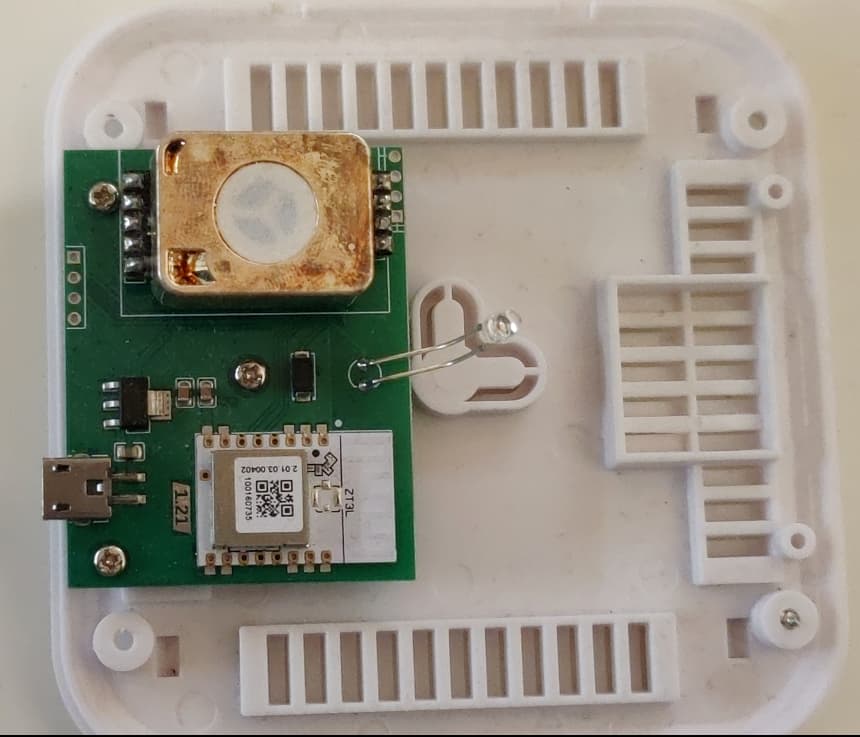
Let’s just say that it does not react if I put it in a kitchen pot with 1dl of gin in the front for 10 minutes. So it is not TVOC or drunk sensor, but really NDIR sensor IMO. 
Protoncek:
I’m talking about CO sensors (carbon MONOxide, not DIoxide, without 2), those are not so common and more expensive. co2 sensor is basically not needed in average house / room, since co2 is pretty easily detected by human. It’s co “the one” who is silent killer.
Ok ok, since title of this thread is about both gases, I just wanted to give information about good ones that are proven in practice. Personally, I don’t have near me anything that can generate much of CO so no need for that sensor currently.
Looks like ENS190
The best way to test these things is with a CO2 cartridge. I use the 9 gram ones that drive bicycle inflators or soda bottles, using a basic metering valve
Put one in a closed container and squirt in some CO2. You’ll know VERY quickly if it’s genuine or not. (“bucket chemistry” in the parlance of my old high school teacher)
It’s important to know what kind of CO2 sensor it is. There are Infrared (NDIR) and electrochemical ones - the NDIR ones cost more but have a 10+ year lifespan. The electrochemical ones are much cheaper but have a very short lifespan
CO2 levels aren’t detectable by human senses until they hit dangerous levels (upwards of 10,000ppm). At 1500-2000ppm it starts causing headaches and affecting cognitive performance (thinking speed) and is believed to be linked to respiratory problems with prolonged exposure to those kinds of levels
The problem is that in modern houses, CO2 levels can build up VERY quickly. My bedroom was easily hitting 2500ppm overnight with the door closed
CO testing is a little harder. The standard home method using a piece of burning paper releases a bunch of VOCs and PM1s that can confuse the issue - fortunately there’s a solution for this (canned CO). Unfortunately it’s quite expensive (€20/can)
The latter of the two links below sells in the UK for £14+shipping. I’m planning on buying one because I suspect that the Tuya CO detector I’m currently testing zeroes out in sustained medium-high CO level environments (This is a problem with some of the cheaper electrochemical sensors designs which use integrating monitor circuits - they only register changes, not steady states)
The latter of these two sells in the UK for £14+shipping
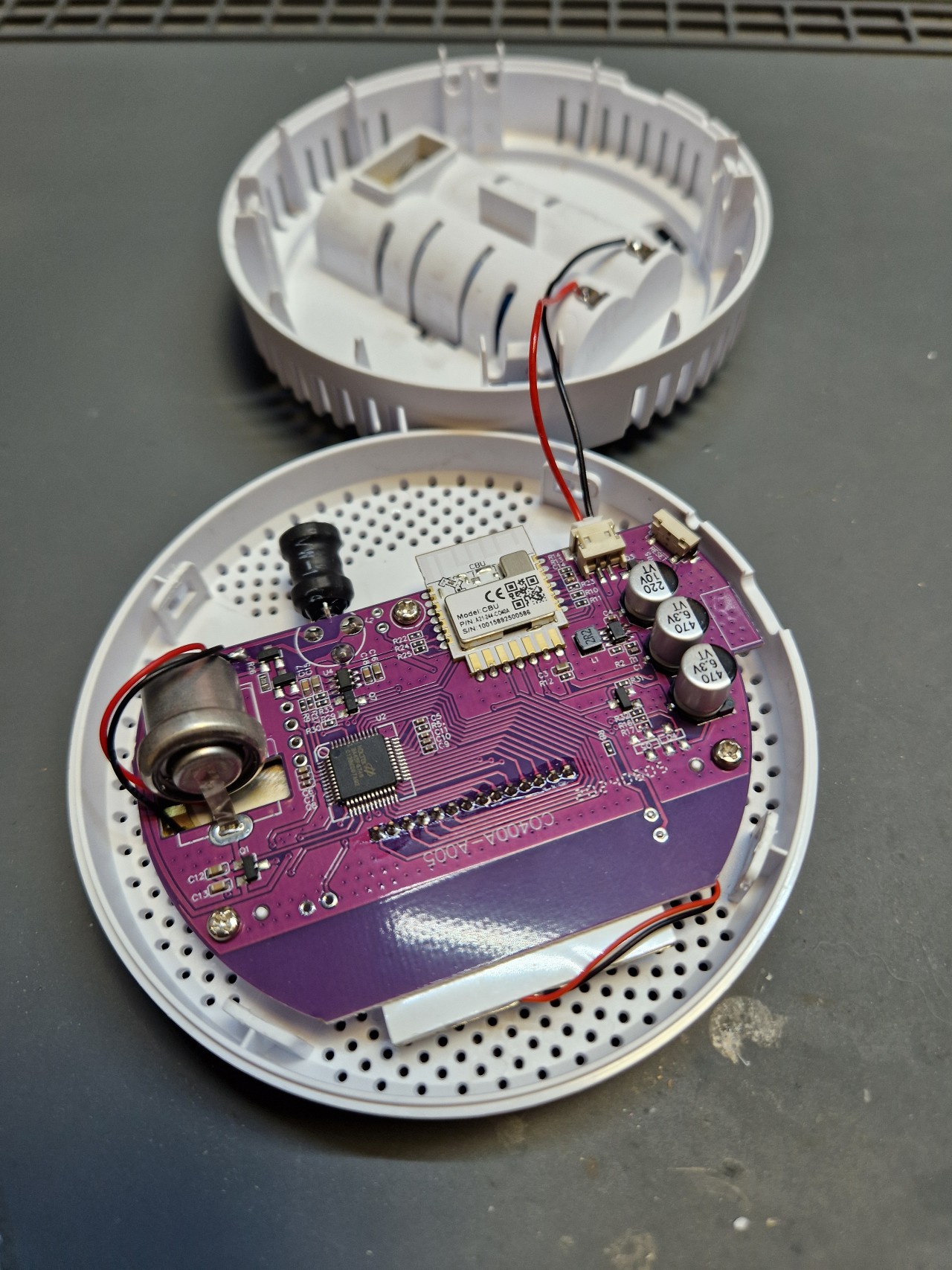
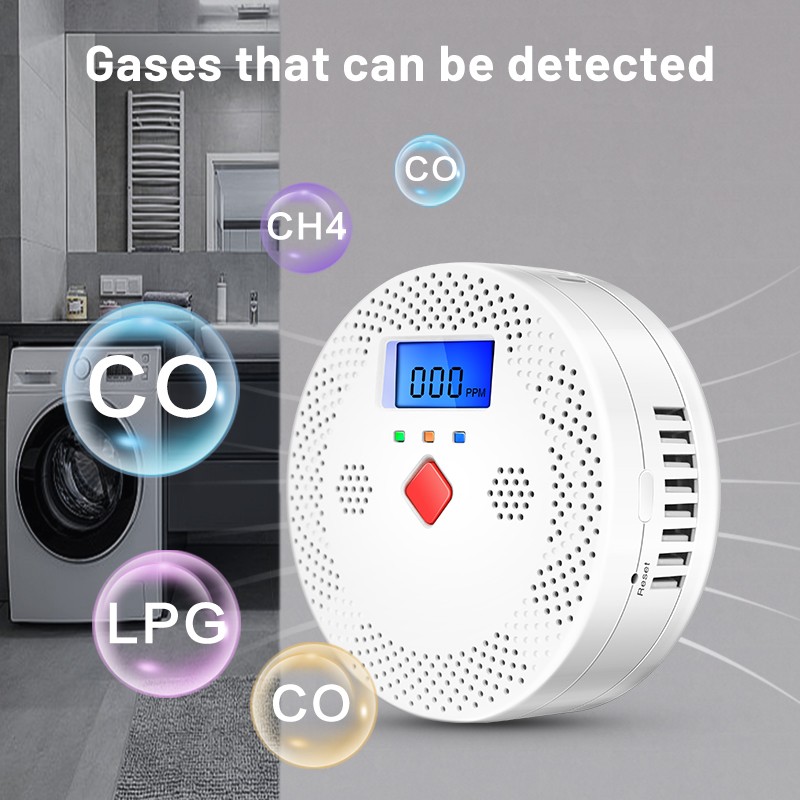
Pick one:
One gives life span 2 years in air, other 5 years.
If 2 years is valid, it’s likely expired when it arrives from AE…
Edit: Re-thinking, unpowered storage likely doesn’t cut the life-span so dramatically.
Exactly. But even after clear PPM numbers in HA, it was not easy to convince $WIFE to leave window open from the upper side and door to ensure air flow. With that before-sleep setup, I have achieved not to hit more than 850 PPM during the night. 600 PPM average. Without this simple door-window setup, it can build to 1700-1900 (probably more than 2000 sometimes). Much less headaches, less sleepyness. Even $WIFE had to admit that … after 4-5 months.
In the absence of real testing facilities, I have used “negative” test - false CO2 sensors react on alcohol. All 3 of mine doesn’t. Also, after longer usage and observation in empty room and crowdy with guests, then with only 2-3 people … it behaves in expected way. Now that someone said here it looks like ENS 190, I have searched for it and yes, it does look like that one.
General rule for Ali shopping is: don’t buy very cheap multi-sensors with fancy coloured screens. If CO2-only sensor costed me 30€ and some “glamourous” 15-in-1 with color LCD costs 15€, I didn’t even bothered to order and try the later.
Now that I read here, maybe getting one sensor for CO may be a good idea, altrough my housing doesn’t have any heating on wood or anything I can think of producing large quantities of CO - in the building or nearby. Smoke, heat and gas sensors are already in place. I must think of it …
Photoacoustic NDIR CO2 sensors are smaller, cheaper and consume less power.
Sensirion SCD40 modules can be found <$20.
That’s the one I’m testing.
It’s a Holtek reference design using a wierd proprietary (undocumented(*)) MCU serial protocol and deep sleep isn’t properly supported in esphome beken yet, so i’ve been putting it off as it chews through a set of batteries in about a day thanks to the wifi module drawing 100-180mA (wifi power saving modes don’t work well on Beken either)
It’s worth noting that the lifespan noted for these sensors is when continuously powered. It’s about 15 years when unpowered and battery operated designs usually pulse the sensor every 5 minutes or so, resulting in a service life of 8-10 years
What worries me is that frontend integration amplifier design - which only shows changing levels. The MT8 cpu is likely to be doing some clever maths to compensate for that but I really want to ensure that in a steady-state low level CO environment it actually does what it’s supposed to.
(*) There’s a description of the data packet format for other chips but the message size is different on those. It may be buried in the devkit but that won’t run up in a Wine environment. Tuya firmware reverse engineering efforts all stopped at extracting dpid lists to the cloud, not the serial-to-dpid tables (which is fine if the connected device is speaking Tuya as that’s extensively documented, but so far I’ve hit 4 makers speaking their own protocol to a Tuya wifi module and there are bound to be more as time goes by)
SCD40 is a CO2 detector, not a CO one
Yes, the photoacoustic ones ARE a better bet, but these electrochemical CO things are ubiquitous at the moment, just like they used to be for CO2 sensors a decade ago (PAS and NDIR CO detectors are only just getting out of the laboratory. Formaldyhyde ones have been announced by Sensiron but they’re not here yet, so no pricetag)
I picked up my CO detector for $6 and the local electrical store sells similar units at about the same price. You can’t (yet) come close to that price with the better detectors
In the longer term it’s theoretically possible to measure multiple gasses with one sensor using multiple IR receivers and tuned IR filters but I suspect that won’t happen in consumer space for a while, despite it being covered in academic papers already. The driving force for these has been nano-satellites for earth observation where every gram counts and using gas spectrography absorbsion bands is the only way of taking measurements