I will answer honestly. I really like those projects and I think they are a real example of what the community can do. Checking their repositories and their actual status, what I genuinely think is still the hardest piece of the whole puzzle is a really reliable wake word experience — and at the same time it’s that thing that makes that speaker truly usable every day. At the end it’s where the Echo family succeeded compared to the Home/Nest one, at least in my experience.
Probably this is not what those open source projects have as their #1 priority; it seems that being scalable, covering as many devices as possible, is more important for them, and there is absolutely nothing wrong with this, because they are providing a great way to get out of the cloud jail to as many users as possible, and I can’t agree more.
But what I’m doing is the opposite. I don’t care to scale, I’m focusing on having a pretty good experience with the on-device wake word recognition. Public pre-trained models are trained on generic audio, but what this device actually gives to the model it’s what is left after beamforming, AEC and noise suppression, and that residual is a different signal with its own artifacts. So I’m training a custom “okay nabu” on the real hardware, through the real pipeline, on exactly the thing the model will see. And at the moment it’s also smaller than the default one.
To be specific, what leads me to say this is that at least with open source / free / non-commercial AEC and NS solutions, I experienced that there is a limit in what they can achieve. For example, using more sophisticated AEC algorithms on my Mac mini gives almost the same result of the AEC running on the P4. So this seems the actual bottleneck, and if you add NLP (non linear processing) it eventually also suppresses your voice, leaving nothing usable for the wake word detection. So the cancellation side seems to be the bottleneck while the model training seems the right path.
I already can see the difference against the stock “okay nabu” while music is playing, and at the same time there is still a big room for improvement.
However, when these projects will be also available for the second revision of the Echo Dot 3 (I have 3 of them), I will be happy to try them and compare to my solution!
Keep up the work man. I only got those, right now, unrootable models at home and would prefer a ESP-32 solution.
I’m dreaming about offline voice control, local network speaker function (AirPlay [e.g. shairport] or Google Cast [e.g. mkchromecast]) and Bluetooth.
Just ran into this project! I would be more than willing to swap out the boards in my echo dot 3. Been wanting to finally separate from the amazon hellhole. As soon as your newest PCB drops I will get them asap and report back on the results. Keep up the awesome work and thank you again!
Hey mate, your project is awesome!
I have 4 echo dot 3 (all crumpet i think), and i’ll wait for your test, it’s two year i’m thinking how to replace these hw with something useful and usable with ha.
Appreciate a lot your efforts!
This is a really awesome project! Thanks a lot for all the work you put into it!
I really cant wait to get rid of my amazon spy devices without wasting the hardware without trying to sound impatient, can you say when you will receive your new boards and when you will be able to test it? I cant wait for your results
Also, what do your prototype boards cost? I’d really like to get a feel on what i’d need to expect.
Thanks! I think I’ll receive these new prototypes in 2/3 weeks (probably 3 weeks). The price it’s not really a clue because for few boards it’s always quite high. With a “real” production run it decreases a lot. Anyway I don’t want to give neither a too high or a too low price at the moment. I will update you when I’ll know more about it and everything will be set up
I think that’s why this project seems to hold a lot of promise; it bypasses pretty much everything except Amazon’s wake word engine:
“Amazon’s microphone processing (echo cancellation, beamforming, per-device mic calibration) and wake word engine stay, so it hears you across the room and over its own music like before. Only the Alexa client is replaced, by a small daemon called hassmic that speaks to Home Assistant as an ESPHome device (default) or as a Wyoming satellite.”
It seemingly gives full ESPHome satellite functions to any Donut model echo.
It almost seems too good to be true (though requires access to the onboard hidden USB pads and a linux-based PC). The caveat being it’s been vibe coded (blechhhh) and thus could probably use a good review by someone with better hardware/software integration skills.
At least one user in these forums has been testing it, and the author threw some credit your way:
Still, caveats aside, I’m still gonna pick up an extra Donut, silo it, and see if this works.
Yeah, I saw that. It’s great work Obviously I can’t say anything bad about the Alexa wake-word itself. But knowing that Amazon’s blobs are still there, just “sleeping”, does not make me feel really comfortable.
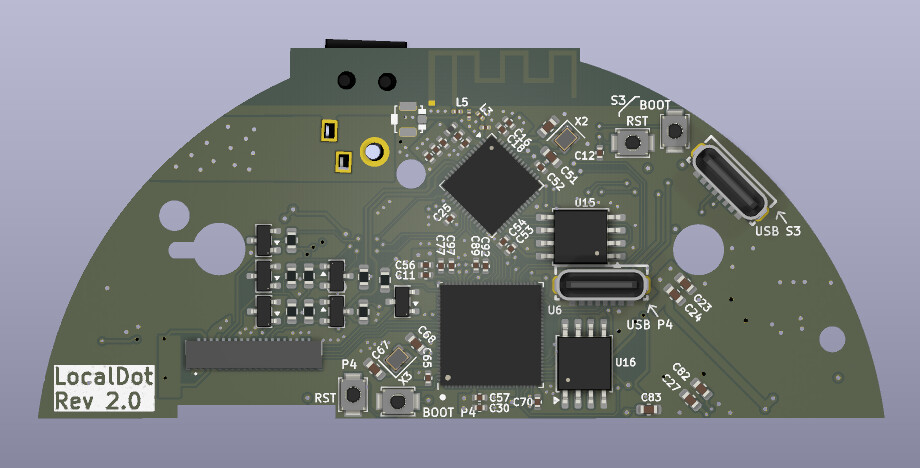
Hi everyone! A few weeks ago I reached out to Crowd Supply about LocalDot, and the pre-launch page is now live!
If you’re interested, you can leave your email there to get updates (and the number of subscribers is part of what decides when the campaign can actually start)
As you know, I should get the new board revision in a few weeks, and I’ll post here as soon as I test it, as always
I’m very interested in LocalDot and planning to convert several Echo Dot 3rd Gen devices.
I also own some Echo Dot 3rd Gen units with the built-in clock display.
Would LocalDot work in the clock versions if I leave the clock display disconnected? I’m mainly interested in retaining the speaker, microphone array, LED ring, and buttons.
Clock functionality would be a nice bonus, but isn’t required.
Reading this teardwon it seems that the top pcb is the same of the non-clock version, so there’s high possibility that it will work Unfortunately I don’t have it so I’m unable to try and confirm


 without trying to sound impatient, can you say when you will receive your new boards and when you will be able to test it? I cant wait for your results
 Obviously I can’t say anything bad about the Alexa wake-word itself. But knowing that Amazon’s blobs are still there, just “sleeping”, does not make me feel really comfortable.