If you have a Reclaim heat pump hot water system, you’ll know the problem: the tank has one temperature sensor, about a third of the way up. After the first couple of showers it reads cold, even though the top of the tank may still be full of 60 °C water. So the reading doesn’t really tell you whether there’s enough for the next shower.
I’ve built a package and dashboard card that combine that sensor with the heat pump’s energy use and the ambient temperature, to estimate what’s actually left:
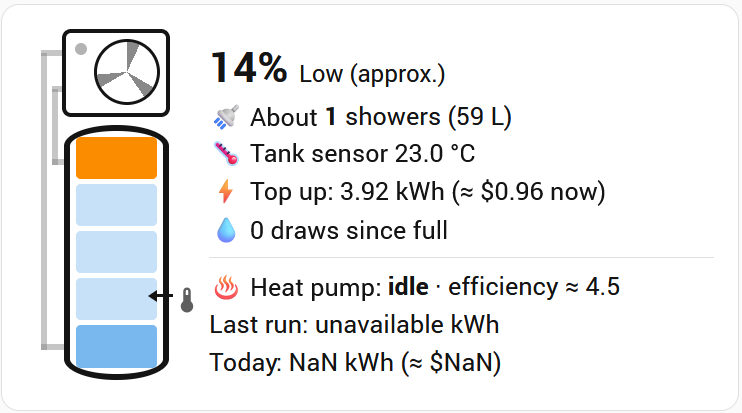
- Tank charge (%), litres of hot water, and showers left
- Energy and cost to top up now (auto-detects Amber Electric, works with any price sensor, or pricing can be switched off)
- Heating progress during a run, plus each run’s energy and cost, and today’s totals
- Draws since the last full heat, and when the tank was last full
- Maintenance reminders: anode check (glass-lined tanks) and pressure-relief valve
- A full-heat check: a warning if the tank hasn’t reached full temperature for 7 days
The card draws your tank to its real proportions (the tank model is chosen in a helper, from Reclaim’s spec sheet), with the hot, transition and cold layers, where the real sensor sits, and the heat pump above it with its pipes lighting up while it runs.
How it works: the model is calibrated from real heating runs. A full heat is tank volume × 4.186 × (60 °C − mains temperature), and heat pump efficiency is modeled against ambient temperature. On my EHPE-4550P-A that matches the rated COP of 6.02 at 32.6 °C closely. Three separate mornings when the tank had run out each needed almost exactly the theoretical energy for a full heat, which was a nice confirmation.
Status: experimental. It’s calibrated on one system so far (RE400AGLH + EHPE-4550P-A, Sydney). The sensor sits at about a third of the height on every Reclaim tank model, so it should carry across models, but I’d love data from other setups. There’s optional CSV logging built in (one line per heating run); if you’re willing to share yours, open an issue on the repository.
Requirements: Home Assistant 2026.9+, the Reclaim Energy integration, button-card (HACS), and packages enabled.
Repository and install instructions: GitHub - r5e/ha-reclaim-tank-insights · GitHub
All of this builds on David Collett’s excellent Reclaim Energy integration, which provides every sensor and control used here. Big thanks to him.
Not affiliated with Reclaim Energy. All figures are estimates.
Longer term, I’m planning a proper companion integration: UI setup instead of YAML, self-calibration from each heating run, automation blueprints (low hot water alerts, boosting on solar surplus or cheap prices), and timer recommendations that adapt to the season. Ideas and feedback welcome.
 , as adding a “fixture” for a “dip-in” sensor is kind of overkill, a basic sensor taped with i.e vulva-taped will do , i have a bunch of these on my heating system