the boards are designed to be a drop in replacement with no modification. v1 board for v1 mini, v2 board for v2 mini
Looking forward to this drop in replacement PCB for my 2nd gen speakers.
To identify what version you have: (it appears “H2C” is not a unique model identifier)
- v1 PCB is for 1st gen “Home Mini” has Micro-USB power, and base is smooth rubber.
- v2 PCB is for 2nd gen “Nest Mini” has round power plug, and base has screw hole to allow wall mounting.
I noticed the v2 aka 2nd gen Nest Mini repository now shows mention of reworking it to add Thread support, and future prototype revisions. Happy to see the v1 product doing great on MiciMike Home Mini Drop-In PCB | Crowd Supply , great work! Hope the microphone and speaker can function as good as the original hardware on my local devices, sans the cloud stuff.
From “not yet” to ordered: an open Nest Mini (2nd gen) voice board, derived from MiciMike
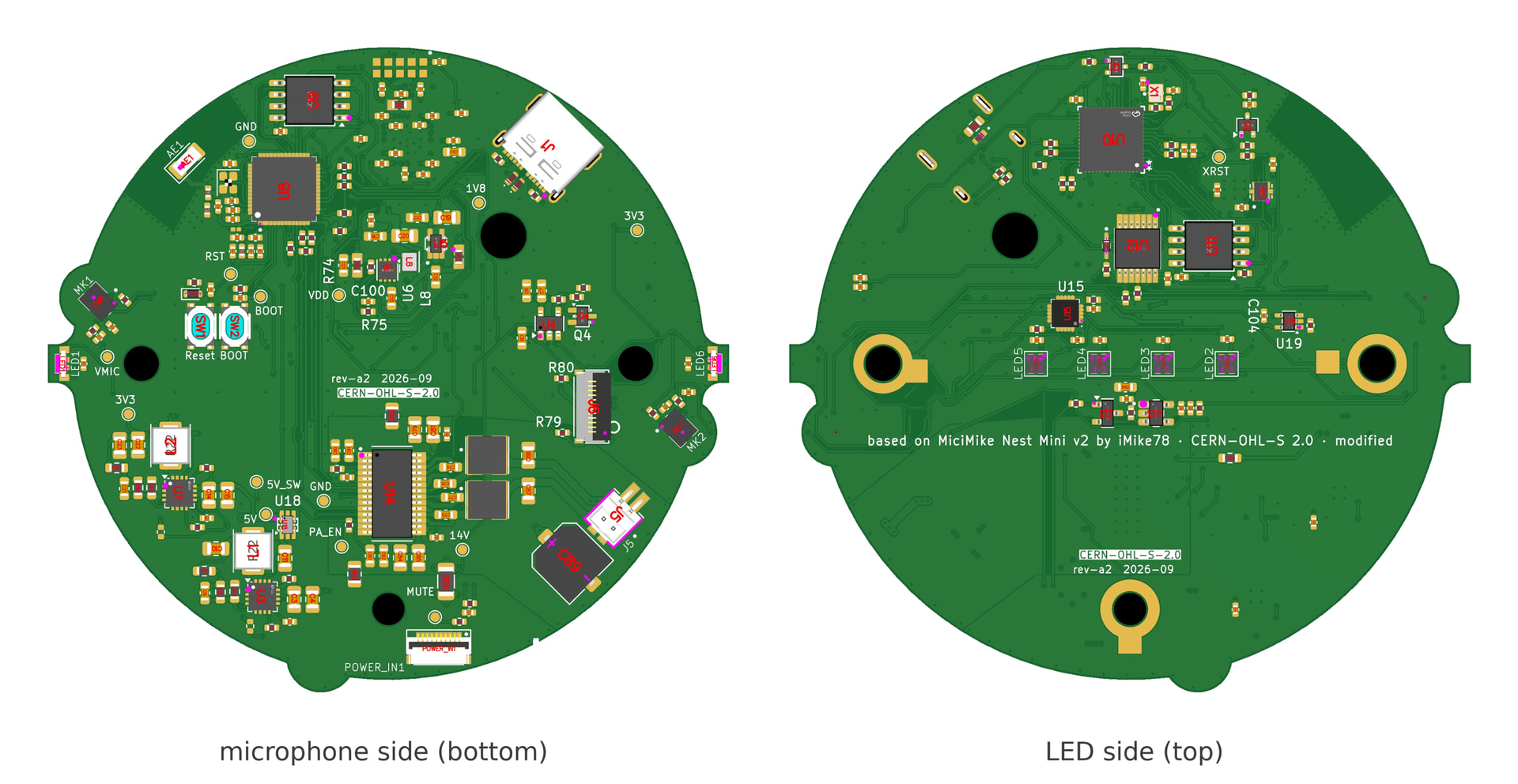
A short story, because a few of you have been waiting on this topic as long as I have.
We wanted a local voice assistant for Home Assistant — one that stays in the house, not in a cloud. The Voice PE does the job, but we didn’t want its look in our rooms. What we did have, in several rooms, were Google Nest Minis: nice speakers, good microphones, a touch surface, and a board inside that we’d rather not run any more. So when iMike78 published nest-mini-drop-in-pcb, that was exactly the idea: keep the speaker, swap the brain.
The project stalled before a working board existed, and after waiting for a while we decided to take it in our own hands. Since September we’ve reworked the design from the upstream commit: verified every pin of the ESP32-S3, the XU316 and the TAS5805M against datasheets, the Voice PE schematic and the firmware, and found a few things that would have meant a silent board (amplifier output pairing in PBTL, the XMOS data path, sample rates). We added ESP32-side access to the XMOS flash so no XTAG is needed, the Voice PE audio architecture with the unmodified Voice PE XMOS firmware, an ideal diode so USB and 14 V can be connected together, and an expansion connector for a custom enclosure.
Everything is published under CERN-OHL-S v2, with iMike78’s design credited as the origin and every change documented with its reason: GitHub - marceldale/nest-mini-v2-voice: Open voice satellite board for the Google Nest Mini (2nd gen): local Home Assistant voice assistant with ESP32-S3 + XMOS XU316, ESPHome, Voice PE compatible. Open hardware, prototype stage. · GitHub
Status, honestly: the first two assembled boards were ordered from JLCPCB on 2 October. Nothing has run on hardware yet. Bring-up results — good or bad — will go into the repository’s Discussions. Please don’t manufacture from the files before that.
Thanks to iMike78 for the starting point, to Nabu Casa for the Voice PE reference and firmware, and to FutureProofHomes for the Satellite1 flashing approach.
For reference, @Alessandro_Alfonzett, another Home Assistant community member living in Italy, is currently working on a drop-in PCB replacement for the Amazon Echo Dot 3 / Amazon Echo Dot 3rd generation in a new project he calls “LocalDot”:
GitHub repo for LocalDot (no schematics uploaded yet):
Notable it sounds like (pun intended) like he has is using an ESP32-P4 as a co-prosssor instead an XMOS MCU, while still uisng the ESP32-S3 as the main host processor, (while keeping an ESP32-S3 as the main host MCU instead of also upgrading that the ESP32-S3 to the newer ESP32-S31 to gain the benefits of its built-in DSP as well as having the option using its EEE 802.15.4 radio for Thread or Zigbee in the future).
Similar to MiciMike drop-in PCB replacement for Google Nest Mini it also sounds like like he is using a Texas Instruments TAS5805 amplifier to connects to the Echo Dot’s original speaker, and hardware-wise, but instead of of using his own microphone it looks like he wired support for all four original microphones as the voice input (though noted that he mentions that so far only got one microphone to work in ESPHome). He is also planning to launch a crowdfunding campaign on Crowd Supply for the LocalDot.
PS: I do not actually own any Amazon Echo devices myself so for me this is more an interest so seeing more PCB replacements in general, and hopefully ideas, inspiration and knowledge can be shared between all these projects.