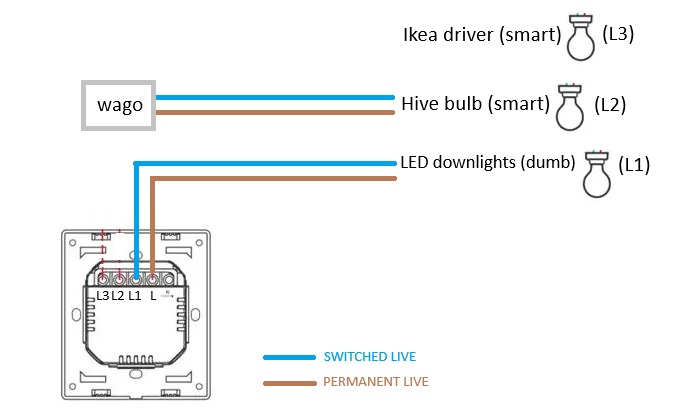
Sonoff ZBM5 wiring workaround with smart bulb

Hi all,

I just wanted to check that my thoughts for wiring this switch are sensible and safe. I currently have a 2 gang UK light switch (no neutral) that I want to swap for a 3 gang ZBM5 switch for

  1. LED downlight circuit (dumb)
  2. Bulb in ceiling rose (smart bulb)
  3. IKEA tradfri driver (controlled via HA automation)

I understand that I cannot detach relay no.2 for the smart bulb due to the lack of neutral in the circuit, but I wondered whether it is possible to connect the permanent live and switched live of the smart bulb circuit in a wago terminal block (giving it constant power) and use the physical switch to operate the bulb via a HA automation? The dumb light circuit in 1 providing the permanent live for the ZBM5 zigbee. Any thoughts or alternative ideas very welcome, thanks!

Hi,

TL;DR - No, install a Sonoff Mini4RM behind the ceiling rose and use the existing mechanical switch.

Your diagram doesn’t show a connection to the Neutral terminal on the switch, only two connections to the device phase in (L), and switched relay out (L1).

If you rewired the standard 1mm2 2+E cable to a UK light switch in the ceiling rose to L and N to give a low-current permanent feed, you could connect to L and N on a device to give a WLAN input device.

Realistically, this is no better than a RF battery button (Z-Wave, Zigbee, Thread - £5 from IKEA) mounted over a blanking plate where the switch was. This used to be common with “Smart Bulbs”.

Alternatively, mount a mains dimmer module behind the ceiling rose where L, N, and load terminals are all neatly located. Even better, you can use the standard mechanical switch so no need for a RF button at all.

Get a hole saw a little smaller than the distance between rose screws, and think about the requirement for secondary insulation (I use a custom shroud or a small box in a loft).

On some installs, I’ve used the standard 1mm 2+E to pull in a new 3+E cable from the rose to give a proper permanent live feed and switched load live, but…

Sonoff relays are designed for EU round back boxes (which are explicitly banned under BS7671) so struggle even to fit in a UK 50mm back box. You can buy spacer rings to make the 1G patress stick out of the wall more, but that looks ugly.

There are tens of other posts in here with others struggling with the same issues. The UK has fundamentally different wiring from the EU, different back boxes, and LED lights are very strange loads making no-neutral devices very, VERY unreliable (even with a ballast module).

If this helps, :heart: this post!

Most multi-gang no-neutral switches with decoupled mode will only run into this limitation for the first relay (L1, or L3 if you’re unlucky), since that’s where they draw the parasite power required for powering the switch. As long as you don’t enable decoupled mode for those, you should be fine using it for L2. I would double check with Sonoff support regarding this before purchase, though.

Alternatively, pulling a neutral to the switch is a pretty trivial task assuming the switch and the dumb lights are in the same room, there’s space in the conduit and you have access to the ceiling rose. I pulled one in the kitchen & it took me longer to set up & dismantle the ladder than the actual job. The benefit of this is that you’ll be able to use decoupled mode on any switch, plus you’ll be able to use the switch as a zigbee mesh router.

In the UK conduit is sadly VERY unlikely, and 2+E should be cable clipped to the studs making pull-back difficult.

The best access you get is often with a 25mm flat wood drill, multiple 500mm extensions screwed together, and ceiling access to drill down for a new cable route.

Cable access cutters can help in floors (metal plate just drops in) and walls (mesh plate to support finishing plaster):
https://www.screwfix.com/p/armeg-wood-cutter-111mm/80049

EDIT: Add a link to the hole plug to better explain the system:
https://www.screwfix.com/p/armeg-sbc-cover-111mm/10648
(Another company does a similar cutter for metal discs which are cheaper and also work in plaster, but are less widely available.)