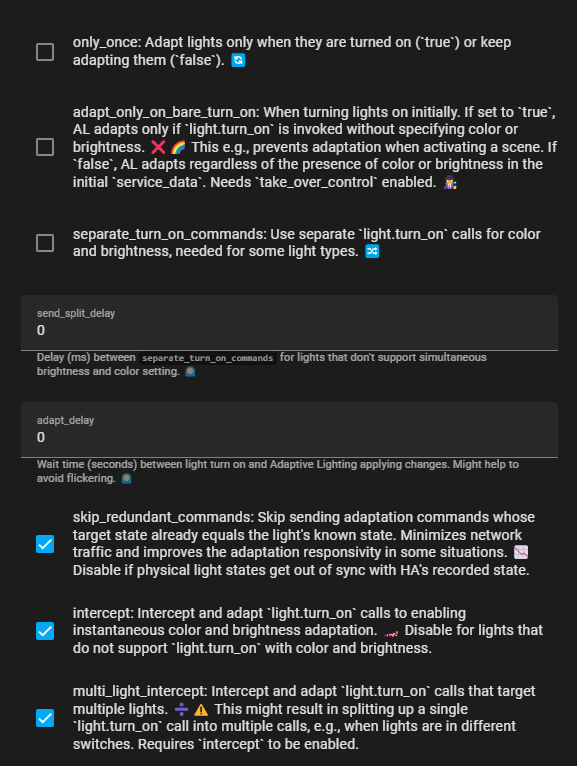
@maesenator, just disabling the switch.adaptive_lighting_adapt_brightness_NAME_OF_INSTANCE should do the trick. I have just tried to reproduce your problem but cannot.
I strongly suspect that you have perhaps a second Adaptive Lighting instance that includes your lights, which has adapt_brightness enabled.
Please enable debugging logging (see here) and share the logs. I am pretty confident that this is an error on your side because I have seen this problem a bunch of times before and it always turned out to be a user-error.
@nonamejuju, @maesenator, @bouwew, it is the Home Assistant UI that automatically adds the checkbox in the UI next to any slider and (I think at least) I have no control over that, so that is why that checkbox doesn’t do anything.
FWIW, I was experiencing this issue with 1 out of 6 instances of AL. Instances that I’ve had running for at least a year and we’re retained during updates.
Today, I’ve removed this instance entirely and recreated it (with identical config). This evening my lights are not dimming.
I will continue to observe and provide logs if I have something to log, but for now it appears to be resolved.
PS: I can guarantee that the brightness switch was turned off. It is for all my instances.
Did you ever find a fix for the delay on the Caseta lights? I understand Lutron intentionally delays sending the update to its hub by a few seconds, which occasionally causes Adaptive Lighting to enable manual control.
I have a function request.
A function visit/guest/party equal the sleep function, but to be used when we have a guest at home and we want to keep the light at a higher temperature and brightness.
Basically duplicating the sleep function.
Do you mean a toggle that would override the adaptive function and set brightness/color to a specific range? That could be accomplished with a toggle helper and automation.
Does anyone know if there’s an accessible place that the configurations are stored when they’re created in the GUI? I’d like to duplicate a configuration then tweak it slightly.
I know it is possible using helpers and automation, but the idea is to replicate the operation of sleep mode, but use it to maintain a higher temperature and brightness.
Let’s say I have 3 different automations that turn on a lamp and I create a “Guest Mode” helper.
When turning on the guest mode, I disable Adaptive Lighting, so in each of the three automations I have to check if the “Guest Mode” helper is on and tell it to turn on the lamp and change the brightness and temperature.
If the “Guest Mode” function is integrated with Adaptive Lighting, all we need to do is turn on the guest mode and Adaptive Lighting remains in control, as it already does with sleep mode.
In addition to your suggestion, there are at least two more options:
Use sleep mode to do this job, but then you lose sleep mode as it should be used.
Use an automation to change the parameters of sleep mode according to the condition, sleep mode or guest mode.
However, I think it would be interesting for the integration itself to have this feature natively.
I’ve had an issue for a while now that I’m pulling my hair out trying to solve.
The issue is pretty simple: I have multiple LIFX lights that I have around the house and an automation every day at the same time turns them on with the light.turn_on command. When they turn on each morning they immediately transition to 1%. My transition time is set to 1s if that’s relevant, but the lights stay at 1% for anywhere between 1 and 5 minutes, until they come back to the % they should be. Only brightness is changed on these lights, not color temp since they’re all colorful lights. This ONLY happens during this morning automation, I have been unable to replicate it manually (either by manually running the automation or turning them off and on myself).
I can share my settings but I’ve looked through every single one and can’t possibly figure out what is causing this. Does anyone have any idea?
I’m trying to understand one thing that is not clear to me from the documentation:
Is there a difference (in terms of zigbee commands/traffic) between Adaptive Lighting acting on a turn-on command vs on an “apply adaptive lighting command”?
In other words, will the normal turn on command result in 2 separate messages over the network (one to turn on, followed by one to change brightness and color temp), and will the apply command result in a single message (with turn on, brightness and color temp all in one), or are they essentially the same?
I’m trying to work out how best to make use of Zigbee groups while still preserving Adaptive Lighting functionality in a space where different lights may be on or off.
The lights are primarily controlled using a Hue Tap Dial Switch:
Pressing different buttons turns on different sets of lights e.g. one button just turns on lamps, another button turns on lamps plus the main light.
An Adaptive Lighting configuration applies to most of the lights in the room. Primarily, the switch buttons just call light.turn_on so I want the lights to be adapted.
Rotating the dial adjusts the brightness using a script which first checks which lights are on i.e. it only adjusts the brightness of lights which are already on.
All of the above works without using Zigbee groups but it would be preferable to have lights turning on at the same time, for example. What I’ve found is that if I set the AL configuration to target a group containing all the lights and then manually control some of the lights individually, those lights will not be marked as manually controlled so AL will take them over again automatically. Not sure if there is any way around this? Ideally I would be able to turn lights on and off using groups and have AL using groups, while still being able to control subsets of lights too.
Has anyone figured out the best way to integrate SK6812 or other RGBW WLED controlled strips? Cooler temperatures work fine but all “warm” tones are too red. I dont see a difference in the “use RGB values” setting with these strips either. (The value for 2500k for example comes through as: rgbw_color: 255, 123, 0, 96).
On the other hand, using sleep mode and defining my own RGB value for a very warm light works perfectly.
Is there a setting in AL I can play with, or in WLED? (I havent had any success modifying the white handling modes in WLED thusfar).
I have a problem that I hope someone can help with. Here is my setup.
Hardware
I have Inovelli zigbee dimmer switches with Philips Hue bulbs. All of the bulbs have execute_if_off turned on. I have created groups for each circuit that includes the bulbs and the switches. I have also bound the switches to the group.
Software and Integrations
I am using zigbee2mqtt for all of my zigbee devices. I have the adaptive lighting integration also installed to adapt the color temperature of my lights throughout the day. I do not want to adjust the brightness, just the color. I also do not want to enable manual control ever. I want the lights to always be able to adapt.
I have created I have setup an AL integration for each room of the house and it is pointing to Z2M to the light groups. Although I have also tried pointing them to the bulbs individually as well.
However, I am having a problem that whenever the bulbs turn on they remember the last color temperature before adapting based on the integration. This can be jarring at time. I have the initial transition time set to 0 in all integrations.
I also have the light groups passed to apple home using the homekit integration. I control my lights using siri, the apple home app, the home assistant app, physical inovelli switches, some aqara zigbee buttons, and/or aqara motion detectors.
Whenever the lights are controlled through an automation (with buttons or sensors), I use the light:turn-on action. I also tried the AL apply service, but it produced the same beahvior.
I want the color temperature to always adapt without any delay or visible transition. Can anyone help with this? Am I missing something obvious here? Any help would be greatly appreciated. Thanks in advance.
I’ve noticed this, although our switches are all ZWave. I settled with accepting that there is occasionally a small delay, and it’s only really noticable when the prior setting was from a few hours earlier.
A solution that I didn’t like was to set the default brightness to something low, although you’ll still get a delay, it won’t blast you in the middle of the night.
Alternatively, not sure if your switches do this, but ours can do “smart bulb” mode. I believe if you were to use this you’d avoid the switch directly controlling the relay inside which might eliminate the delay in adaptation, however you’d likely get a delay in turn on/off as well as have your lighting dependant on your HA server being functional (something I try to avoid).
None is perfect, just spit balling ideas to see if you can find a compromise. I think this may be a limitation of the ZigBee/ZWave platform (latency/bandwidth).
Thanks for the reply. I do have all of my Inovelli switches connected to Hue bulbs in smart bulb mode. They have been since installation. I am just living with it for now, but would love to find a way to fix it.
I remember when I used Homekit for smart home control exclusively that the adaptive lighting worked great.
I’m using this integration with LIFX lights via the HomeKit connection, and I’m running into an issue where this integration activates its own manual_control attribute. I even have an action that sets manual_control to false, but it only lasts for a minute or two before the next adaptive lighting action incorrectly changes it back to true, thereby preventing any further adaptations. Has anyone else run into this?
Edit: The solution to my problem was to check the prefer_rgb_color box. Somehow, the adaptive lighting action was changing the mode and adaptive lighting detected that change as triggering the manual control option.
Hi All, I wonder if I have missed some notes with an update, but recently I’ve been having an issue with AL where lights are not changing over time automatically. I have not changed anything with my setup, and if an automation triggers a light, it stays the old colour - however if I manually turn the light off/in via the device in HA it updates the colour.
PS: I have brightness changes turned off as I only want the colour to change and apply a brightness level when I switch on the light in my automations (e.g. I always want it to be 50% in the kitchen during the evening).
I have what may be a stupid question. I’m a Home Assistant newbie, although I’m also a veteran software developer - so I’m usually pretty good at figuring things out. But I’ve come a cropper on this one!
What I want Adaptive Lighting to do is basically what I’m already doing, for example, on my phone: Run my office light at 100% brightness and full white (in my case, not the highest color temperature - so the white from my Tradfri bulb isn’t horrible-greenish) during the whole day and early evening, and then - starting at around 22:00 - gradually dim the light and shift the color progressively warmer. So both the brightness and the color curves should look something like a sine wave with the top chopped off.
This seems to be quite easy to do in terms of the brightness; but I can’t see any simple way to do the same thing with the color balance. Everything I see in the documentation, as well as the simulator at Shiny App , shows the color as an un-“chopped” sine wave, such that the color temperature peaks at around midday and then almost immediately starts declining throughout the afternoon.
The best I’ve been able to do so far is to set up an unrealistically short nighttime to try to fool Adaptive Lighting:
This gets me fairly close to what I want - but, for example, at 20:00 my light is already at a noticeably warm setting, where I’d really prefer it to still be on its daytime white color.
Is there some configuration option I’m missing? Or some other trick I could use? Otherwise, this seems like a fairly obvious missing customization feature - and given how customizable Adaptive Lighting is in other ways, it’s hard for me to believe that it’s missing this one. (And I note that the Ikea lighting control program, which is crap in most ways, does offer this kind of customizability.)
Thanks in advance for any help or suggestions y’all can offer!