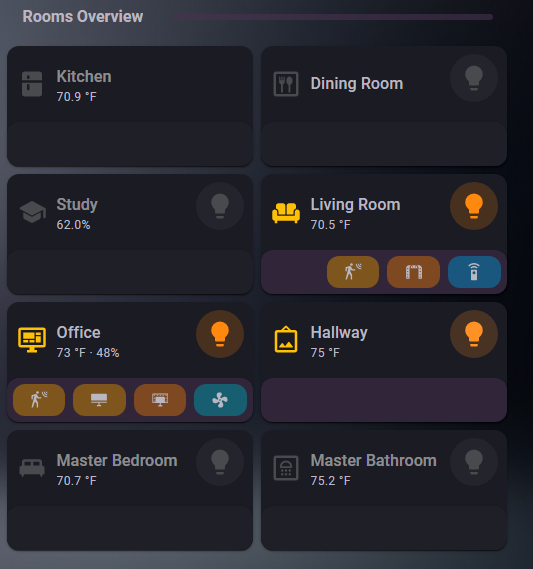
I’m not completely finished with these room cards yet – haven’t set up navigation or popups. There is a ton of logic that I’ve “stolen”, mostly from the card-mod pages – but I’m pretty dense when it comes to css navigation. Theme is Material You (thank you for that!), Background is from Frosted Glass
- Dimmed rooms are unoccupied
- Purple bar does follow the theme colorings
- TBD: alternative color main icon and maybe feature row when the room is set to sleep mode (from adaptive lighting)
- Lightbulb does work, color/background changes with the rgbvalues of the bulb as is default with a tile button. Long press turns it off and on, single tap brings up more-info – for now.
- SubButtons are reverse-row, and go in an order that makes sense to me.
- SubButtons hide when they are off/inactive.
- I’m a huge fan of bias lighting, so when the light syncs are active those buttons turn mediaplayer blue to indicate they are in sync mode.
- The motion and presence detectors (really it’s the default color I guess) is var(–warning-color); all other button colors are some sort of state color depending on the entity.
home.yaml – only including 1 room to cut down on length
    - type: grid
      column_span: 1
      cards:
        - type: custom:bubble-card
          card_type: separator
          name: Rooms Overview
          modules:
            # - "!default"
            - "!home-assistant-default"
        - type: custom:streamline-card
          template: roomsum_tile
          grid_options:
            columns: 6
            rows: 2
          variables:
            area: office
            entity1: fan.z_wave_outlet_attic
            entity1_icon: mdi:fan
            entity2: light.hue_play_monitor_backlight_office
            entity2_icon: hue:lightstrip-tv
            entity3: binary_sensor.helper_pc_presence_office
            entity3_icon: hue:room-computer
            entity4: binary_sensor.helper_group_office_motion_sensors
            entity4_icon: mdi:motion-sensor
roomsum_tile.yaml (using streamline-card, successorish to decluttering card)
roomsum_tile:
  default:
    - entity1: input_boolean.dashboard_placeholder
    - entity1_icon: mdi:flask-empty-outline
    - entity2: input_boolean.dashboard_placeholder
    - entity2_icon: mdi:flask-empty-outline
    - entity3: input_boolean.dashboard_placeholder
    - entity3_icon: mdi:flask-empty-outline
    - entity4: input_boolean.dashboard_placeholder
    - entity4_icon: mdi:flask-empty-outline
  card:
    type: custom:mod-card
    card_mod:
      style:
        hui-horizontal-stack-card:
          $: |
            div#root {
              display: grid;
            }
            div#root > * {
              grid-column-start: 1;
              grid-row-start: 1;
              display: block !important;
            }
            div#root > *:nth-child(2) > :first-child {
              --ha-card-border-width: 0px;
              --ha-card-background: rgba(0,0,0,0.0);
              width: calc(36px + 2 * 10px);
              display: block;
              margin-left: auto;
            }
        .: |
          ha-card {
          border: none;
          height: calc((var(--row-size, 1) * (var(--row-height) + var(--row-gap))) - var(--row-gap));
          }
    card:
      type: horizontal-stack
      cards:
        - type: area
          area: '[[area]]'
          display_type: compact
          alert_classes: []
          sensor_classes:
            - temperature
            - humidity
          features_position: bottom
          features:
            - type: custom:service-call
              entries:
                - type: button
                  entity_id: '[[entity1]]'
                  icon: '[[entity1_icon]]'
                  autofill_entity_id: true
                  hold_action:
                    action: toggle
                    target:
                      entity_id: "{{ config.entity }}"
                    data: {}
                  haptics: true
                  styles: !include roomsum_feature_style.yaml
                - type: button
                  entity_id: '[[entity2]]'
                  icon: '[[entity2_icon]]'
                  autofill_entity_id: true
                  hold_action:
                    action: toggle
                    target:
                      entity_id: "{{ config.entity }}"
                    data: {}
                  haptics: true
                  styles: !include roomsum_feature_style.yaml
                - type: button
                  entity_id: '[[entity3]]'
                  icon: '[[entity3_icon]]'
                  autofill_entity_id: true
                  hold_action:
                    action: toggle
                    target:
                      entity_id: "{{ config.entity }}"
                    data: {}
                  haptics: true
                  styles: !include roomsum_feature_style.yaml
                - type: button
                  entity_id: '[[entity4]]'
                  icon: '[[entity4_icon]]'
                  autofill_entity_id: true
                  hold_action:
                    action: toggle
                    target:
                      entity_id: "{{ config.entity }}"
                    data: {}
                  haptics: true
                  styles: !include roomsum_feature_style.yaml
              styles: |-
                :host {
                  --feature-height: 32px;
                  --mdc-icon-size: 18px;
                  --feature-button-spacing: 8px;
                }
                .row {
                  justify-content: end;
                  flex-flow: row-reverse;
                }
          card_mod:
            style:
              ha-tile-info $: |
                .primary {
                  font-size: var(--ha-font-size-l) !important;
                  white-space: unset;
                  {% if is_state('binary_sensor.helper_occupancy_[[area]]','off') %}
                    color: var(--disabled-text-color) !important;
                  {% endif %}
                }
                @media (max-width: 800px) {
                  .primary {
                      font-size: var(--ha-font-size-m) !important;
                      max-width: 65px !important;
                  }
                }
              ha-tile-icon $: |
                .container {
                  --mdc-icon-size: 30px !important;
                  height: 48px !important;
                  width: 48px !important;
                  border-radius: 24px !important;
                  margin: -9px;
                  {% if is_state('binary_sensor.helper_occupancy_[[area]]','on') %}
                    --tile-icon-color: var(--state-active-color);
                  {% else %}
                    --tile-icon-color: var(--state-inactive-color);
                  {% endif %}
                }
              .: |
                .container > hui-card-features {
                  min-height: 44px;
                  padding: 6px;
                  border-radius: var(--ha-card-border-radius, 12px);
                  box-shadow: var(--ha-card-box-shadow);
                  {% if is_state('binary_sensor.helper_occupancy_[[area]]','on') %}
                    background: rgba(from var(--secondary-background-color) r g b / .5);
                  {% else %}
                    background: var(--primary-background-color);
                  {% endif %}
                }
        - type: tile
          entity: light.helper_group_[[area]]
          visibility:
          - condition: state
            entity: light.helper_group_[[area]]
            state_not: unknown
          name: " "
          icon: mdi:lightbulb
          icon_tap_action:
            action: more-info
          icon_hold_action:
            action: toggle
          card_mod:
            style:
              ha-tile-info $: |
                .info .secondary {
                  display: none !important;
                }
              ha-tile-icon $: |
                .container {
                  --mdc-icon-size: 30px !important;
                  height: 48px !important;
                  width: 48px !important;
                  border-radius: 24px !important;
                }
              .: |
                mwc-ripple {
                  display: none;
                }
                ha-card .container .content {
                  justify-content: center;
                }
                ha-card {
                  height: calc((var(--row-size, 1) * (var(--row-height) + var(--row-gap))) - var(--row-gap) - 50px)  !important;
                  margin: -3px;
                  box-shadow: none;
                  --ha-ripple-color: none !important;
                }
The random include the style key made getting the backgrounds and settings for all 4 badges so much easier – as much trial and error I was doing, I’m happy I found a way to only do it once.
roomsum_feature_style.yaml
|
  :host {
    flex-basis: 22.5%;
    {% if is_state(config.entity,'off') %}
      display: none;
    {% endif %}
  }
  .background {
    opacity: .5;
  }
  {% if config.entity is match('light.hue_play_') and is_state('binary_sensor.helper_hue_sync_[[area]]', 'on') %}
    .background {
        background: var(--state-media_player-active-color);
      }
  {% elif config.entity is match('light') %}
    .background {
      background: rgb({{ state_attr(config.entity,'rgb_color') -}});
    }
  {% elif config.entity is match('remote') %}
    .background {
      background: var(--state-media_player-active-color);
    }
  {% elif config.entity is match('fan') %}
    .background {
      background: var(--state-fan-active-color);
    }
    .icon {
      animation: spin 1s linear infinite;
    }
  {% else %}
    .background {
      background: var(--warning-color);
    }
  {% endif %}
  @keyframes spin {
    100% {
      transform: rotate(360deg)
    }
  }
Initially I had something different for the light.hue_play/sync detection.
{% if config.entity is match('light.hue_play_') and is_state((area_entities(area_id(config.entity)) | select('match','switch.hue_sync') | first), 'on') %}
Which did work, but the frontend was not aware that those entities were set to 'living_room" when the device was set to ‘infrastructure’ – so it refused to find the sensor. 1 room worked because that room has it’s own bridge, but not the other. Even creating a helper for that room with the correct area label didn’t work. The current code simplifies by just calling the helper sensors directly; I’m sure skipping the area_entities(area_id(config.entity)) is less compute anyways.