Fair. Perhaps: “When will Matter Wi-Fi devices be as easy to install as Matter Zigbee devices”?
I’m kidding. It does not appear that I have permissions or, perhaps the know-how to change the topic title.
Fair. Perhaps: “When will Matter Wi-Fi devices be as easy to install as Matter Zigbee devices”?
I’m kidding. It does not appear that I have permissions or, perhaps the know-how to change the topic title.
I can. Got it for you.
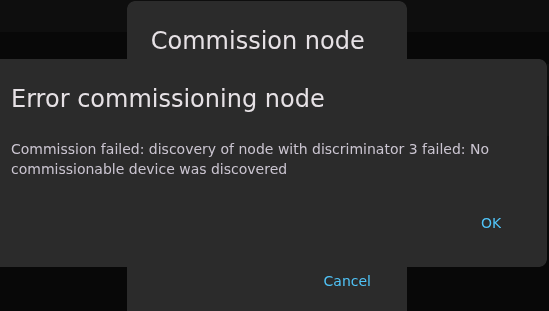
I disabled BLE proxy, reset the device and tried again. Still on love.
I suspect that this is just not meant to be and I will need to simply order the THIRDREALITY Zigbee Multi Function model.
Matter does need other peoples computer (AKA cloud  ) for deployment/commissioning. Do your devices reach the boss?
Congrats! Let’s hope the real owner of your device continues to grand you access. Just because you got a “matter certified” device does not grand you lifetime usage of the device. The vendor might change the terms of service at any time as they like. For example remove matter compabilty from the device you bough - forcing some property cloud on you if you don’t like bricks instead… 
We can do matter but don’t do HA 
I don’t think that’s a bad approach at all. Zigbee is a fully local mesh protocol, with no external dependencies to “commission” the device. Just pair it to your coordinator and it’s good forever on your local network.
I was really interested when Matter was announced, and I closely watch HA users’ experience with it here. Some seem to love it.
I’m not there yet. It seems to me like a bunch of device manufacturers got together to insert roadblocks into our ability to use devices after we’ve purchased them. I’ve seen claims that this is being done “for security.” Like somehow we should trust them more than ourselves to decide which functionality on which devices we should install into our own networks.
I’m trying to stay open-minded, but I’m very close to calling BS on the whole thing as just a scam by manufacturers to wrestle control away from the local installer. It might even allow them to perform the ever-popular switch to a subscription model once there’s a large enough installed base. True, that’s just hypothetical at this point. But we’ve all seen it often enough to know it’s not out of the realm of possibility. So I watch and wait.
I think google, amazon, apple (the big CSA paying members) have matter exactly like they wanted it. They painfully figured out with local only solution like zigbee they can’t force revenues after selling it and does not allow the walled garden scenario ether. 
So under the disguise of security matter just doesn’t grand any ownership rights to the buyers - making it a win-win-win for everyone expect the buyer. 
Beside all of that matter device vendors still can force manufature apps (even online accounts and clouds) to access all features of a device - or even simply for on-boarding. 
For example a matter and works with HA certified device makes the manufacture app (obviously with trackers) mandatory 
I really do not care and am not part of the privacy and local obsessed IOT users. You are and that is fine with me.
Not so much an obsession as an responsibilty
Do you have a source for that? Or did you personally made that experience with a particular product?
I mean , in general, it can happen to any modern device that’s connected to a network and i also had a zigbee lamp that lost the zigbee capabilities after an update. My old Neato Vacuum Bot lost features because the company went down and so on.
So it’s not Matter specific.
Responsibility for what ? It is perfectly your right to be concerned about anything, but personally I do not want to live in a digital cave.
I’m far from privacy obsessed. If I listed here all the privacy “best practices” I don’t fully follow, I’d be chastised by this community.
You can call me “local obsessed” if you want. Fool me once, shame on you. Fool me twice, shame on me. I’ve learned the hard way that turning over control to the manufacturer means taking a risk that they might abandon the product line, take servers or certificates off line, change the feature set, switch to a subscription model or just go out of business. I see no reason to risk any of that.
Having said that, there are people to whom I would recommend that route. People who want a turnkey solution with minimal setup and decision-making on their part. People who don’t mind paying subscription fees. People who are OK depending on an external network connection and a cloud server for their local devices to work.
I would also recommend those people not use Home Assistant.
As for Zigbee devices losing functionality based on a vendor’s update, I’m curious about the details. Why would a manufacturer do that? They can’t force you to use their cloud solution; Zigbee is totally local. The devices can’t even talk to an external server. I can imagine an update which breaks a feature, or makes a change that the HA integration can’t support (yet). But I see no reason for a manufacturer to intentionally make an update available which would break the device. They have nothing to gain.
If I thought that could happen, I’d simply choose not to update the devices via ZHA. The devices would continue to work forever on my local network, never even knowing there was an update available. They do not and can not check for updates on their own.
As I said, you are entitled to your opinion and preferences.
I don’t think it’s about opinions. It’s about getting all the information out there, so people can make decisions which work for them. There are compromises with every decision about which devices and protocols to choose. It’s good to know what the potential benefits and risks are before committing to a direction.
Using terms like “obsessed” and “digital cave” don’t really add to the discussion.
Obsessed is maybe too strong, though some seem to make this almost their life struggle. Digital cave is very true, It is like the preppers that choose to live in old underground missile silos.
I really do not care whether others, for the right or wrong reasons, prefer to stick to local. It is their choice and maybe I join them if some Russian or North Korean succeeds to switch off/on my lights (OK I am being facetious…), but personally I choose to take advantage of the wider product range and take the risks of not being limited to local access.
I hardly live in a digital cave but I would prefer it living in a palace full of crap that I paid for but don’t own. It is perfectly your right not to be concerned about anything at all, go you!
Ya - that makes two of us
I am just curious (as I have obviously dove head first into the HA environment), what would you recommend as a suitable substitute?
Applies to all the ones you can’t own. That you can’t control, can’t configure, can’t extend and not even repair because you weren’t granted ownership rights.
I would just take your post as a source because you kindly provided them
Same is apparently happening to matter devices as linked in my previous post
Nope and probably never will. We choose devices based on principles that also honor ownership and allow full local control without any cloud dependency (unlike matter).
TL;DR We prefer buying over renting 
This is a good question. If not HA, then what?
I know people who have installed security cameras, and pay a subscription to access them via the manufacturer’s cloud. For these people, the convenience of plug-and-pay is a good compromise. To them the cost is minimal and if the manufacturer goes out of business, well, that’s just a good excuse to go out and “blow that dough” on new hardware.
To your question, I’m not sure which plug-and-pay vendor solution I’d recommend to these people, in lieu of HA. Maybe SmartThings? I haven’t looked closely at what’s available ever since I chose HA something like six years ago.
Maybe this is just opinion, but to me, you either want local control, or you trust one vendor to do it for you. There’s little point in doing all the work maintaining HA if you’re giving away control of big chunks of your system to some third party. And just as I’d recommend HA users stick to a bare minimum of protocols, I’d recommend plug-and-pay users to stick to a bare minimum of vendors. I’m a big believer in the KISS principle.