I have a similar arrangement, and in one sunny month last year my lowest import ever was 12 kWh for the entire month. Normally I expect around 0.5 kWh per day or 15 kWh each month in the summer at best.
There is always a small +/- 10 Watt balancing noise when the solar PV and the load are stable. Since the inverter is attempting to balance to zero grid current, this could, in theory, be shifted to balance at grid export 10 to 20 Watt. Whilst there is a Backflow Power setting, used to limit export to the grid, I am not aware of a setting for the zero balancing point. So no I don't think we can.
Solis inverters, apparently, have a 5 second balancing response period. Any tighter than this and oscillation could occur - there is always a degree of response dampening in any feedback-loop control system. For the most part, excessive import is caused when either a large load is switched on, or when a large Solar PV generation is abruptly curtailed by cloud.
When, for example, switching a 3 kW oven or washing machine, the additional 3 kW has to come from somewhere. Rapidly turning this on is not possible without drawing (at least temporarily) from the grid, but can be mitigated. First is to have a good power meter with calibrated CT clamps, and a good connection to the inverter. Second, in the case of hybrid inverters, is to have a battery that is responsive and has large capacity. I have a pylontech with 5 kW output to match my 5 kW inverter, so with a background load of 500 W, and solar PV of 2500 W, the battery is charging at 2 kW. Turning on a 3 kW load means changing this from 2 kW charge to 1 kW discharge, all in less than 5 seconds.
Here is a snapshot of my grid power [against solar, battery and load power] from yesterday around solar noon. Grid import is highlighted in purple, positive values.
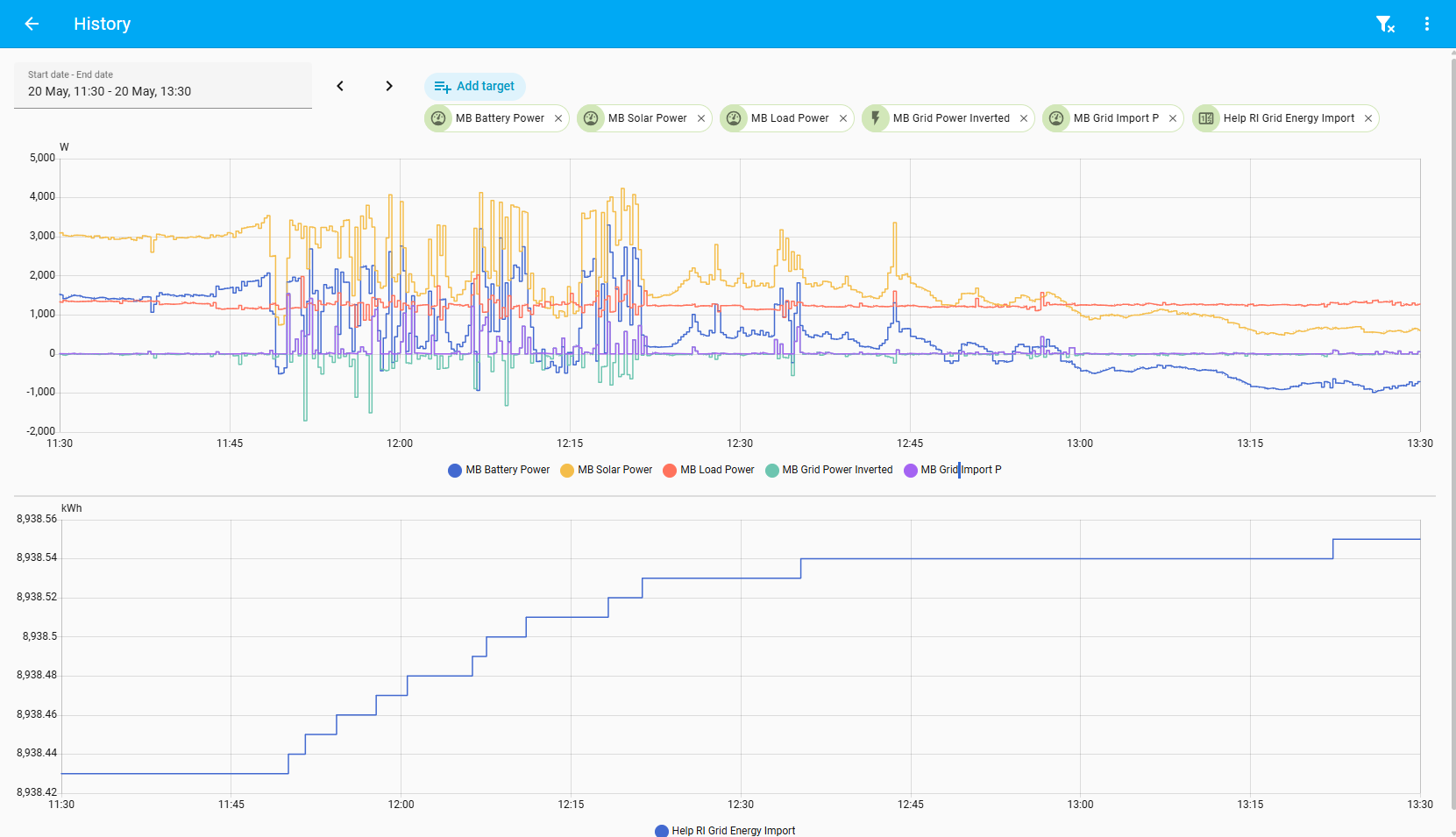
My inverter monitoring, using Modbus, is only every 15 seconds, so there is always a degree of 'averaging' and false delay taking place in these readings. Clearly, when the solar PV is stable, and the load is stable, there is little grid import/export fluctuation.
Where the solar PV changes dramatically (cloud), and also where the load changes, there occurs a period of imbalance, where grid import / export occurs. Most of the grid-import seems to occur, as expected, following points where there is a rapid fall in solar PV or an increase in load. Certainly my experience is that consistently sunny days (with little cloud) have the lowest grid-import, and days with strong sun and patchy cloud cause most of the resultant import.
You will see, from the Grid Import Energy (Reimann Sum) that the small changes make very little difference to the energy imported, and that it is the large changes that result in the significant increases in the energy figures.
No, AFAIK you can't shift the balancing point, but more importantly, it would not make that much difference unless you moved the balancing point by several hundred Watts. To eliminate all import I would have to be exporting around 800-1000 Watts, which is just not possible over an extended period of time.