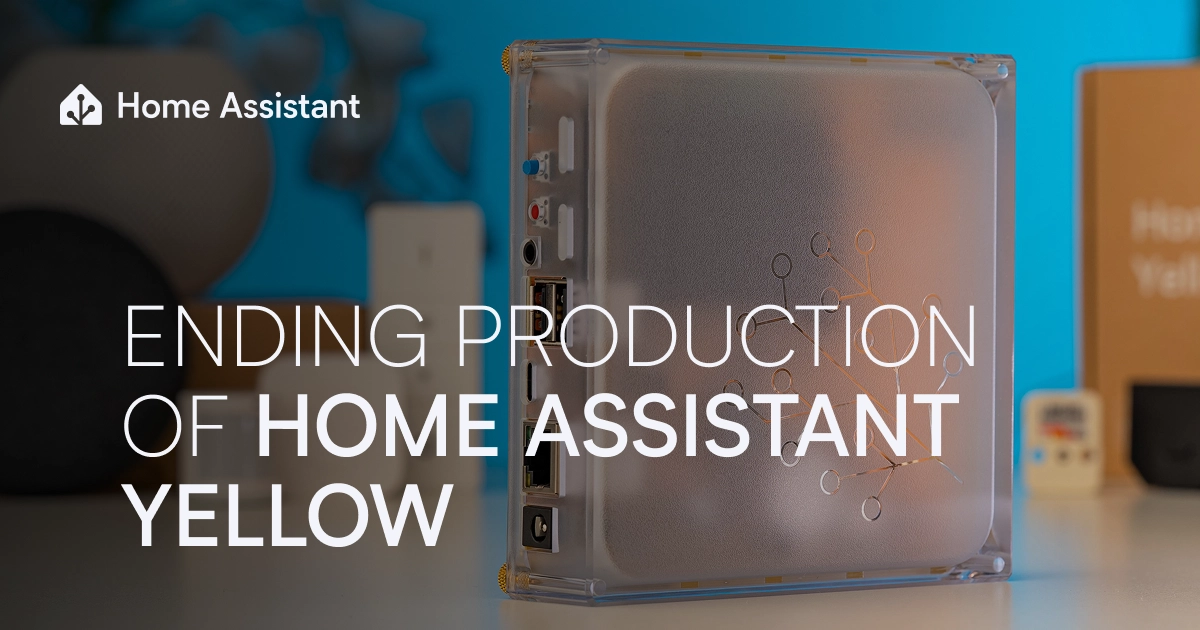
Ending production of Home Assistant Yellow

Today, we’re announcing that we will no longer be producing Home Assistant Yellow. Rest assured, it will continue to receive software support far into the future.

I’m Carl, Vice President of Commercial at Nabu Casa, the organization that builds and sells official hardware for the Open Home Foundation. I couldn’t be more proud of our hardware achievements over the past 12 months, including Voice Preview Edition and Connect ZWA-2 (including its cool new Wi-Fi and PoE experimental firmware).

Home Assistant Yellow was similarly groundbreaking at launch and helped fund Home Assistant’s development. However, for reasons I’ll explain below, the time has come to end production. This means that if you were considering buying a Home Assistant Yellow, you’ll need to act fast, as stock will not be replenished (check the Order Now button on the Home Assistant Yellow page to see if your local retailer still has stock).

Nabu Casa is now exploring what hardware could replace Home Assistant Yellow, so if you have any suggestions on what we should do next, please tell us in the comments! In the meantime, the good news is that there are already plenty of other great ways to run Home Assistant. For example, if you’re looking for hardware that’s both easy to start with and supports the Open Home Foundation, we’d recommend the Home Assistant Green.

A golden era

There is a long yellow brick road that brought us to today. All the way back in 2021, we announced Home Assistant Yellow (originally called Amber). It included some pretty unique features, including its built-in Zigbee or Thread adapter, optional PoE, and overall expandable approach. As it used the Raspberry Pi Compute Module platform, included GPIO, and had an NVMe slot, there were a lot of different ways you could upgrade it over time (including people being able to upgrade from CM4 to CM5, which was quite the speed bump 🏎️).

It wasn’t all smooth sailing with Home Assistant Yellow. We essentially launched the device in the middle of the great Pi shortage. It definitely complicated things for a time, but it all eventually stabilized. In late 2023, we launched Home Assistant Green, which became the easiest way to get started with Home Assistant. This new product led us to end the sale of Home Assistant Yellow devices that shipped with a CM4 already installed (called the Home Assistant Yellow Standard), which allowed us to focus the product line on the kit versions.
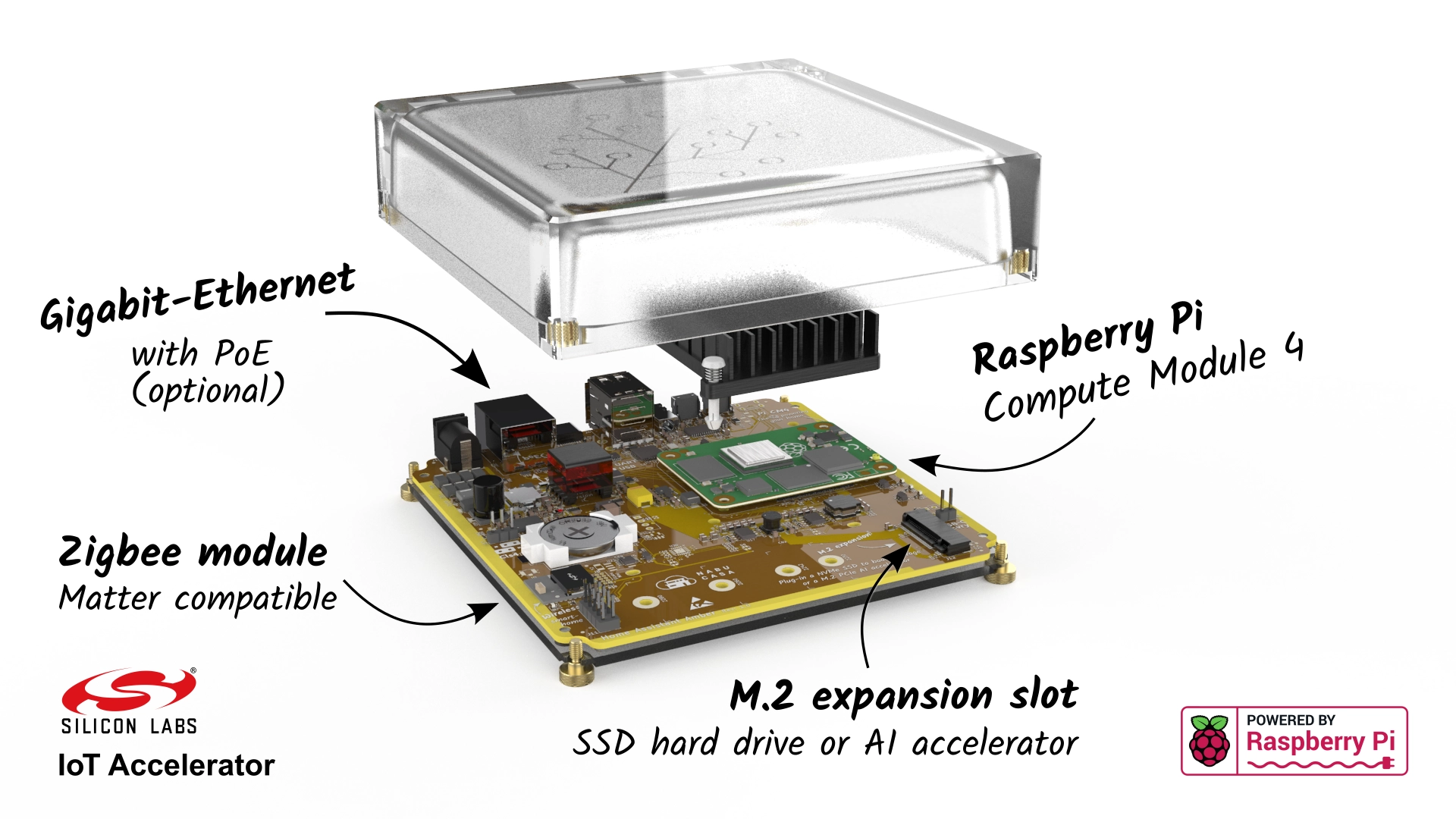
Small, but so much room for activities

Home Assistant Green continues to have strong sales, but Home Assistant Yellow sales have been naturally slowing down, as happens a couple of years into any product’s life. This month, it finally reached the point where it no longer made sense to have another production run, which ultimately pushed us to discontinue Home Assistant Yellow.

Technology changes, and small-form-factor computing has always moved fast. For instance, in the early days of Home Assistant, the community’s de facto recommendation was always the most recent Raspberry Pi device, but we’re seeing more people gravitate towards Mini PCs. We’re now exploring what we could build next for our power users, but we’re still some way off, so don’t wait if you need something today.

Software support continues

As long as it’s possible to run Home Assistant on Yellow, we will continue to provide builds. If you want living proof of this commitment, take our first hardware device: Home Assistant Blue. It ended production in 2022, but still receives new builds of Home Assistant, something that shows no signs of changing for a long time. We continue to streamline and make Home Assistant more efficient, as it’s our goal for you to run it on the hardware you have.

Say ‘ellow to the future

I’d just like to take a moment to thank everyone who bought a Home Assistant Yellow over the years, and for all the great feedback you shared with us. We’re sad to say goodbye to our trusty little expandable powerhouse, but it’s had a good run and we’re super proud of how far we’ve come. Also, we’ll soon be announcing the date of our next hardware product (not a computing device… but something very cool nonetheless), so stay tuned!


This is a companion discussion topic for the original entry at https://www.home-assistant.io/blog/2025/10/15/yellow-end-of-life
4 Likes

I always liked the idea of the Yellow and have deployed a few of them to different homes. The next device I’d love to see after the Green is one that has a bit better I/O with a little more horsepower. Even something like what the current N100 or N150 offers. One other element that would be awesome, rackmounting… for those homelabs out there.

5 Likes

PoE was the reason I went Yellow. I would sure like a replacement to support a flavor of PoE.

13 Likes

With all the LLM integrations nowadays, you need online services to get fast responses.
Home Assistant stands for running everything local. Now we send again our videostreams and local data to the big tech clouds!!!

I think a mini pc device with enough power to run also local LLMs with Ollama should be a nice new hardware project. But maybe in cooperation with Beelink and not developed by Nabu Casa itself.

The question is, is this already available to sell such pc for a reasonable price?

4 Likes

I was excited to see the ZWA-2 have a PoE option in the recent port. I’d love to see the replacement for the HA Yellow also support PoE.

NPU/GPU option would also be amazing. Maybe something with similar hardware to the Unifi AI Key? That manages to fit an Nvidia Jetson Orin NX inside.

3 Likes

Nabu Casa needs to design it. It should be home assistant through and through. That’s why I buy whatever you guys put out because first and for most, home assistant is why it’s being developed in the first place. Mini pc type would be nice for local LLM utilization with something like frigate.

2 Likes

Reminder that schematics and layouts are on GitHub, so if anyone really wants one they can make one.

6 Likes

#1 important feature needed is POE. I manage a number of remote HA installs for friends and family and sometimes have to cycle the power to the port to hard reboot the device. If this could be added to Green, I would be so happy.

2 Likes

Would love to see more official compute hardware options that are are more power than the Home Assistant Green. Maybe a continuous series that covers entry-level, mid-range, and high-end without hpibg the PC-route, all capable of running the full voice pipeline locally.

Alternativly a new network-attached ”AI base station” as a stand-alone appliance that can easily ve replaced and/or upgraded seperatly, similar how a NAS (storage server) can sit anywhere on your network at just be great at one thing, but with focus on being a local AI server. And I honestly think that modular approach would make more sense from a retail purchase point-of-view as someone who already bought a Home Assistant Green could partially upgrade their setup by just buying a such ”AI base station” (networked AI-server appliance).

At least mid-range hardware from China are coming down in price and offer more M.2 PCIe slots for expandability. Just check out for example the new Radxa Orion O6N and Orange Pi 6 Plus in Nano-ITX SBC form factor based on CIX P1 12-core ARMv9 SoC with 30 TOPs NPU which have up to 64GB RAM and two M.2 Key-M sockets for storage and/or AI accelerators:

If could combine something like that with one or two optional M.2 AI accelerator cards such as the Geniatech AIM-M2 40 TOPS AI Accelerator M.2 Key-M Module (based on the Kinara Ara-2 NPU) with 16GB VRAM onboard then that could perhaps be good enough to call it a entry-level Edge AI server if packaged the right way?

AI acceleration hardware is moving fast so would be great if were an official solution that was upgradable.

For reference, FutureProofHomes posted a sneak peak video of their upcoming AI Base Station running local LLM a few of months ago, however that is more of a software solution as the hardware shown more or less just a Nvidia Jetson Orin Nano 8GB which makes it fast but expensive and memory constraint if wanting to run multiple AI modules for both generation and reasoning.

There is no 1fitsAll device. So you should concentrate on the average entry level consumer that wants to buy a „home assistant hub“. Everyone else can choose from plenty options according to their need.

7 Likes

You asked for suggestions where to go with hardware?

Please develop a hardware which is the migration target for todays Yellow - actually a successor.

I have a Yellow with active use of NVMe storage and ZigBee (z2m).

I am looking for a low effort migration from current Yellow to its successor via backup and restore.

If this can be assured I am confident, that you will receive much applause from the community and the device will be a great success.

Best
Bodo

9 Likes

I have 5 Yellows in use. 1 as POE and the other 4 as standard USB-C mains power. Whatever Nabu Casa comes up with, I really hope for both power options (ideally in the same system so you can switch without having to get different hardware!). Easy backup / restore to the new system would also be crucial.

I also happen to use both the built in Zigbee controller and the either a Zooz 800 ZWave hat or the new ZWA-2 depending on my ZWave needs. I would love to see something that can easily handle all of this without complicating things a lot.

I moved to the Yellow because I didn’t like having the various RPis I had with a bunch of stuff dangling off of it as this makes such a good all in one box. I hope whatever the successor is, that it keeps the clean form factor.

2 Likes

To everyone asking for a green with POE, you can always use a Gigabit PoE Splitter 12V/2A DC 5.5 2.1mm Connector. I use it on every install.

5 Likes

Can you share how many Home Assistant Blues, Yellow and Greens are sold to this day? That’d be interesting

4 Likes

While on the topic of hardware, I for one would also love to see Nabu Casa and OHF make both make a new official Home Assistant voice assistant with a much better built-in speaker that should be optimized for music playback, as well as seperate (non-voice) HiFi-class devices with AUX line-level audio-input and audio-output (without internal speaker/microphone) as dedicated multi-room audio appliances designed for music playback using the new Resonate protocol with Music Assistent, (i.e. similar to Wiim wireless music network streamer and sound system product family).

4 Likes

From the (opt-in) Home Assistant Analytics there are 9447 HA Yellow and 39223 HA Green reported. The HA Blue does not seem to have a separate entry, but I guess those are reported as ODROID-N2 (4479).

They estimate that less than a fourth of all Home Assistant users opt in, not sure if this is comparable for people buying Nabu Casa hardware (or maybe that’s how they estimated the opt-in rate in the first place).

3 Likes

I for one would also love to see Nabu Casa and OHF make both make a new official Home Assistant voice assistant with a much better built-in speaker

Plus one on that. Something like the satellite one from FutureProofHomes

1 Like

POE

Built in Zigbee, Thread, Bluetooth connectivity

Upgradable storage

Maybe a microphone or option to incorporate HA Voice?

Named after another color—Purple, Red, Orange, Indigo

5 Likes

Wonder if installation and integration analytics are calculated/collected differently. The installation statistics for example say that there are 512,941 Active Home Assistant Installations, while integrations says that 99.6% of the install-base have the ”Sun integration” but there are only 408,139 of those integrations deployed. It also says that there are 104,846 that have the Zigbee Home Automation integration but that it is the same as 25.6% of users, which are numbers that not add up as 25.6% of 512,941 makes 131,314 (rounded up):

versus number here:

1 Like

Sure. Off the shelf, about $5,000.