Hello out there!
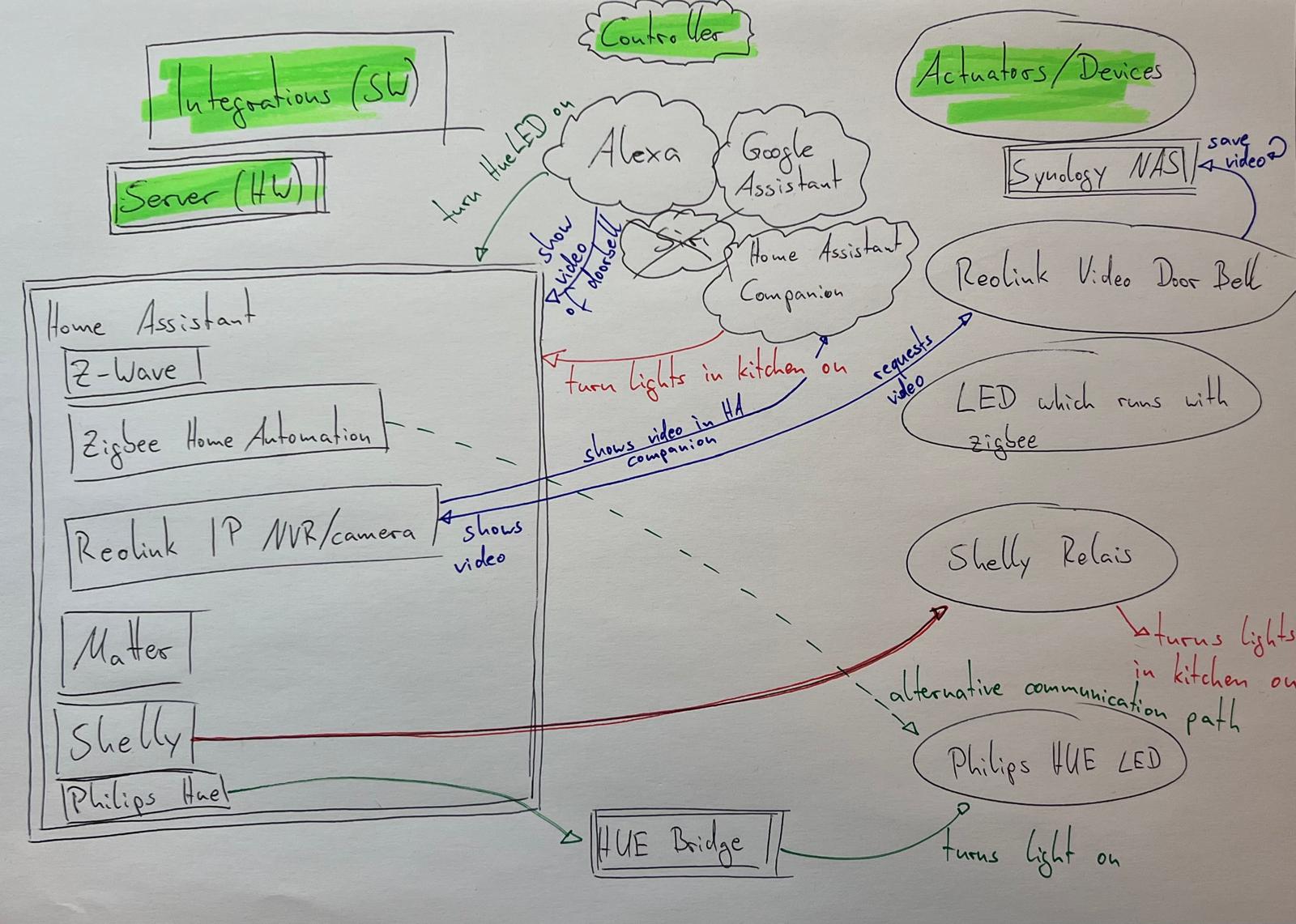
I’m new to the world of smart home and would like to understand in general the way that home assistant works. I tried to make a sketch of a few more or less complex examples:
simple - unidirectional task with specific integration on HA:
Task: turn lights on with a Shelly relais
a) ask the HA Companion/Alexa/… to turn on the lights in the kitchen
b) the ‘Shelly’ integration communicates with the Shelly relais which then turns on the lights
with additional hardware:
Task: turn a HUE LED on
a) ask the HA Companion/Alexa/… to turn on the HUE LED
b) Integration ‘Philips HUE’ communicates with the HUE bridge, which is in the same Wifi-network
c) HUE bridge turns on the LED
The question for me at this point: would it be possible to skip the HUE bridge as the HUE LEDs are working with the zigbee standard? Wouldn’t it be possible to directly use the zigbee integration and skip the long way over the HUE bridge (with the need of additional HW)? Is this possible or are there reasons, why there is a Philips HUE integration available as the hardware from Philips communicates over zigbee protocol?
bi-directional with additional HW (NAS):
Task: show the viedo of the doorbell and save the snippet on my NAS
a) it rings
b) the HA Companion creates a push notification on my smartphone, that someone is in front of my door
c) I open the HA Companion to see the video → communication is realized with the integration for Reolink
d) I set the automation, that after someone rang the doorbell, a 15 second video should be saved on my NAS → video is sent back over Wifi to the Reolink integration which then forwards the video material to my NAS (in my sketch, I drew it wrong as the doorbell would directly communicate with my NAS according my notes)
Is the general concept understood correctly? I guess there are at least some mistakes within my idea of how this all works and I hope that someone can explain where they are 
Thanks a lot!
best, orPoG