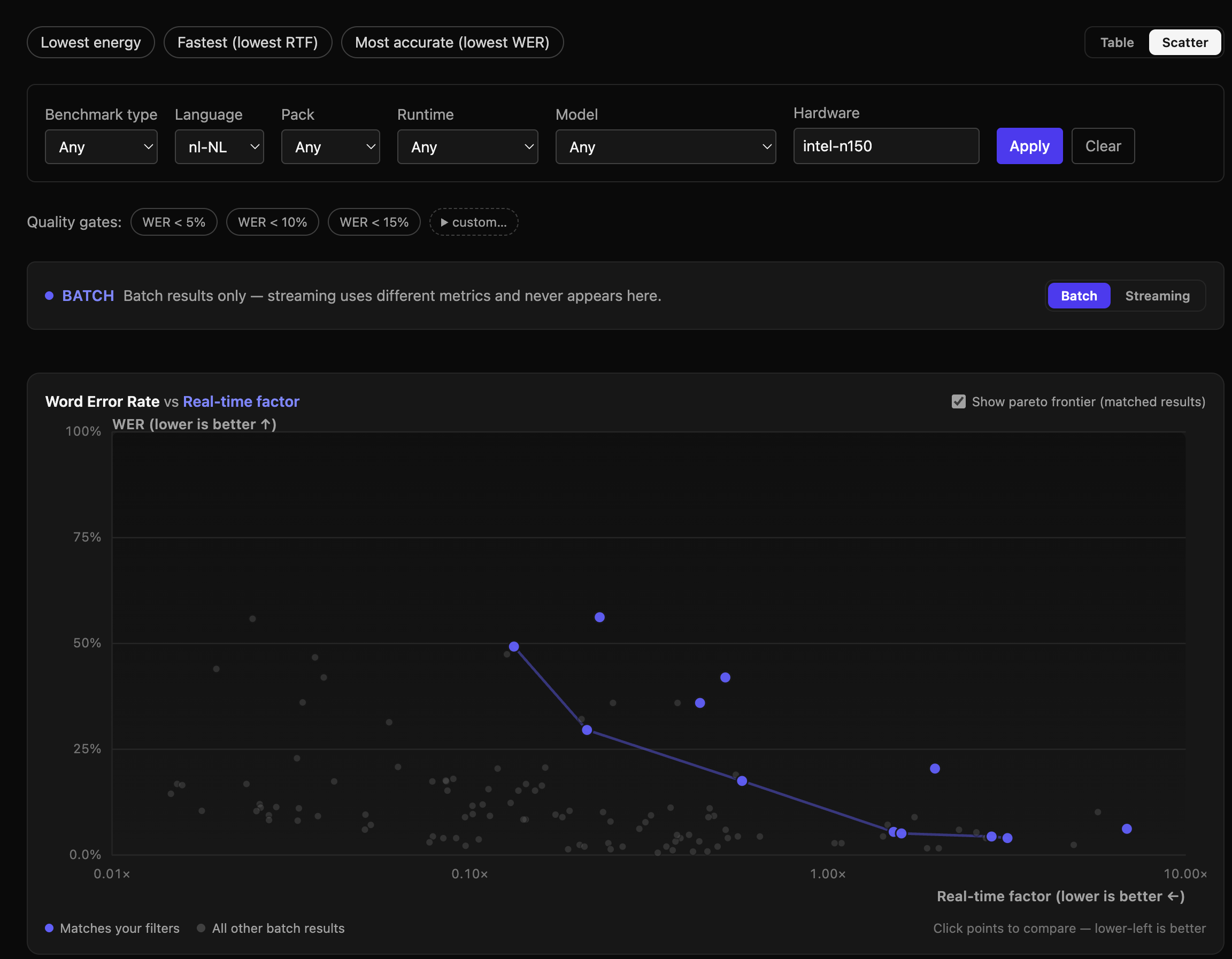
A lot of us picking hardware for a local Assist pipeline end up guessing: does this SBC actually run faster-whisper medium in real time, or do I need to drop to tiny and eat the accuracy hit? Vendor numbers don’t answer that, and blog posts go stale fast.
We built GOESB (Global Open Edge Speech Benchmark) to fix that — a reproducible benchmark for on-device STT specifically. Every result is hash-verified and signed, runs against official profiles + open packs so numbers are directly comparable, and the runner never executes arbitrary code (reviewed, in-tree adapters only). No account needed to submit.
Similar spirit to what [@stefanozampieri’s multilingual wake-word project is doing for wake words — making it possible to know what actually works on your hardware before you commit to it, instead of finding out after.
The problem right now: we need your hardware, not ours. Every result on the leaderboard today is from an Intel N150, an old Xeon, or an Apple M1 Pro — because that’s what we own. If you’re running Assist on an RK3588 board (Orange Pi 5, NanoPC-T6, ROCK 5), an N100 mini-PC, a Raspberry Pi 4/5, a Jetson, or anything with a Hailo accelerator, your result is one that literally doesn’t exist yet.
Easiest way to run it — install, then just type goesb with no arguments. It drops you into an arrow-key menu that walks you through picking a profile and pack, running, and submitting:
curl -fsSL https://raw.githubusercontent.com/taktx-io/GOESB/main/scripts/install.sh | sh
goesb
Audio and models never leave your machine until you explicitly submit.
Heads up: this is still very much a product in development. It works reliably on what we’ve tested, but we haven’t tested every board — install or run issues on hardware we don’t own are plausible, especially anything exotic (odd ARM boards, NPU-only setups, etc.). If something breaks, please file an issue on GitHub rather than just giving up on it — that’s exactly the kind of signal that helps us fix it for the next person on the same board.
If your board isn’t on the leaderboard yet, this is genuinely one of the most useful five minutes you could spend for the rest of us trying to make the same hardware decision. Happy to answer questions here.