Good selection of PoE sensors?

Hi,
In reference to New HA powered house plans
I’m looking for reasonable selection of PoE sensors:

  • PIR/mmWave presence
  • temperature, humidity sensors (indoor)
  • smoke

I don’t want DIY stuff, I don’t have time and skills to assembly them.

PoE because:

  1. I don’t want to care about changing batteries
  2. If they could communicate with HA server over ethernet, it would be great, but might also be wifi or zigbee

There’s a rich selection of Zigbee and Wifi sensors, but all battery powered.
Any hints?

Unfortunately I’ve never seen PoE versions of any of those sensor types. USB-C, yeah, but never PoE.

With that said, there are PoE to USB-C RJ-45 adapters usually costing between $20-$40 US. I use them with my Raspberry Pis and they work pretty well.

$20 for POE to USB alone is quite ridiculous markup to count on top of each sensor. It will be cheaper to connect 230V cables everywhere (I’m still at the design phase for the house) and just attach USB chargers everywhere.

1 Like

I don’t disagree. :man_shrugging: I was answering your question and offering an alternative should you be dead set on going with PoE. :blush:

Got it :slight_smile:
Any recommendation for USB charged sensors? Tuya and other popular brands don’t have them…

You can buy battery delete kits or just run wires to every device. The #1 thing you need to pay attention to is the voltage of the device. If you apply too much voltage you will cook the device. Here’s a picture of me powering a z-wave device that takes coin cell batteries with a power supply.

1 Like

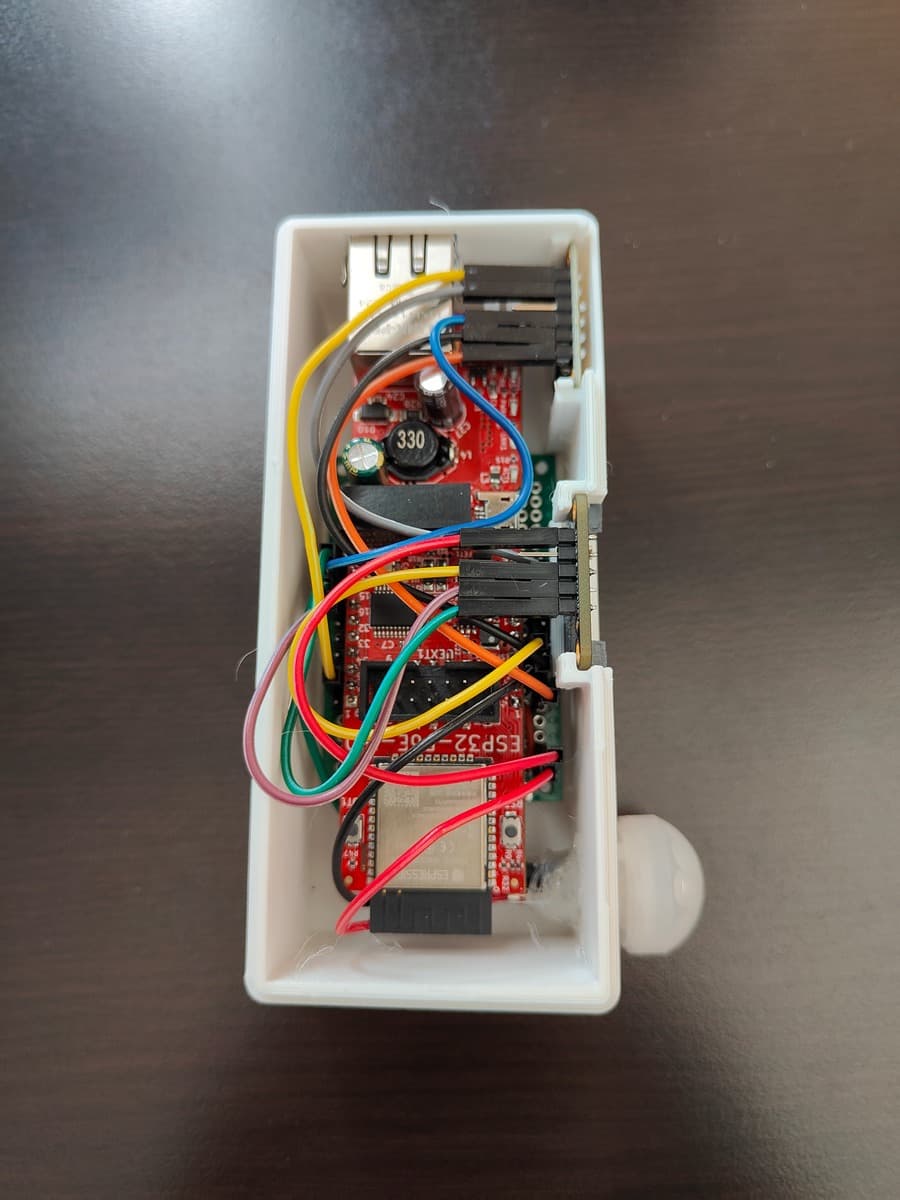
I made my own.

2 Likes

I am using reolink poe cameras as my security setup (don’t worry, I deny them internet access across the whole vlan). Their primary purpose is a feed to my BlueIris server. This gives me the opportunity to either use the motion sensor itself on the camera as a trigger in HA for motion lights, in addition, since blue iris has its own detection, I can use an either/or trigger for my automations which works very well. I could probably set up a sound trigger since some of the cameras have microphones.

I also use the poe to usb converters for my chromecast and Rpi’s. However, the Rpi’s were only in place for watching movies off the NAS years ago. Now the chromecast handles all the media duties with the app called localcast. I really need to repurpose them as some sort of sensor(s).

I too would like more poe sensor availability with HA, especially anything that is locally controlled since I despise cloud control. You never know when some product/api is going to be EOL, or if a company gets bought out and shut down. With some things, cloud is the best option,. However, I will always be of the “local control” mindset.

Anyone else have anything to contribute?

This might be what you’re looking for: https://www.reddit.com/r/homeassistant/s/Pjd9Dvw334

I know of at least one source for POE environmental sensors. Unfortunately, they’re designed for commercial building automation and run in the neighborhood of $200 per device.
Power over Ethernet Sensors for Remote Building Monitoring

A more reasonable solution is probably to use 5V POE splitters (about $10 on Amazon), if you’re willing to do wifi or Zigbee for the communications portion.

I also would dearly love to have sensors using Ethernet cable for both power and communication.

[edit: fixed URL]

I did not want to, either. :smile:

However after spending like a year investigating commercially available Zigbee mmWave sensors and still not really finding any that met my needs, I am seriously reconsidering this stance (as in total, DIY may have actually taken less time(!)).

Also your particular combination of wants is (at least to me) pointing in the direction of DIY. Maybe not what you wanted to hear. But hear me out…

mmWave needs to be powered all the time, so PoE would be nice for that. But the next level in Occupancy detection (after mmWave) is to start asking “who?” is in a given room. And then you are looking into something like Bermuda (or similar BLE trilateration). Combining the two, I think, might be the Holy Grail of Occupancy detection.[0] And good Occupancy detection is the cornerstone of many (almost all?) Automations.

Something else related is light level detection. Which many Zigbee (PIR) sensors only send when Motion is detected (and some mmWave, like FP1E, do not send at all!).[1] Another reason to have an “always on” sensor. So if it is overcast, the lights can come on, even though it is the middle of the day.

You probably might not realize all of this until you get a year or two into your home automation journey. And by then you will have spent a lot of money and time buying many different devices. This is where I am at now. And I have been a strong proponent of Zigbee (70+ devices now).

However slowly I am realizing that ESPHome seems to provide everything I am looking for. I want an all-in-one sensor providing mmWave, light (lux), and a BLE beacon (for Bermuda). And the only way to realize that is with ESPHome.

Now, there are a number of commercially available multi-sensors based on ESPHome. Maybe you want to go that way. However, personally, I find almost all of those to be ridiculously over-priced for what they are (as ESP32 and these sensors are only few bucks each). And none of those (to my knowledge) are PoE.

Which brings me to your main requirement, PoE. Which I think is actually a pretty great idea! [2] However there is very little COTS[3] PoE IoT[4] products available, at least that I am aware of. So now we are back to rolling our own. As there are PoE ESP32 modules available, and then you can do whatever you want (and also, modify in future, as needs inevitably change).

ESPHome makes things pretty easy, actually. It’s a very nice project and was a great idea. This is “low code” and just following some simple step-by-step instructions. Not like programming Arduino from scratch in C.

I think you should do yourself a favor and at least take a look at the project.

[0] Although I have yet to achieve this. I will let you know when I get there. :smile:

[1] Which is really a shame, as otherwise this was the best mmWave Zigbee sensor I found so far which meet my requirements.

[2] Due to all reasons mentioned above with always on sensors. But also BLE beacon monitoring can take up a lot of bandwidth, which therefore might be better to do over Ethernet than Wi-Fi.

[3] Consumer Off The Shelf

[4] Apologies for that acronym salad. :open_mouth:

I didn’t plan on using occupancy at the level of people identification. The concept seems interesting, but at my common sense doesn’t seem feasible without using cameras inside for people identification or having all residents always wearing some ID device (which I definitely don’t want).

For now I plan using my PIR+mmWave alarm sensors in some rooms, presence sensors (https://www.athom.tech/blank-1/human-presence-sensor I found this model very reliable in testing at my current old house) and in very few locations may need both as alarm sensors are good at detecting motion, but not presence if people sit or stand still (like working at the desk with the PC).

I gave up on the PoE idea for these devices. I didn’t find anything that meets requirements and is reasonably priced. I’ll just deliver 12v over alarm or Cat6 wires and use 12v to USB power converters hidden inside a custom 3d printed wall mount.

Re Zigbee vs Eth, I prefer Zigbee, but the nightmare is range. I don’t find the routing via AC powered devices reliable. I have lots of problems with those far from the base in my current house, and the new one will be larger so some locations will be forced to use Wifi.
Another disadvantage of Zigbee as you noticed is they only report on change and you can’t query them for status, which is really problematic sometimes i.e. when combined with weak signal. If the message is lost, the state remains invalid potentially for hours. For all sensors I made every effort to make them wired. For controllers like lights etc, I’ll mostly use wifi with preference on Matter Sonoff MiniR4M. What I really miss is a 2- and 3-gang switch.

In practice, I think most people carry their phone with them almost all of the time. But if this is not the case in your house, of course this will not work as well.

The only devices I plan to install on any members of the household are the cats. :laughing: Which sounds funny but I think brings up interesting possibilities in negating false positive motion detection.

You have to not only build a strong backbone mesh of many Router devices, but they have to be the right kind of devices (as some mfrs. do not correctly implement the spec).

Yes I have had my share of problems with Zigbee as well. It sounds like a great idea (in theory) and does work pretty well most of the time (at least for me). But now that I have been using it a while, we have some sensors dropping off and other issues. So now making more automations to monitor that problem (and batteries). Anyway I have heard many people saying their Wi-Fi stuff has been rock solid, so I think I will start playing with those soon.

This should be pretty easy to implement with something in decoupled mode, no? And there are also wireless keypads, which we are using in places we want another control, but there is no an electrical box.

My kids don’t wear phones with them in the house. I try to avoid it as well :slight_smile: I don’t want to rely on it. No argue here, I just don’t find it that useful, but I totally get why someone might want that.
And yes, I plan to have my cats wear GPS after we move. I don’t know how they are going to handle changing the living location…

Zigbee vs Wifi vs Wired - I see we have same experiences.
So to summarize:

  • whatever can be wired, let it be wired.
  • Zigbee - nice, but only in places with good signal range, mesh/routers are not reliable. My biggest problem with zigbee is that if device drops from the network, there is basically no way to detect it other than no state change for long time. This disqualifies some usage.
  • All other - Wifi. I’m using many wifi devices in my current house as test before building the new one and I find almost all of them very solid and stable.

Re 2/3 gang, not sure I you understood me: I meant specifically a Sonoff Matter MiniR4M. It’s super nice, small, reliable, easy to use. But it has no 2/3 gang version. There is obviously plenty of 2/3 gang switches to choose, but not with Matter support, or ones with Matter are not available where I live (Poland) or too expensive.
Re keypads, sure, but one of my principles is that the house should work also offline, so in most places I will just have traditional manual switches, with above mentioned MiniR4M inside the wall socket behind the manual switch.
With 2-3 gang switches they may not fit into the wall due to lack of space, though…

1 Like

I am as we speak working on automations to detect this as well. For example the Battery Notes integration is capable of this. And since I have wanted to use that anyway for a long time now (for its main functionality) I decided to install it and try it for this, too.

However the fact that this is even necessary makes me question it somewhat. Automations to monitor devices. At some point it becomes “turtles all the way down” I guess :laughing:, but one or two layers of redundancy is not so bad, I suppose.

Maybe I drank the Zigbee kool-aid a bit too much in the beginning, but it just sounded like such a great idea “in theory”. Now I have 70+ Zigbee devices, might as well use what I already have as best as I can. :man_shrugging:

Yeah everyone seems to be saying that, I suppose I will find out soon as I have like 10 more ESP32 on the way and planning to deploy a bunch of combination sensors with light, mmWave, and BLE tracking.

Indeed, I was thinking 2 or 3 “way” not “gang”. In other words I was thinking about controlling one set of lights from 2 or 3 places, what we would call 2/3 “way”. Where 2/3 “gang” means 2 or 3 switches in the same box, all in a row together (or alternatively, controlling 2/3 different loads, from one device). Just to make sure we are understanding each other (I know some terms are different here and there maybe).

Anyway, yeah, just had a brain fart there for a moment, apparently.

If I ever built (or even renovated) I would install the biggest boxes I could find. And plenty of them (maybe even extra gangs, even beyond what I thought might be needed, and then cover them up with empty plates). But I think you were given that advice already, :smile:

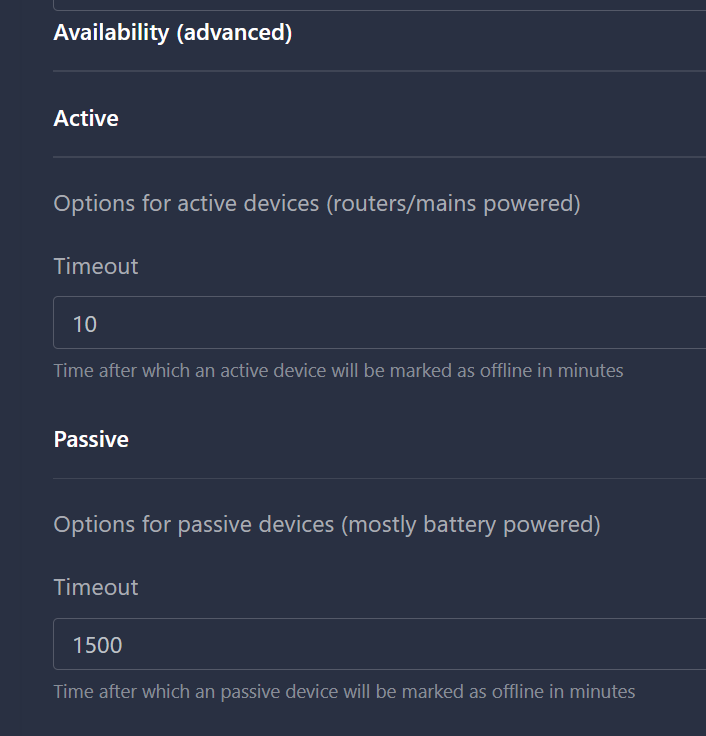
That “long time” is configurable in both ZHA & Z2M and can be set separately for mains and battery powered devices:

Z2M:

ZHA:

Eureka !!
I have VERY high hopes for this upcoming device–

-Very good price point (about $70-$100, depending on options)
-runs ESPHome (certified as Made for ESPHome)
-POE power & connectivity (or wifi or USB)
-multiple mounting options: ceiling flush-mount, in-wall in electrical gang box, or freestanding desktop/shelf.
-Allows for TWO mmWave sensors: one for motion/position tracking, one for presence (bodies at rest)
-lux & UV sensors
-option for CO2 / temperature / humidity sensors
-RGB LED’s
-buzzer/chime --programmable, using RTTL
-GPIO socket for additional IO (incl. probably I2C & such sensors)
-Bluetooth tracking
-Bluetooth Proxy

I so much want these things to work out!

I did find one sort-of-similar device a few months ago: It’s a multi-sensor that doesn’t require batteries. In this case, it runs on 120V AC power, because it’s a smart outlet that directly replaces a regular AC outlet, & is loaded with sensors, including mmWave. It’s the InvisOutlet:

This one gets power fom AC mains, & communicates on wifi, using MQTT or Matter.

Unfortunately, the software side so far doesn’t deliver as well as the hardware. Some people are having success with it on Home Assistant, & some are not. Unfortunately I haven’t got mine connected yet.

But the idea is cool: no battery; lots of functionality packaged together into a unit in a place where you’ve already got a mounting hole in the wall and already have power. I’m going to keep working on mine.

1 Like

Can you share the board used?

Both devices look really nice, thanks for sharing.
The latter is no use for me because it has US standard outlets, and I live in Poland.
The Apollo one is really interesting. If it was a bit cheaper, I’d probably order a few right away, but for $70 base and additional cost for each sensor, it’s a bit expensive.

1 Like