After spending more time reading about similar projects, I think have a much better understanding of the approach you tried with the proximity sensor.
I believe the goal of the sensor is to detect the metal in the meter dial’s hand. Basically, the sensor “pulses” every time the metal part goes under it while water is running.
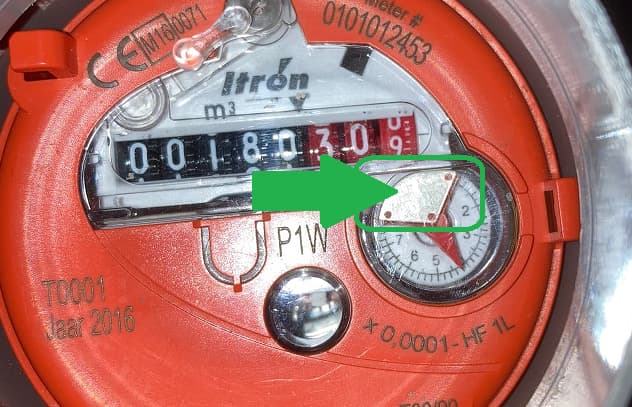
But for that to work, you need both:
- A piece of metal in the meter’s dial
- A sensor that is sensitive enough to detect the metal through the plastic / glass face of the meter
- A meter that is not fully metal, as it would always trigger the sensor
So for this reason, I believe it was never going to work for your NeoVac meter, because it does not have a metal part in its dial and your sensor is half as sensitive (4mm instead of 8mm) as the sensor that was successfully validated by Pieter Brinkman. And point #3 also means it would never work by pointing the sensor at the brass part of the meter, that was my mistake, I originally completely misunderstood how the sensor was meant to be used.
Flume and YDrip, on the other hand, take a different approach and try to detect variations in the magnetic field around the meter. On paper at least, this should be a more robust approach, as I believe that NeoVac meters should still have a magnet embedded somewhere to be able to send a pulse to the Superstatic (or equivalent).
I found online that there are some very cheap meters which are designed with the counting face of the meter being immersed in water. In these meters, it seems like everything is mechanical and they only use gears to rotate the numbers on the display. However, this is not the case for NeoVac’s meters, so I believe they must have some magnets inside to translate the rotation of the impeller on the wet side to something that can be measured and displayed on the dry side.
And assuming this magnet is strong enough generate a magnetic field that is not lost in the ambient magnetic noise, it is possible that it could be reliably measured from outside the meter. So that gives me hope that a hall effect sensor or a magnetoresistive sensor could work for that application.
And on that note, I’m off to research the most promising sensors for that approach. I just want to mention this thread, as they are basically doing the same thing but for a gas meter: Attempting to read an Elster ACM-250 dumb gas meter with a QMC5883L