I can put a few WS2812B LEDs in each lantern but I am struggling to find good options for all black, skinny, 4 core electrical cable that I can hang the lanterns from.
(I need VCC, GND, DI and DO)
Unifi sell cat6 compliant PoE compatible patch cables with an outer diameter of just 3mm:
So I feel like it must be possible to get a nice black/transparent 4 core cable with a <3mm outer diameter that should be cheaper than £6 for 8m (cost of Unifi’s Ethernet cable).
Why the 2812 LED? The lanterns are red, so why do you need color control?
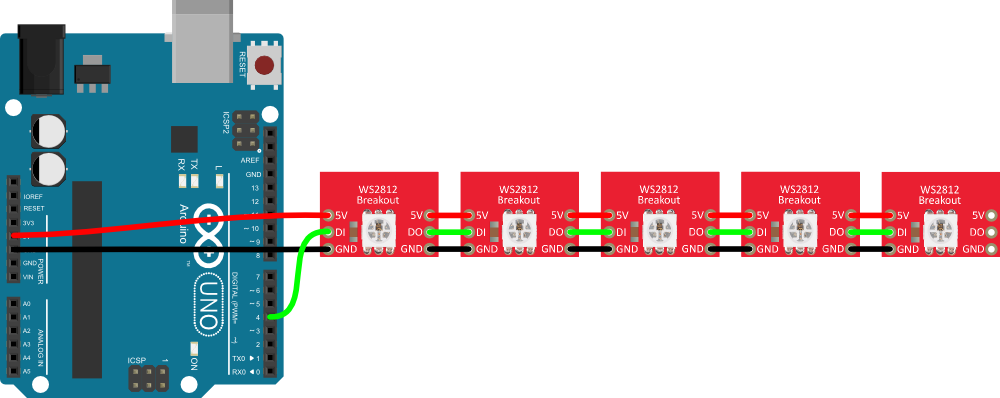
You only need three wires from the controller for any WS series LED. In a string or strip the controller sends data IN to Din and the LED sends data OUT via the Dout pin to the next LED’s Din pin.
If all you want to do is light the lanterns, just use a standard 5mm clear LED which only needs two wires. Or buy a fairy-light string and replace the battery with a 3V power source.
These are some good questions to which the answers are mostly “because overengineering”
I want them to flicker like real lanterns
I don’t want them all to flicker in sync so they need to be separately addressable
I want brightness control
So RGB isn’t essential, but addressability is. I was considering maybe having just 2 cores in the hanging wire and putting each one on a mosfet so I could generate a separate PWM for each lantern… or maybe having 3 cores and using WS2812 but not connecting the DO, then having some sacrificial LEDs in the ceiling IN parallel to advance the data signal to the next LED, that was a particularly silly idea…
Overall a 4 core hanging cable and using WS2812 seems the neatest way to achieve the effect flexibility that I’m looking for
That sounds like a cool effect. Why didn’t you start with this?
(Hmmm, got me to thinking about our Halloween decorations. We’re using candle LEDs but they aren’t bright enough to be seen).
If you are passing data to the next lantern, you still only need three wires. Why would you need a sacrificial LED? Just wire Do from the last LED in a lantern to Di of the first led in the next lantern.
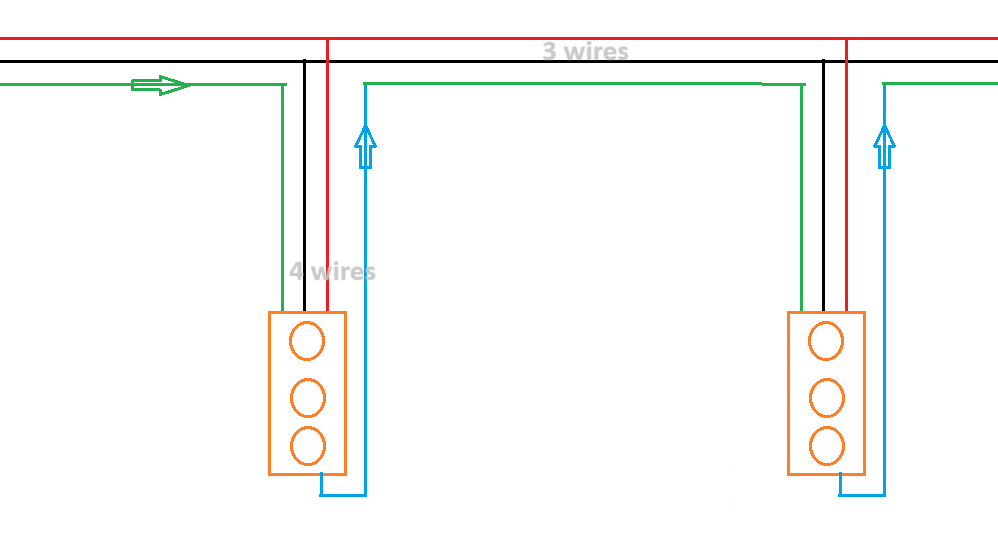
The fourth conductor would be the DO to the next lantern. If there are only three conductors then the lantern only receives a DI so you need a sacrificial LED in paralllel between this lantern and the next one so that the data signal is addressing the right set of LEDs. Anyway I think the answer is clear or black ultra thin USB cables.
Something else to consider is to get a hunk of (probably solid conductor) CAT5 cable, and strip the jacket off of it for a few feet. This will expose the individual twisted pairs; you could grab 2 of them and maybe wrap them around whatever the lamps are hanging from presently. They will be much lower profile than having the outer jacket present. If I were to try to do this, I’d probably get some heat shrink tubing and use that to affix the 2 pairs to the hanger string/wire in a few spots.
Its very easy to strip the jacket off the cable; peel back a little bit at the end, and use the string in there to cut the jacket as you pull it back. Do this before you get a few feet off the end of the cable so you just don’t pull the string out.
I don’t think this approach changes and decisions on how to assemble things electrically, soldering, etc. It’s mostly just a mechanical variation. Unfortunately, the twisted pairs all will have a white component that might be distracting? But maybe not?
You clearly don’t understand the WS2812 series of LEDs. There are three wires between the LEDs. There are three wires from the controller. There is no need for a sacrificial LED or for four wires.
I count 6 lanterns running up & down that stairwell in the image. That’s quite a long length for the couple of strands of copper you get in USB cables. The WS2812 seem to run on 5v, so voltage drop could be an issue with thin wires. Hell, it might even be an issue with solid Cat5.
@triblondon I suggest you use a voltage drop calculator. Quinled’s site has a bunch of info on the Wattage used and a link to a voltage drop calculator on that page.
Ultimately, your success will depend on a number of factors, some of which you haven’t shared here:
Conductor length. How long of a distance from the nearest power source to the last LED?
Conductor thickness. What’s the maximum conductor/cable thickness you would consider, before it’s no longer “skinny”?
Number of LEDs. How many LEDs in total or per lantern?
LED voltage. You might have to use 12v or 24v LEDs - are you comfortable with that?
Power injection. Are you willing/able to inject power at additional points if needed?
If you answer the above questions, maybe others here with way more knowledge than me could help you make the right choice.
To be honest my searching has not yielded any better solution than buying Ubiquiti’s thin cat6 cables. I know these are high quality and the fact that they terminate in well moulded RJ45 plugs might offer a useful way of connecting them all together. An 8 meter one is 6.60 GBP, which is actually amazingly competitive vs just buying 4 core wire on a reel - and 4 core wire with an external diameter of no more than 3mm seems hard to find.
I actually have around 30 lanterns in total, but I’m not too worried about voltage drop since the number of LEDs in each lantern might well be as few as one, and power injection is happening between each lantern (plus the 3-core cable between each drop will be thicker). I guess I’ve never tried WS2812 with long runs of cable on the data line, so we will see if that is a problem, but since the current is tiny, I am hoping it will be ok.
Data line is regenerated by every LED, so it doesn’t degrade at all.
Usually people stress too much about current with these LEDs while actually almost no-one drives them simultaneously at full power.
I made 300+ LED strip for my daughter and for testing powered it from 2A supply. Never bothered to upgrade the PSU, it’s working just fine.
Can we just agree that this is not the same as your previous image.
Your previous image was parallel and this is serial.
Secondly:
How do you attach the cable to the LED?
With glue?
No you cut it and solder it.
You don’t have long USB micro cables laying around from when that was the charging cable for phones?
I have used many old cables for new things.
I’m not going to need that many USB micro ever again…
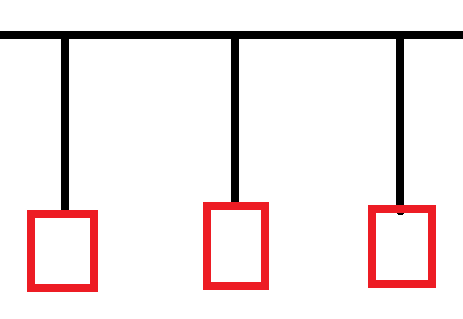
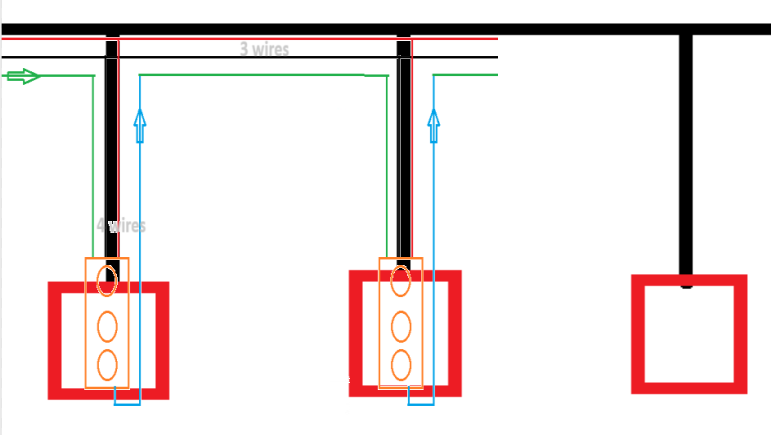
No, it was just presentation of wiring where horizontal line is running on ceiling from lamp to lamp and vertical lines are the wires where lantern is hanging.
In both images the wiring is same, parallel power and serial data.
And now you posted a picture where you need four wires.
That’s the key.
Your previous image made it look like three wires was enough.
I just wanted to clear things up since the image can be interpreted as a fork parallell three wire (vcc, and, data) would work.
That works when you can wire from one to the next as the image Stephen posted but since the wire needs to go up then down to the next lantern then four wires is more efficient.
Just want to clear things up since there has been discussions about three wires.