I installed smart lights throughout my house but I miss the tactile feel of switches. It’s just not very satisfying to open an app / use a touch screen / use voice commands to turn lights on and off.
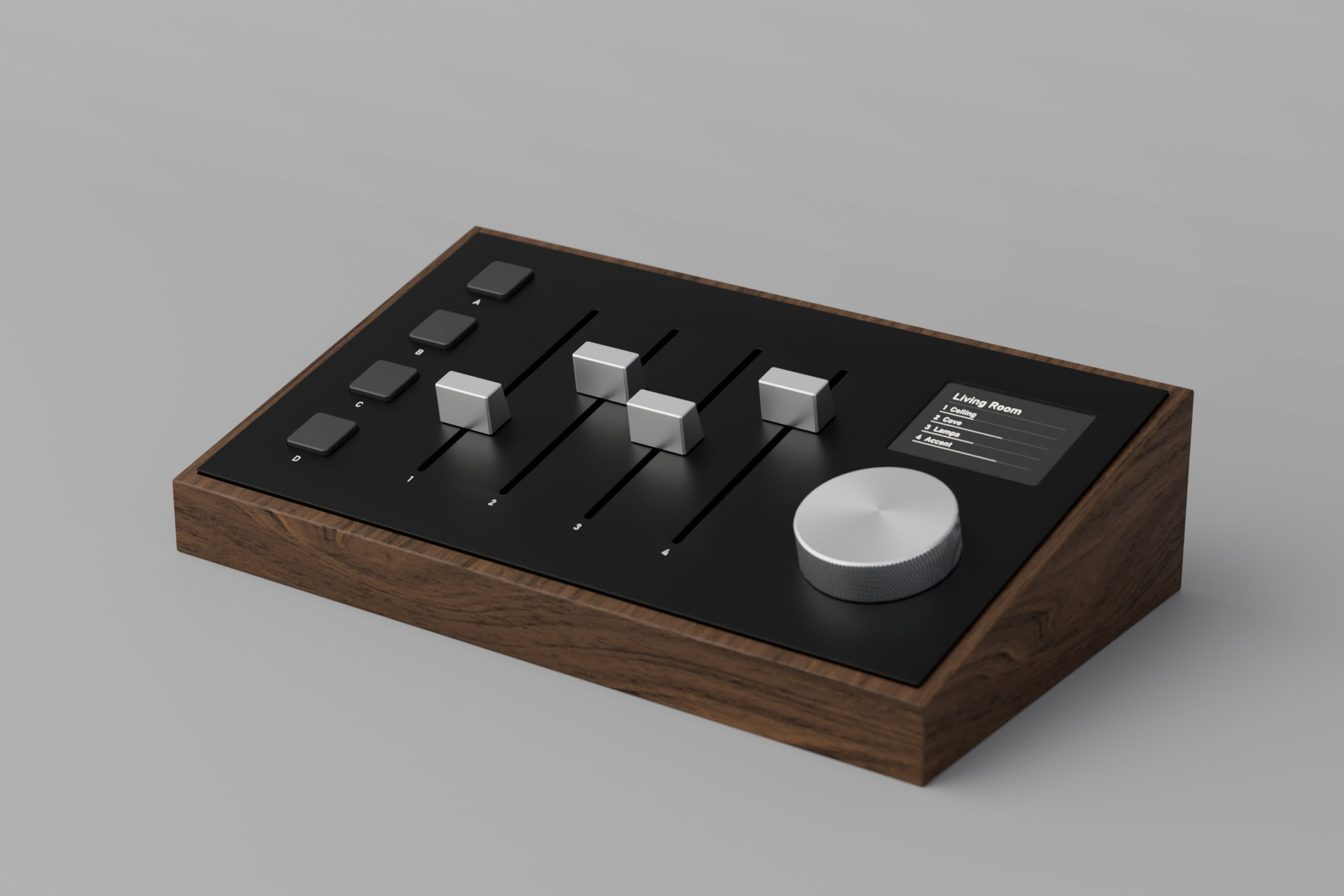
So my idea is to build myself a console with faders to control my house lights. I obviously can’t have one static fader per light, so I’m adding a rotary encoder to cycle through light banks (and a small screen to visualize what bank I’m on). So I can basically control all lights by groups of 4. I’m going to use motorized faders so that when I cycle the faders automatically move to the current light setting. This also means the console will move on its own when I dim the lights from elsewhere, which I think will be pretty cool.
I want this to be a beautiful object, so my thinking is aluminum faceplate and walnut housing (I have a CNC at home that can do much of the heavy lifting). Here’s a rendering of what I have in mind. The 4 extra buttons are for mood presets:
My plan is to use an esp32, a 2.4 inch amoled screen, Alps Alpine Faders, a Bourns rotary encoder, and some MX key buttons.
Has anyone ever tried something like this before and have tips on implementation? I ordered a few different motorized faders to experiment with them, but I’m finding them hard to source (ended up ordering some expensive Alps Alpine ones). Curious if anyone has had any experience with those or cheaper China imports?
Also, for those of you far along in your home automation journey, what else should I add now to my console / what other than lights might I want to control with it down the road?
In an old house I lived in many years ago there was a console in the kitchen wall, with smaller ones for each room and the front door. Doorbell, transistor radio, two way intercom, front door unlock, and piped music from a small cassette player you could slot a cassette into. Ridiculous amount of buttons on the front, and multiway cables to each room. Each other room had a button for the intercom, a volume control and switches so you could unlock the front door and talk to other rooms. The audio was always with a bit of hum, and scratchy, but hey, it worked! I suspect the amount of copper wiring actually held the house together. I think the technology was from the 1960’s or '70s. You would find the cabling cost alone too expensive these days, and wireless would be the way to go.
You may need a touch control panel with a displayed switch matrix that is touch sensitive to select which light to control, that changes the background depending on what you are controlling, rather than having hard wired push switches. You could also extend it to control the mood music and fan speed control for each room, and maybe a switch for selecting TV channel and setting volume as well. This would dispense of the individual sliders and switches, so the rotary wheel with internal press button could do the job combined with a screen.
It could be battery powered, but I suspect it would be in the charger base a lot of the time if you are going to use an ESP32, a touch panel screen with backlighting, and motorized sliders.
Intercom from room to room is pretty cool. I would have loved that as a kid growing up… Infinite prank and play opportunities with the siblings. I bet it worked better than my google home broadcast too… Must have been a super high end setup if it dates back to the 70s.
My idea is that the rotary knob is the main way to cycle light banks. The buttons would be for mood presents of a given light bank (e.g. nighttime, daytime, cosy, etc.). My goal is to map as much of the core interactions to physical controls as possible. I do plan on having a touch screen though, it will open up a number of options (e.g. setup, save a light preset, switch from controlling lights to something else, etc.). I like your suggestions, I don’t have fans at home but I could see how that would be neat. Controlling audio is top of mind too.
Battery is tempting but the fader motors will be hungry, so I’ve made peace with it. And part of the idea is to make this a room or desk fixture like a nice amp or A/V device.
The one you turn, and then press to confirm your selection? Optical for longevity?
My neighbour has an alternate way to call the teenagers to the dining room for dinner. She unplugs the WiFi access point! The howls…
In true hacker spirit, it needs to be able to play Doom on it. Sound effects optionally controlled by the inbuilt volume control too.
Could you have a touch sensitive surface display, maybe under a very thin layer of smoked perspex for cool looks and fingerprint free, and project your controls on the screen and swipe them.instead? A flat sided object, no protruding knobs, passive until tickled to spring to life. Twiddle your thumb over a circle to rotate it, slide it over a bar to adjust the volume, and tap on a square to press the button. Change the text and colors for feedback, or even a green tick stamp over the top to indicate command has been received and actioned.
@toszlanyi For sure a midi controller would already go a long way:) It was my starting point actually. But I want to avoid having a computer in the loop. I also want the motorized faders so I watch them snap to position when lights are controlled from elsewhere or when I change bank. Also want to build this in a way my wife will tolerate it in the living room
Yes, I’m playing with optical encoders with a press button. What I have in mind is attaching a small haptic LRA so that I can simulate detents (when toggling light banks) but also have a smooth operations for things like volume. Ambitious, I’ll see if it actually works.
Solid move! That deserves a dedicated physical switch in the kitchen. I’ve always wanted to have a decibel meter so my kids can see they’re too loud. Maybe I can bundle both for the next project
Now we’re talking. Rotary button to turn, faders to move, buttons on the left to fire. This must be done.
A flat screen would be the rational move, and you could certainly build something elegant that way. But swiping glass just doesn’t register the same way for me. It’s why I don’t particularly enjoy using my phone to control my lights. There also something to be said about being able to adjust lights without having to read a UI. That said my idea for the screen is what you describe - dead front behind dark glass so that it fades away when not in use.
Naah, she grins, gives that plug a solid yank, with an evil flourish, prefixed by “watch this” and starts counting the seconds. Never fails. She’s got them well trained!
@Thyraz Thank you! I’ll post updates here as I go along. Waiting for a boatload of electronics I ordered (turns out sourcing those faders was not easy!), and should get to work on this in earnest in a week.
One idea that came in my mind:
A wide, but low display that spans the whole width of the faders.
But most likely not a form factor that is easy to find.
That way you would be able to show indicators above each fader.
Like icons for lights in that mode, or frequency of the fader in equalizer mode and so on …
And maybe a proximity sensor to turn on the display only when needed.
Way too busy with other projects at the moment,
but the more I think about it, the more I have the feeling that I need to build something like this at a later time.
A screen spanning the faders would be awesome and its something I’ve looked into a bit. There are screens available in formats that would work (6.9″ ‘stretched bar’ LCDs, ~175×34mm, sold with HDMI driver boards for PC case mods). It looks like these screens can’t be driven by a regular ESP32-S3 (need a R-Pi class device) because they are controlled through MIPI-DSI/HDMI vs QSPI. So definitely doable, but adds a bit of complexity and cost. So my thinking is build with a single screen to start, add a second screen if the UX feels clumsy.
I really like your idea of a proximity sensor to wake the display on approach, I think I’m going to try that.
Let me know if you do end up building something like that as well, would be great to have someone to share ideas with!