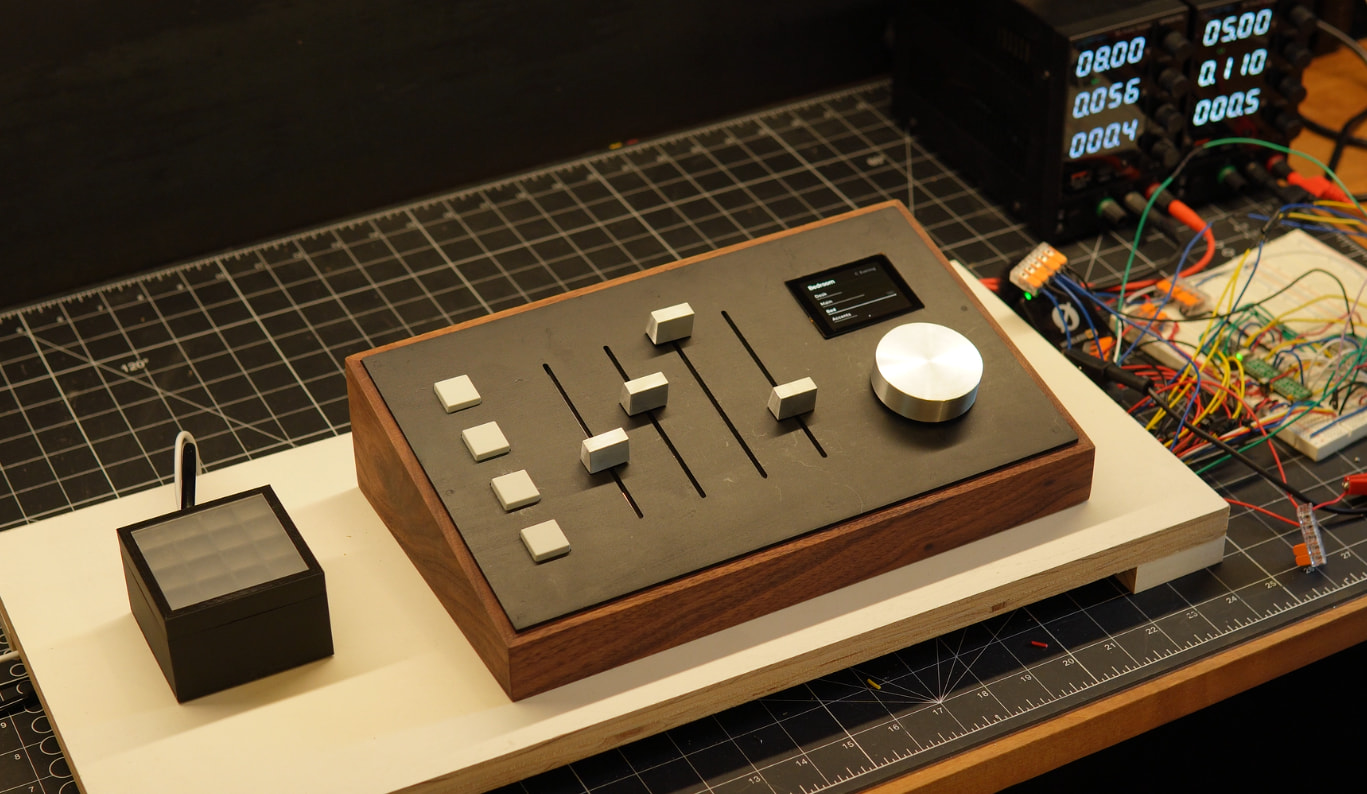
Alright, I now have a functioning prototype of my house lights control console! Here’s a video of it in action: https://www.youtube.com/watch?v=P0wlPy0ad0s
How it works / what it does:
The console allows you to control all your smart lights, 4 at a time (individually or as groups). The rotary knob lets you scroll through light banks, which then assigns 4 lights (or groups) to the faders. The faders are motorized, so they move to match the light’s current level. Change a light from the app or an automation, and the faders follow. All of it works through HA.
I also added buttons for light presets. For now the buttons get assigned alongside light banks, so you get four presets per room/bank (e.g. full on, cozy, night mode, all off).
Hardware
I am a big fan of old school AV equipment aesthetics. To me that means: great physical affordances, minimalist design, and premium materials. So I went for a walnut chassis, an aluminum faceplate (the one you see is painted wood, I’ve yet to make an aluminum one), custom aluminum fader caps and rotary knob (my shapeoko sort of hated me for doing those parts, and that feeling was mutual). The knob is massive (5.5cm across, nearly 100g, mounted on an optical rotary encoder, I freaking love it!). The keycaps are from a custom keyboard cap maker (Signature Plastics).
Electronics
I’m controlling everything through 2 ESP32s. One is dedicated to the inputs (faders, rotary encoder, buttons), the other to the screen and the HA connection. Having a dedicated ESP for the inputs allows me to read fader positions fast enough for closed loop control.
Faders: I’m using Alps Alpine faders and though they’re great they need to be babied into homing precisely. So far I’ve been able to pull off using the ESP32’s onboard ADC for this. I also tried using a dedicated ADC (ADS1115), but I haven’t found that the higher accuracy it provided was worth the lower sampling speed. I’m not done with fine tuning yet, sometimes the faders still overshoot their positions a little before self correcting, but I think I can iron that out without extra hardware. I’m not using FaderBuddy because Scott’s board is built around a different fader but shoutout to the project. If you’re building something like this yourself, I’d seriously consider it.
Rotary encoder: Not much to say here, outside damn good quality optical encoders are expensive (~30 bucks for a Bourns encoder). It works beautifully though, both mechanically (very smooth motion) and it’s very consistent, which makes using the knob super enjoyable.
Screen: I’m using a 2.41 AMOLED touch screen. It’s a bit on the small side IMO, but the next size up I found is huge ~4inch in that format. I’m not using the touch functionality for much yet, I don’t want to overly rely on it (the whole point is physical affordances), but I think it will come in handy for a few things. Right now I just use it to toggle between bank view and presets view.
Up Next
Faceplate: I’m going to get an anodized aluminum fabricated (I could do the milling, but not the anodizing)
Haptics: I want to play around with adding an LRA to the rotary knob, mostly to simulate detents when cycling banks.
Motor fine tuning: Lots of features to be added to the fader controls, from smoother motion to snap to position (for lights that can’t fade for example)
PCB: I’m going to have to shrink the electronics to fit in the console, so this means custom PCB, plus proper mounting for everything and proper power/USB input.
I’ve grown to really like this project, enough that I’m toying with making a small series. It wouldn’t be cheap (the faders alone are ~$30+ each - thanks tariffs - and there’s a lot of machined aluminum), so it will depend on whether there’s actual interest, we’ll see. Curious what you all think of it as a small commercial project, and happy to answer any questions about the build!