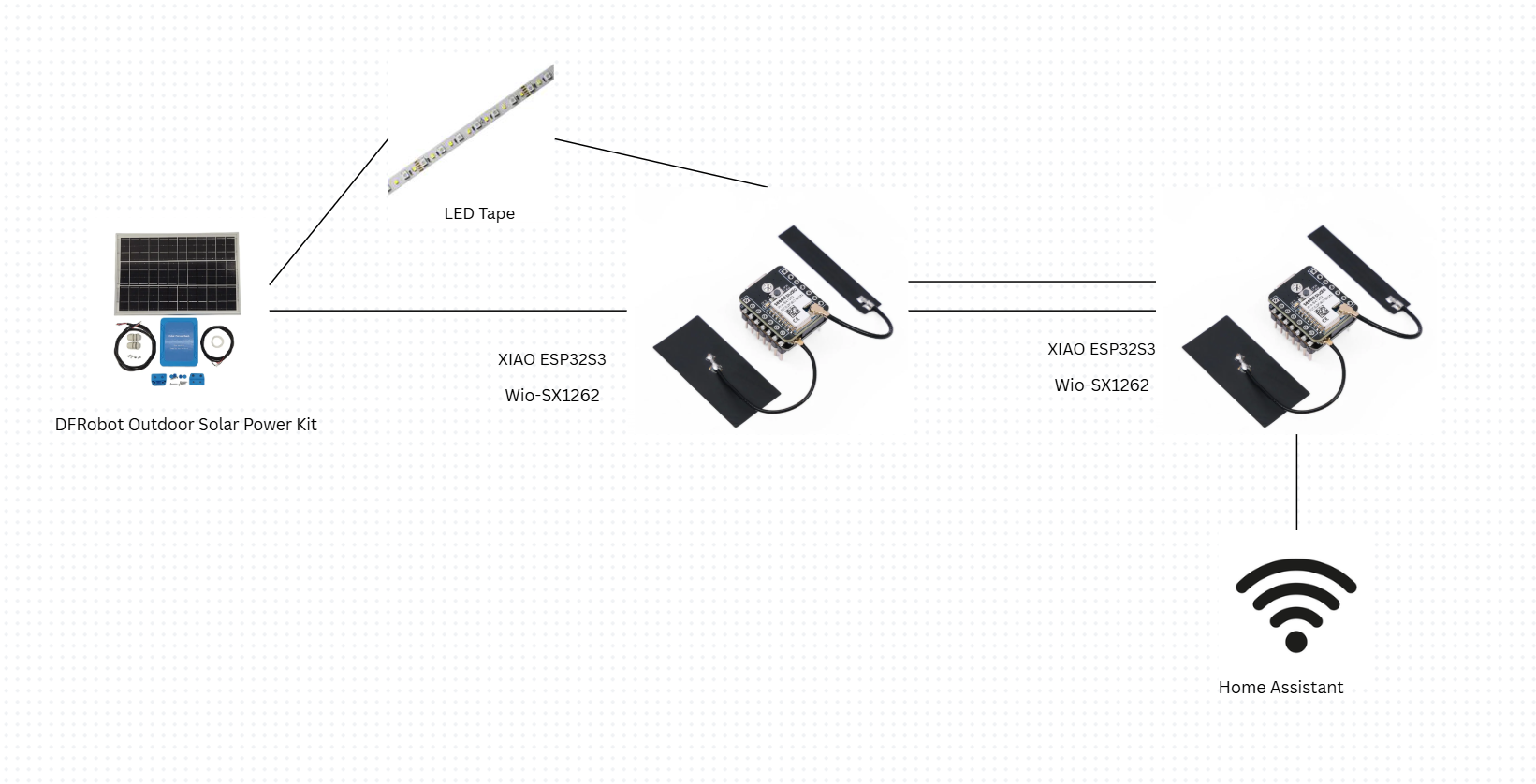
From a basic stand point it could work, but you’ve provided very little detail… what are you actually trying to light?
Different types of strips can consume significantly different amounts of power… standard 3528’s run a little under 5W/m, while the a standard density 5050 can consume nearly 3 times that.
And, that battery pack isn’t storing a huge amount to begin with. Ten amps would be plenty if it was just running the ESP32 overnight. But I think you’d be lucky to get 90 minutes of light even with just a meter of 3528’s… And that’s only going to provide about 700 lumens.
The basic concept looks good. I haven’t used LoRa or a LED strip yet myself; but my greenhouse project requires solar panel, LiPo battery and deep_sleep to conserve power on the ESP32-S3.
Are you doing this mostly as a learning exercise ? If so, that’s excellent … because there are a lot of factors to consider which aren’t always obvious, and even harder to quantify. Factors include:
have you looked up the operating power required for the LED strip, the XIAO ESP32S3 7 Wio-SX1262, and any other components ?
Will the remote (battery operated) ESP32-S3 be required to be powered and listening to LORA all the time ? How much power will this consume per 24 hours ? I note the XIAO ESP32S3 has battery connector on the board’s underside, which suggests to me that the XIAO ESP32 probably uses low-power components.
How many hours of “strong sunlight” do you expect every day ? The eight hours which DFRobot mentions sounds awfully optimistic, as does the 10W of power generated. In the real world we have clouds and even rain - but also we don’t want to run the battery flat every day.
How long do you expect the LED strip will be lit each night ? Would it be feasible to limit the operation hours, or add a motion sensor ? If it will only be operating at night, could you put the ESP32 into deep-sleep during the daylight hours ?
Are you OK with the remote ESP32 and LED strip to just turn off when the battery reaches its over-discharge protection ? This is the tricky one. since the battery output is buck/boosted to give steady 12V and 5V, it is not possible to know how much charge is physically in the battery … until suddenly there is not enough
There rarely is a clear answer to many of these, so expecting to get it right first time - for your application in your environment - is asking for disappointment.
Didgeridrew - I’m running 60cm of 5050 LED tape. I’ll also only run the LED’s around 5% for sunset-midnight with short bursts of full power. I’ve done power calcs and I think the solar panel should have more than enough capacity to make it through all but the bleakest winters.
@Karosm - I looked into wifi solutions but from what I could understand, anything using wifi would consume too much power. I could probably point an AP in the direction so I think signal would be fine if there was a low power wifi based solution.
@donburch888 - Your greenhouse project sounds incredible similar functionally. I’m also planning on using deep_sleep to conserve power. This is functional, but it’s definitely a learning exercise at the same time. I could just buy a cheap simple solar light off Amazon to solve this problem, but then I wouldn’t have that remote control which feels like a fun challenge to solve. I mention power above- I did some calcs and i think it should work. At the end of the day, if there’s no sun, solar can’t work, so I just stick what feels like enough headroom on it and if it doesn’t work, I guess that’ll be a learning opportunity!
I’ve done lots of work before with LED tape and low voltage stuff, but the LoRa & ESP32’s are completely new territory to me!
Low power wifi means mainly sleeping , only occasionally connected.
But Espnow suites here much better and have more range, no additional hardware needed.