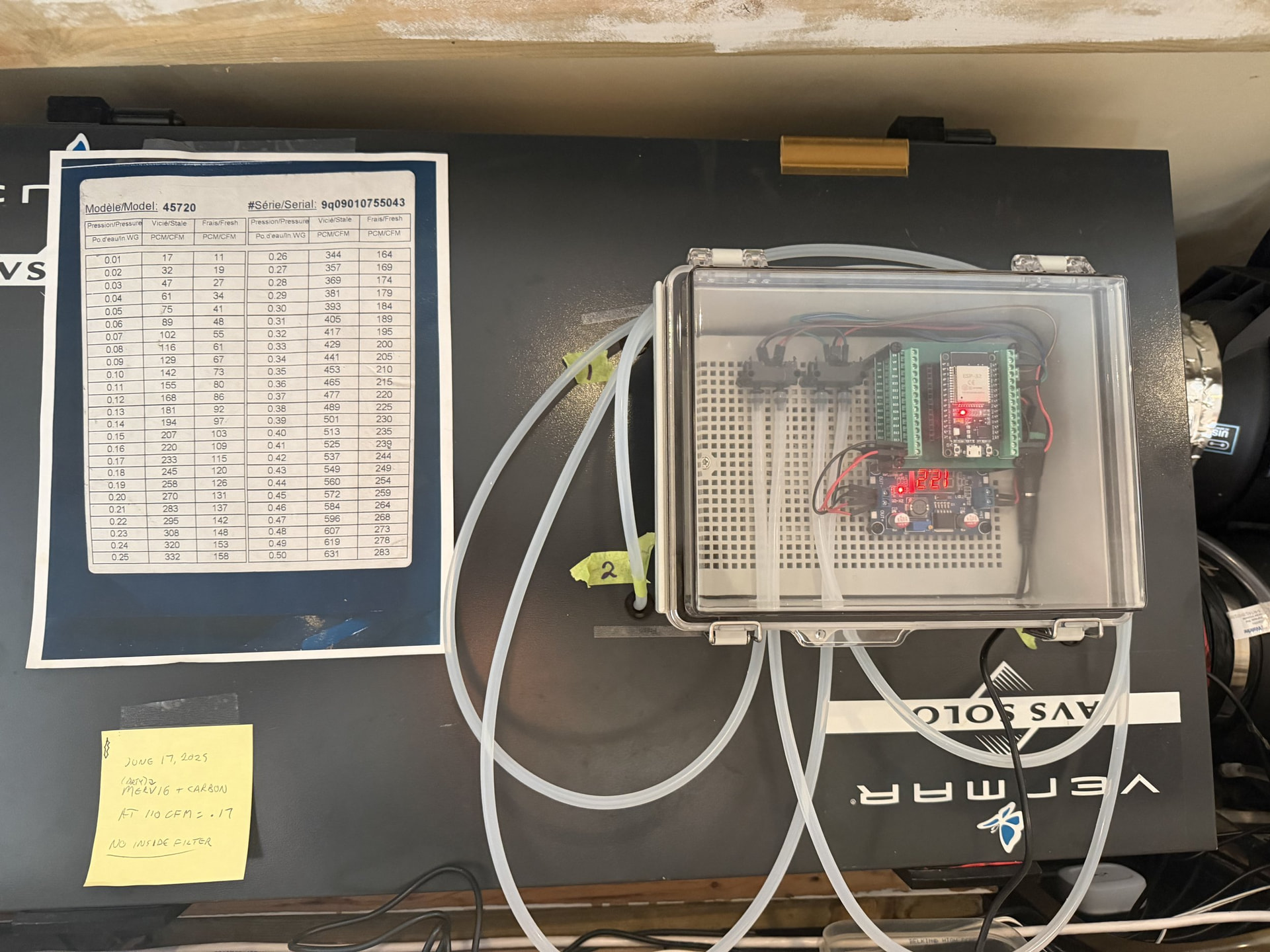
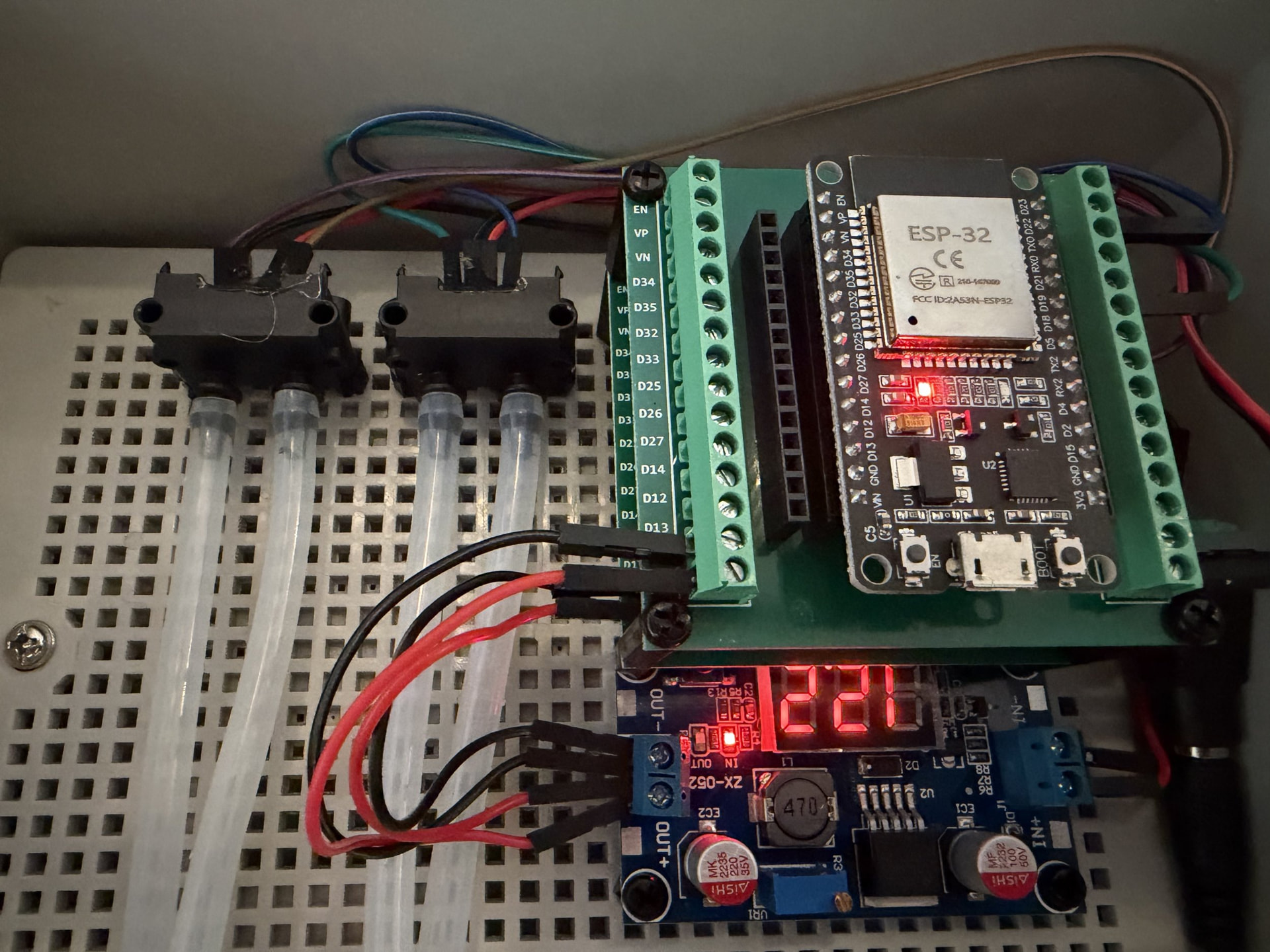
One ESP32 for each sensor, and a 12V to 5V power buck to power both.
I used ChatGPT pretty much for all setup and coding…
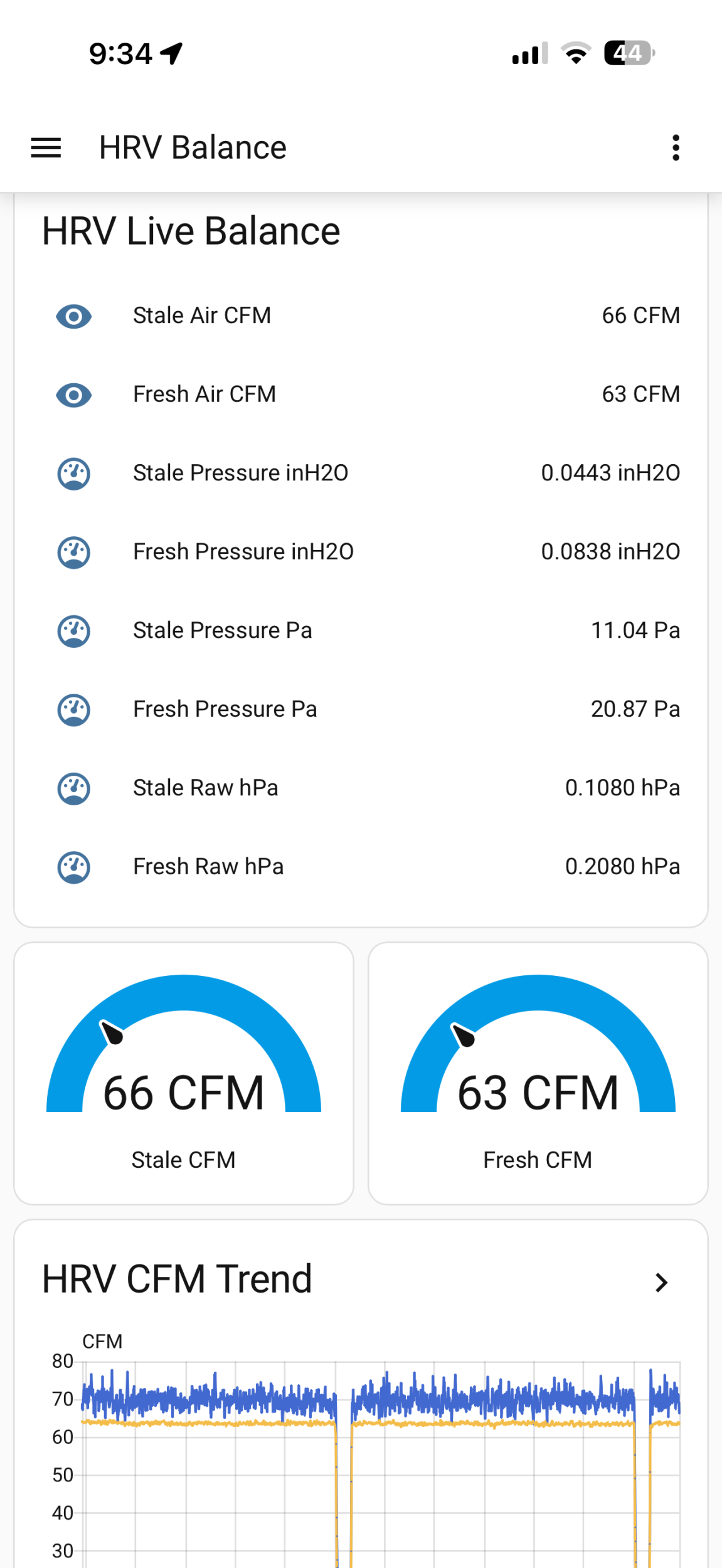
For stale air sensor here is the YAML code. A table is used to convert manufacturer pressure readings to CFM values for this HRV. You could edit these tables to reflect your own unit if doing a similar project. Most units have a this data on a sticker attached to the unit, or in the manual.
# Board: DOIT ESP32 DEVKIT V1 / ELEGOO ESP32 CP2102
# Device: HRV pressure sensor #1
# Sensor: Sensirion SDP810 / SDP8xx I2C differential pressure sensor
# Port use: STALE / VICIÉ air ports
# I2C address detected: 0x25
#
# ESPHome sdp3x publishes pressure in hPa.
# 1 hPa = 100 Pa
# 1 hPa = 0.401463 inH2O
#
# Model 45720 table:
# Sensor 1 uses STALE / VICIÉ CFM column.

esphome:
  name: hrv-pressure-1
  friendly_name: HRV-Pressure-1

esp32:
  variant: esp32
  flash_size: 4MB
  framework:
    type: esp-idf
    advanced:
      minimum_chip_revision: "3.1"
      sram1_as_iram: true

logger:

api:
  encryption:
    key: "Use your own key API Key!"

ota:
  - platform: esphome

wifi:
  ssid: !secret wifi_ssid
  password: !secret wifi_password

  ap:
    ssid: "HRV-Pressure-1 Fallback Hotspot"
    password: "Use your own password!"

captive_portal:

i2c:
  sda: GPIO21
  scl: GPIO22
  scan: true

sensor:
  # Raw SDP sensor value.
  # ESPHome sdp3x publishes this in hPa.
  - platform: sdp3x
    name: "HRV Pressure 1 Differential Raw hPa"
    id: hrv_pressure_1_hpa
    address: 0x25
    measurement_mode: differential_pressure
    update_interval: 1s
    unit_of_measurement: "hPa"
    device_class: pressure
    state_class: measurement
    accuracy_decimals: 4
    filters:
      - sliding_window_moving_average:
          window_size: 5
          send_every: 1
          send_first_at: 1

  # Converted to Pa.
  - platform: template
    name: "HRV Pressure 1 Differential Pa"
    id: hrv_pressure_1_pa
    unit_of_measurement: "Pa"
    device_class: pressure
    state_class: measurement
    accuracy_decimals: 2
    update_interval: 1s
    lambda: |-
      if (isnan(id(hrv_pressure_1_hpa).state)) {
        return NAN;
      }
      return id(hrv_pressure_1_hpa).state * 100.0;

  # Converted to inches of water column.
  - platform: template
    name: "HRV Pressure 1 Differential inH2O"
    id: hrv_pressure_1_inh2o
    unit_of_measurement: "inH2O"
    device_class: pressure
    state_class: measurement
    accuracy_decimals: 4
    update_interval: 1s
    lambda: |-
      if (isnan(id(hrv_pressure_1_hpa).state)) {
        return NAN;
      }
      return id(hrv_pressure_1_hpa).state * 0.401463;

  # Model 45720 STALE / VICIÉ CFM lookup table.
  - platform: template
    name: "HRV Stale Air CFM"
    id: hrv_stale_air_cfm
    unit_of_measurement: "CFM"
    state_class: measurement
    accuracy_decimals: 0
    update_interval: 1s
    lambda: |-
      if (isnan(id(hrv_pressure_1_inh2o).state)) {
        return NAN;
      }

      float x = fabs(id(hrv_pressure_1_inh2o).state);

      static const float p[] = {
        0.01, 0.02, 0.03, 0.04, 0.05,
        0.06, 0.07, 0.08, 0.09, 0.10,
        0.11, 0.12, 0.13, 0.14, 0.15,
        0.16, 0.17, 0.18, 0.19, 0.20,
        0.21, 0.22, 0.23, 0.24, 0.25,
        0.26, 0.27, 0.28, 0.29, 0.30,
        0.31, 0.32, 0.33, 0.34, 0.35,
        0.36, 0.37, 0.38, 0.39, 0.40,
        0.41, 0.42, 0.43, 0.44, 0.45,
        0.46, 0.47, 0.48, 0.49, 0.50
      };

      static const float cfm[] = {
        17, 32, 47, 61, 75,
        89, 102, 116, 129, 142,
        155, 168, 181, 194, 207,
        220, 233, 245, 258, 270,
        283, 295, 308, 320, 332,
        344, 357, 369, 381, 393,
        405, 417, 429, 441, 453,
        465, 477, 489, 501, 513,
        525, 537, 549, 560, 572,
        584, 596, 607, 619, 631
      };

      const int n = sizeof(p) / sizeof(p[0]);

      if (x <= 0.0) {
        return 0.0;
      }

      if (x <= p[0]) {
        return cfm[0] * (x / p[0]);
      }

      if (x >= p[n - 1]) {
        return cfm[n - 1];
      }

      for (int i = 0; i < n - 1; i++) {
        if (x >= p[i] && x <= p[i + 1]) {
          float ratio = (x - p[i]) / (p[i + 1] - p[i]);
          return cfm[i] + ratio * (cfm[i + 1] - cfm[i]);
        }
      }

      return NAN;
And for the 2nd (Fresh Air stream) sensor, similar:
# Board: DOIT ESP32 DEVKIT V1 / ELEGOO ESP32 CP2102
# Device: HRV pressure sensor #2
# Sensor: Sensirion SDP810 / SDP8xx I2C differential pressure sensor
# Port use: FRESH / FRAIS air ports
# I2C address detected: 0x25
#
# ESPHome sdp3x publishes pressure in hPa.
# 1 hPa = 100 Pa
# 1 hPa = 0.401463 inH2O
#
# Model 45720 table:
# Sensor 2 uses FRESH / FRAIS CFM column.

esphome:
  name: hrv-pressure-2
  friendly_name: HRV-Pressure-2

esp32:
  variant: esp32
  flash_size: 4MB
  framework:
    type: esp-idf
    advanced:
      minimum_chip_revision: "3.1"

logger:

api:
  encryption:
    key: "insert your own key!"

ota:
  - platform: esphome

wifi:
  ssid: !secret wifi_ssid
  password: !secret wifi_password

  ap:
    ssid: "HRV-Pressure-2 Fallback Hotspot"
    password: "Use your own password!"

captive_portal:

i2c:
  sda: GPIO21
  scl: GPIO22
  scan: true

sensor:
  # Raw SDP sensor value.
  # ESPHome sdp3x publishes this in hPa.
  - platform: sdp3x
    name: "HRV Pressure 2 Differential Raw hPa"
    id: hrv_pressure_2_hpa
    address: 0x25
    measurement_mode: differential_pressure
    update_interval: 1s
    unit_of_measurement: "hPa"
    device_class: pressure
    state_class: measurement
    accuracy_decimals: 4
    filters:
      - sliding_window_moving_average:
          window_size: 5
          send_every: 1
          send_first_at: 1

  # Converted to Pa.
  - platform: template
    name: "HRV Pressure 2 Differential Pa"
    id: hrv_pressure_2_pa
    unit_of_measurement: "Pa"
    device_class: pressure
    state_class: measurement
    accuracy_decimals: 2
    update_interval: 1s
    lambda: |-
      if (isnan(id(hrv_pressure_2_hpa).state)) {
        return NAN;
      }
      return id(hrv_pressure_2_hpa).state * 100.0;

  # Converted to inches of water column.
  - platform: template
    name: "HRV Pressure 2 Differential inH2O"
    id: hrv_pressure_2_inh2o
    unit_of_measurement: "inH2O"
    device_class: pressure
    state_class: measurement
    accuracy_decimals: 4
    update_interval: 1s
    lambda: |-
      if (isnan(id(hrv_pressure_2_hpa).state)) {
        return NAN;
      }
      return id(hrv_pressure_2_hpa).state * 0.401463;

  # Model 45720 FRESH / FRAIS CFM lookup table.
  - platform: template
    name: "HRV Fresh Air CFM"
    id: hrv_fresh_air_cfm
    unit_of_measurement: "CFM"
    state_class: measurement
    accuracy_decimals: 0
    update_interval: 1s
    lambda: |-
      if (isnan(id(hrv_pressure_2_inh2o).state)) {
        return NAN;
      }

      float x = fabs(id(hrv_pressure_2_inh2o).state);

      static const float p[] = {
        0.01, 0.02, 0.03, 0.04, 0.05,
        0.06, 0.07, 0.08, 0.09, 0.10,
        0.11, 0.12, 0.13, 0.14, 0.15,
        0.16, 0.17, 0.18, 0.19, 0.20,
        0.21, 0.22, 0.23, 0.24, 0.25,
        0.26, 0.27, 0.28, 0.29, 0.30,
        0.31, 0.32, 0.33, 0.34, 0.35,
        0.36, 0.37, 0.38, 0.39, 0.40,
        0.41, 0.42, 0.43, 0.44, 0.45,
        0.46, 0.47, 0.48, 0.49, 0.50
      };

      static const float cfm[] = {
        11, 19, 27, 34, 41,
        48, 55, 61, 67, 73,
        80, 86, 92, 97, 103,
        109, 115, 120, 126, 131,
        137, 142, 148, 153, 158,
        164, 169, 174, 179, 184,
        189, 195, 200, 205, 210,
        215, 220, 225, 230, 235,
        239, 244, 249, 254, 259,
        264, 268, 273, 278, 283
      };

      const int n = sizeof(p) / sizeof(p[0]);

      if (x <= 0.0) {
        return 0.0;
      }

      if (x <= p[0]) {
        return cfm[0] * (x / p[0]);
      }

      if (x >= p[n - 1]) {
        return cfm[n - 1];
      }

      for (int i = 0; i < n - 1; i++) {
        if (x >= p[i] && x <= p[i + 1]) {
          float ratio = (x - p[i]) / (p[i + 1] - p[i]);
          return cfm[i] + ratio * (cfm[i + 1] - cfm[i]);
        }
      }

      return NAN;
HA’s configuration.yaml needed these bits added:
input_boolean:
  hrv_auto_balance_enabled:
    name: HRV Auto Balance Enabled
    icon: mdi:air-filter

input_select:
  hrv_target_stage:
    name: HRV Target Airflow
    options:
      - "50"
      - "60"
      - "75"
      - "90"
      - "100"
      - "110"
    initial: "50"
    icon: mdi:fan

input_number:
  hrv_balance_deadband_cfm:
    name: HRV Balance Deadband
    min: 0
    max: 20
    step: 1
    initial: 3
    unit_of_measurement: CFM
    mode: box

template:
  - sensor:
      - name: "HRV CFM Difference"
        unique_id: hrv_cfm_difference
        unit_of_measurement: "CFM"
        state_class: measurement
        state: >
          {% set stale = states('sensor.hrv_pressure_1_stale_air_cfm') | float(0) %}
          {% set fresh = states('sensor.hrv_pressure_2_fresh_air_cfm') | float(0) %}
          {{ (stale - fresh) | round(1) }}

      - name: "HRV Balance Percent"
        unique_id: hrv_balance_percent
        unit_of_measurement: "%"
        state_class: measurement
        state: >
          {% set stale = states('sensor.hrv_pressure_1_stale_air_cfm') | float(0) %}
          {% set fresh = states('sensor.hrv_pressure_2_fresh_air_cfm') | float(0) %}
          {% if fresh > 0 %}
            {{ (((stale - fresh) / fresh) * 100) | round(1) }}
          {% else %}
            0
          {% endif %}

      - name: "HRV Balance Status"
        unique_id: hrv_balance_status
        state: >
          {% set difference = states('sensor.hrv_cfm_difference') | float(0) %}
          {% set deadband = states('input_number.hrv_balance_deadband_cfm') | float(3) %}
          {% if difference > deadband %}
            Stale Air High
          {% elif difference < (deadband * -1) %}
            Fresh Air High
          {% else %}
            Balanced
          {% endif %}