The auto-updater is real, and it’s here for everyone!
All you need to replicate what I have is:
A couple decades of coding experience.
At least 3 months of day and night AI experience.
A ridiculously expensive 20x AI plan.
Balls of steel (yolo on the updates).
Then you ask the AI to build you an updater, and there you have it! Home Assistant’s auto-updater is real!
Also works with Zigbee, Z-Wave, TrueNAS, whatever. It’s all here!
No more pressing the update button hoping for the best, it even does a backup before updating just like you would! At least, that’s what the AI told me it did based on my prompt.
Saw, respectfully… No way in hell I’m doing this and I’d advise you to rethink it… It goes 180 degrees against so many best practices in. AI dev and simple IT ops.
I CAN and have had the ability to let Friday do this for about 6 months and there is simply currently no way to do this with an acceptable risk. I enabled the tools to allow an agent to run an update on a human in loop request… But under no circumstance am I driving updates with an LLM… (try it if you’re running zenos you can absolutely ask about what updates you have and ask the agent to apply them but not auto…) But you do you… It only takes one time when it ‘forgot’ to back up.
These kinds of things should be deterministic and reported on by llm not. Driven by…
Nice try. You apparently have missed my 24 month project..(seriously this is my day job… This is a Very bad idea… Ask Amazon how it worked out for them on thier cloud…)
Its called having them and being smart enough to choose not to put in a vice when it’s stupid
Exactly! You do you, he does him. His balls, your balls. I am very libertarian when it comes to other people’s balls! Want nothing to do with them, and you do as you please, just leave me alone.
To be more serious, I have done some experimental “vibe coding” and I think most of the time, specially with small set of code, they are better than an average coder. A specific prompt learned to add is “write the code like humans will need to maintain it once you are done.” Not mine, but the code gets structured a bit better, and indeed easier to interpret.
Some models in some context, i now trust more than humans for certain things. The error rates are significantly lower than with humans.
It is just switching from a hammer to a nail gun. Nail gun will do good enough at most places, the hammer is still useful.
See zenos. It’s all Ai coded. From. Someone who supervised dev for nearly 20 years.
The delta in ALL AI cases. Th dev needs to step back and say should I.
In some cases. Electromechanical equipment. Safety. Systems that must run. You do not put a statistical system in front because you MUST get the same result every time.
Now if there were no deterministic way to do this in code I might look at it and report but this is right on with the safety system. Do t let the AI autonomously pull the trigger.
Give it the ability to help yes. Do on its own no.
And I will continue to advocate that it is an EPICALLY bad idea. This isn’t a matter of. Opinion it’s operational safety. LLMs simply cannot reliably pass the ‘trolley’ problem therefore should not have final decision on system that could contribute to safety outcome. Not YMMV this nail gun can fire itself. Remember that.
‘let’s just lean out the ops staff. A computer with Ai can determine of we need to patch and just do it… Right?’ (actual is famous last words of a lot of ops management rn…)
The right pattern is a deterministic tool that results in a yes no action trigger that’s gated on right conditions. If conditions exist the ai May hit the button for you after confirming… That’s the only auto apply you can legit safely do at this point. Anything beyond you’re kidding yourself with the AI capabilities.(yes, even Fable and OAI Sol High)
Reminds me abit of the Guy with the “Auto-Update” integration, or the Other who asked AI howto install an integration , and his HA crashed, so he asked AI, Again, Howto fix it, and that Failed to
No he had not checked his log-files, prior to or after, to look for Clues
And im sure non of those Auto-Update ideas check the log-files, prior to an important update …
Maybe it’s just me, and my basic low level routines
Check the release notes
Consider whether i want or have time to update now
I basically do the same but Friday reads all that and works out the viability of an update for me. Then fires the correct updates… On my request. < human in loop always…
I do not think anyone is advocating “sudo rm -rf /” by GPT.
I do not have enough emotional investment in what another grown adult does with their own homelab to argue them out of it.
If it works for him, great. If it blows up, he will learn something. Either way, it is his lab, his backups, and his lessons, not mine. If it is good enough, I will try it out.
I Guess you have to “rotate” those 2 … You have to try it out, to see if it’s good enough ( For You ) , if so Then please do, and don’t post anything here about your “emotional feelings” if it causes you “problems”
The AI isn’t doing the updates, it wrote an automation to do it, and yes, it has auto-rollback for some stuff. I told it to verify each update worked and to stagger them, so it doesn’t break everything.
I’m going to do this same thing myself. When I see an update, I typically just let it go unless I’ve heard it’s problematic, which is never. It’s worked for me thus far. The one issue I had was a TrueNAS update failure caused the container to stop. I had it “self-heal” but re-running the old one. Most of this is built into TrueNAS though.
It sends a push notification before doing the update. I mean… I didn’t do the 2026.7.2 update, so who did?
And it’s definitely up-to-date now. There are a few other gates around it as well.
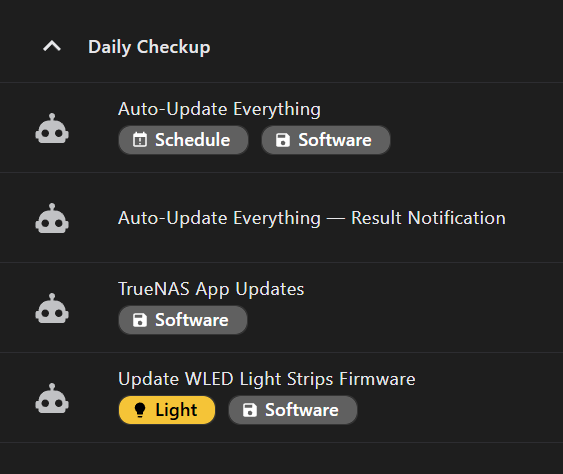
I kept asking it to put all this into one automation. It’s not even consistent about adding labels…
I can’t be bothered to check these usually.
In my experience, AI is worst than most-- Maybe not. Most folks I work with are above average, so your statement is true.
But I let AI roll on multiple projects. I’m using Claude Opus 4.7/4.8 only since I only started in May. But I have it doing all kinds of projects for me, and it’s extremely reliable (eventually, after a lot of prompting) because:
I have existing repos with code.
I documented all my decisions.
Everything is a repo including my workspace, so it gives agents a historical set of changes it can search if it needs to see what broke and why.
I have organized everything to keep context small, but each sub directory or top-level app directory has its own AGENTS.md file.
I haven’t coded at all since May even at work. Everything is agentic now. So much easier to spin up projects. They’re a lot more buggy than if I wrote them, but those get ironed out pretty fast. I can ask AI on my phone to do it for me.
Even the ability to run AI on my phone was something AI built for me . Sure, I could’ve probably done it over a week of staying up late every night, but it can do it for me much faster, and I can do 6-7 projects in one night of staying up late. I’m much more efficient even if I have to delegate everything. My goal is accomplishing tasks, not writing code.
Big Caveat
I’ve been coding for a few decades now, so my prompting is also going to be more advanced than the average user. I know good architectural techniques, and I make sure to prompt it with that info. This isn’t “write an auto-updater for my apps”, it’s 30-minutes to 2-hours of me writing a prompt that explains requirements in detail. The rest is up to the agent’s ~imagination~ hallucinations.
Over time, it documents things, and I can start asking for projects in 1-sentence, but not a big project like this. Usually what I’ll say is “the auto-updater ran, but my TrueNAS container stopped after it failed. Can you make sure it starts back up after a failure occurs?”
I like that. I can ask it to do a “web search” and grab the release notes. That’s a really good idea!
For some updates, like my Agentic runner containers in TrueNAS, I had it wire up MQTT to watch the processes to ensure nothing is working when the update occurs. The rest are currently just yolo.
I like your idea of having it check the release notes. Gonna document that now. Since AI isn’t running the updates atm, that’s a tough addition, but if it notices an update occurred, I can send an agent to look into it and possibly disable the auto-updater and then send a push notification when that occurs.
I was going to paste in the automation, but it did some funky stuff like putting WLED as a completely separate one. I’m having it simplify that into one automation file right now. Gonna take some time as it chugs.
To each their own.
Personally I would NEVER do this, EVER.
Others want it.
Beauty is that someone can choose to implement or not.
They implement it, maybe it works for them.
Personally I only see issues and as stated I would NEVER do it.
All this does is do the thing I’m already doing as a human: clicking the “update” button anytime I see an update in Home Assistant. As a human, I don’t have time to review everything.
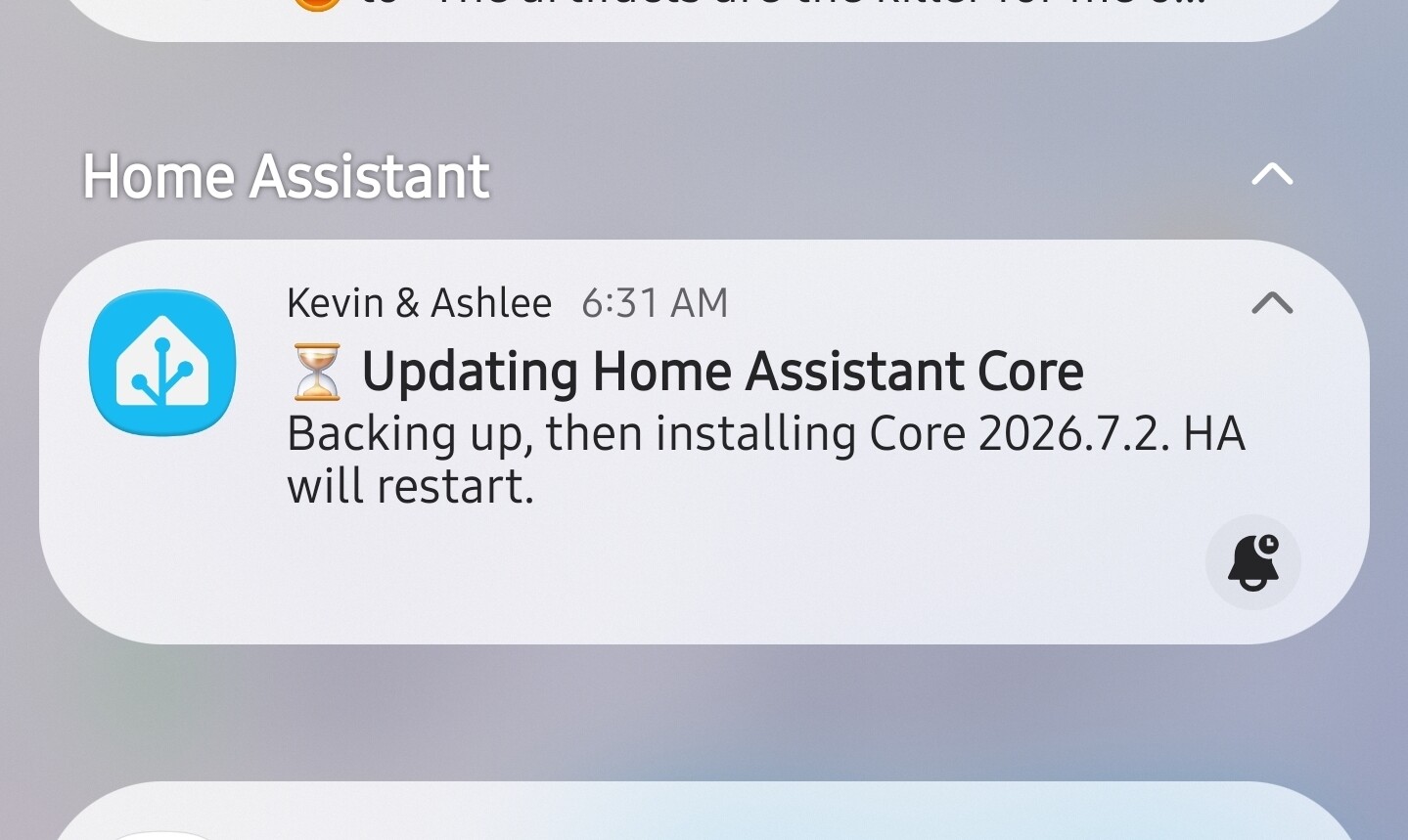
 of steel (yolo on the updates).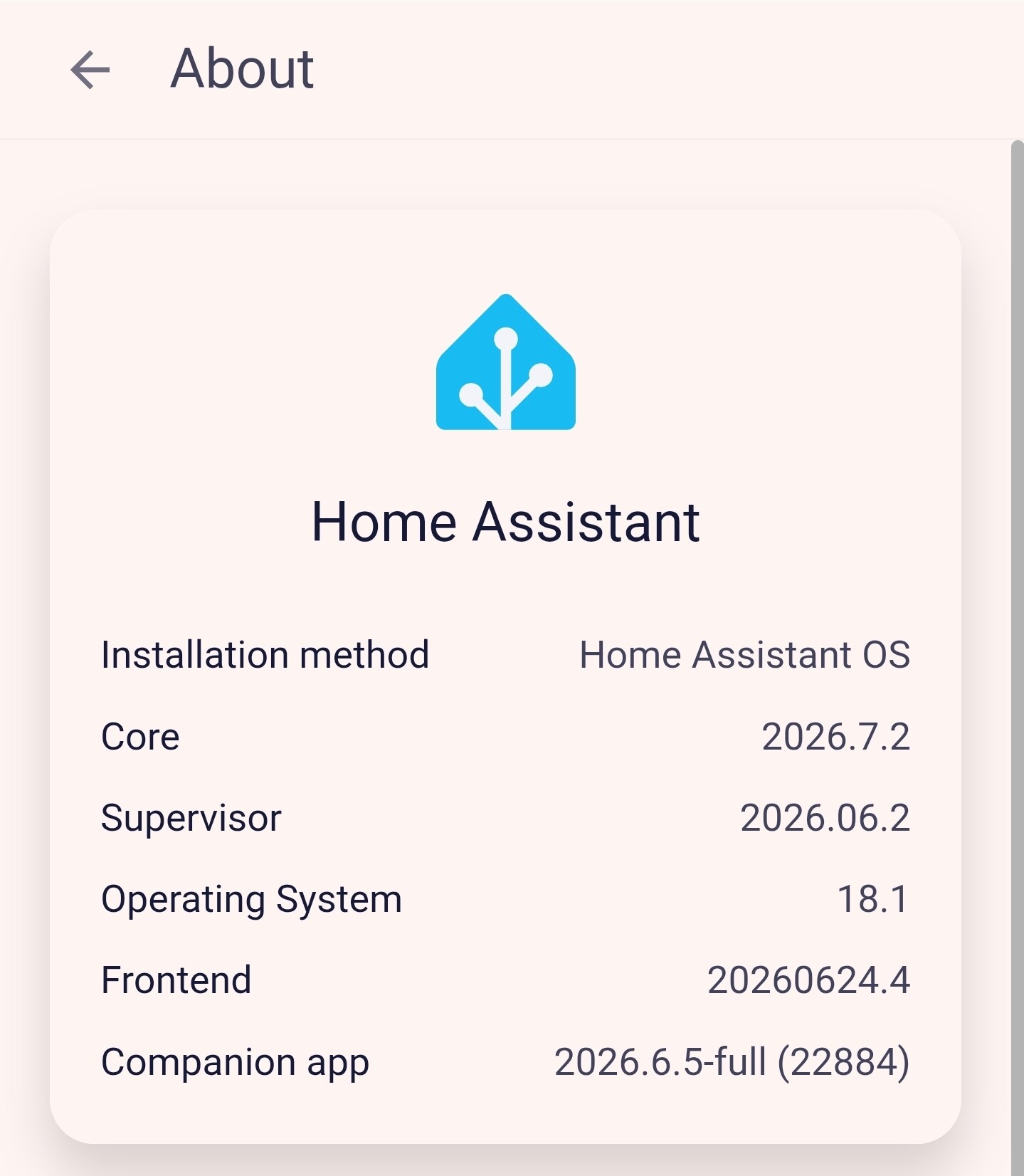
 And, it is clearly not for you as you are missing no. 4.
 Exactly! You do you, he does him. His balls, your balls. I am very libertarian when it comes to other people’s balls! Want nothing to do with them, and you do as you please, just leave me alone.
 :
:
 . Sure, I could’ve probably done it over a week of staying up late every night, but it can do it for me much faster, and I can do 6-7 projects in one night of staying up late. I’m much more efficient even if I have to delegate everything. My goal is accomplishing tasks, not writing code.