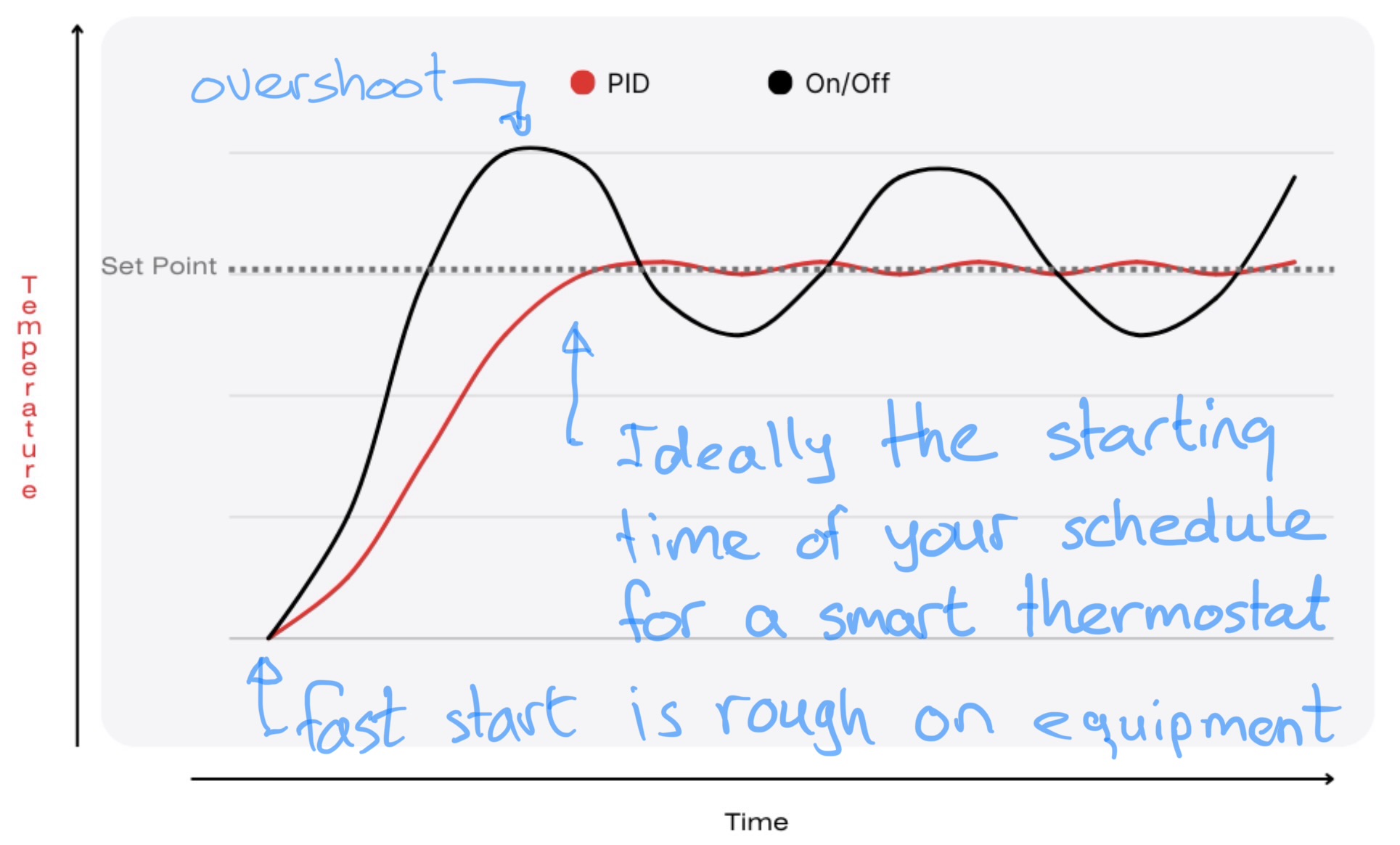
While it has been said before in different forms, it boils down to this: heating and cooling takes time to start and time to stop. For some systems this time can be very long, and environmental factors like weather influence this. Start to late and your temperature is not nice at the beginning. Stop too late and you get “overshoot”. You burn energy too long or make it too hot or too cold. And by using granular heating/cooling levels your temperature fluctuates way less too, while saving energy.
A good thermostat uses the schedule, geofencing, weather conditions and system characteristics to pick the right starting time, ending time and level of heating/cooling. If the HVAC devices do not have granular levels of heating/cooling, they use modulation (periodical on/off) to simulate granular heating/cooling levels. They often learn the right parameters from use, so it takes the smarter thermostats a couple of weeks to work optimally when newly installed.
The below graph is a representation between what a good, modern thermostat can do, compared to the simple logic that the Home Assistant Generic thermostat provides. Turn it upside down and you have a cooling version:
Add to that the logic to pick the right start/stop time, so the moment that the temperature is right coincides with the time that you want it to be so, and so you do not keep pooring in energy when the effect lasts way longer then when you need it. So basically they shift the graph left to match the point that the setpoint is reached with the scheduled time. Or they stop ahead of time without you noticing a thing.
The effect is three fold: you have more comfort, while using less energy, and it is kinder to your equipment so it requires less maintenance and lasts longer.
Manufacturers like Honeywell made their thermostats smart (as in working optimally under varying conditions) long before they were made connected, or cloud (what is now generally meant when called smart). The cloud ones may stop working without internet. The problem is that nowadays the dumbest of thermostats are still being used because they are cheap. It is even worse when those are made cloud. The best ones are smartly optimized and locally connected.
What HA can add is geofencing, room based presence, open window detection, voice control, etc. But in general, if the thermostat can do it then leave it there. Especially the picking of start/stop times relies on the thermostat knowing when you will need the right temperature ahead of time. You also want things to work also when internet or HA is down.
If you like this answer then please mark it as the solution, so others can find it easily.
 highly responsive