Does not really ring a bell for me. And I don’t have HAOS install to be able to reproduce it. Docker deployment method works very well 
You can have a look at one of the posts above that provided a solution for similar problem:
I tried it but doesn’t work. Or I didn’t try long enough. 
Now I just tried with docker and it works pretty well.
Here my environment and my configuration:
I connected the CA350 with a USB to RS232 convertor directly to my home server. My home server runs on proxmox and there I have a LXC with Docker. To passthrough the device, I added on the proxmox-shell the following file:
nano /etc/udev/rules.d/99-usb-serial.rules
And added in that file:
SUBSYSTEM=="tty", ATTRS{idVendor}=="0403", ATTRS{idProduct}=="6001" SYMLINK+="ttyCA350"
KERNEL=="ttyACM[0-9]*",MODE="0666"
To find out the idVendor and idProduct just call:
lsusb
And my device shows the following information:
Bus 002 Device 002: ID 0403:6001 Future Technology Devices International, Ltd FT232 Serial (UART) IC
To make the changes active, use the following command:
udevadm trigger
On the proxmox-UI you just have to go to your Docker-LXC, and under “Ressources” you can add a “Device Passthrough”. The device Path is /dev/ttyCA350 and the access mode is 0666.
Than you have to shutdown the LXC and Start it again (not just restart). After that follow the steps on:
https://github.com/adorobis/hacomfoairmqtt/wiki/Docker-container
And in the docker-compose.yml I’ve got the following configurations:
services:
  comfoair:
    privileged: true
    image: adorobis/hacomfoairmqtt:latest
    container_name: comfoair
    devices:
      - "/dev/ttyCA350:/dev/ttyCA350"
    environment:
      - SOCAT=False
      #- COMFOAIR_IP=192.168.1.50
      #- COMFOAIR_PORT=502
      - SERIAL_PORT=/dev/ttyCA350
      - RS485_PROTOCOL=False
      - REFRESH_INTERVAL=10
      - ENABLE_PC_MODE=False
      - DEBUG=False
      - FAN_OUT_ABSENT=15
      - FAN_OUT_LOW=30
      - FAN_OUT_MID=60
      - FAN_OUT_HIGH=90
      - FAN_IN_ABSENT=15
      - FAN_IN_LOW=30
      - FAN_IN_MID=60
      - FAN_IN_HIGH=90
      - SETUP_FAN_LEVELS_AT_START=True
      - MQTT_SERVER=192.168.178.43
      - MQTT_PORT=1883
      - MQTT_KEEPALIVE=45
      - MQTT_USER=your_mqtt-user
      - MQTT_PASSWORD=your_safe_password
      - HA_ENABLE_AUTO_DISCOVERY_SENSORS=True
      - HA_ENABLE_AUTO_DISCOVERY_CLIMATE=True
      - HA_AUTO_DISCOVERY_DEVICE_ID=ca350
      - HA_AUTO_DISCOVERY_DEVICE_NAME=CA350
      - HA_AUTO_DISCOVERY_DEVICE_MANUFACTURER=Zehnder
      - HA_AUTO_DISCOVERY_DEVICE_MODEL=Comfoair 350
    restart: always
With this configuration the data from the ca350 goes directly over mqtt to my Home Assistant, which is running on a separat LXC on proxmox. There I just use the Mosquitto broker add-on.
I hope it’ll help someone else with a proxmox environment.
1 Like
I finally got the cards running. The card ist showing all values now, there is only one issue left: the 4 fan speed icons in the center are not visible. I can use them though to change the speed. Is this an error in the comfoair-card.js or do I have to change that in HA?
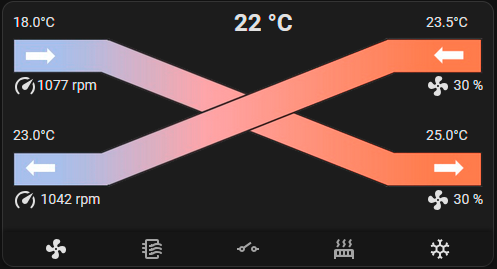
No idea. Better contact author of that card on github
Hello there,
I’ve tried te make my WHR930 (Zehnder Stork-Air) run with HA. Therfore I used the code “esphome-comfoair by @julianpas” on github.
After programming my ESP8266, and restarting, I don’t get any values from my WHR930. On the other hand, changing the fan speed works fine.
So it looks that I’m not getting any data from the unit (WHR930).
I’ve also disconnected the ComfoSense. I tried the ComfoSense connection, the RS-232 connection and even tried to hook up with the RJ45 connector. All with the same result.
So what I’m doing wrong here. Has it something to do with the RS232-mode???
I hope someone can help me with this issue. Thank you in advance…
Kind regards,
Harold
Take a look in the ESPHome console logs for the device if you are getting any possibly mangled or no data at all. It could be the wiring if TX works but RX doesn’t. Also it could be the RS232 adapter. As I noted on GitHub my first RS232 board turned out to be fake.
Lastly you certainly can’t have ComfoSense and the ESP board in parallel connected directly to the device. My solution is to connect the ComfoSense to a separate UART on the ESP and then proxy requests over to the ComfoAir unit.
Hello Julian,
Thank you for your reply.
I’ve allready tried 2 different RS232 TTL boards, both with the same result.
I’ve also looked in the ESPHome console logs, but there’s no data at all. Only the logd “getting temperatures”, “getting fan status”, etc.
To exclude some issues, I’ve ordered the same MAX 232 DIP RS232 as mentioned in your BOM-list, including the capacitors.
As soon as I get the parts, I’ll give it another try.
I’ll keep you informed.
Thanks again…
Hello,
I am bit confused here…
I was initially looking for a mvhr system and found the company for the design and install.
Afterwards I found out there is smarter option to do that ie mvhr, so one can have zones using electrical ducts, smart boosts etc etc.
The other company saying things about the smart mvhr was saying it can be done only by loxone, ie it will be brain for mvhr.
Just wondering if anyone find out something like that, how to build such a smart mvhr system using HA.
I was told that loxone has some modules to set speed, pressure, open/close ducts etc.
Thanks!
I would keep mvhr as simple as possible. Controlling each room separately is not adding much value in my opinion and makes the system overly complicated. Keep in mind that it has to be balanced in order to work properly
What do you mean by keep it balanced?
Well was told that zonal is better bc there is for example no point to exchange air in the rooms without occupancy intensively etc…
No idea.
Balanced means that inflow has to be equal outflow on the ventilation unit. Otherwise you won’t get the optimal heat recovery.
I’m not saying that zonal is not better, I’m just saying that it is much more complicated. In standard one you set up the anemostats once so that the system is balanced and you don’t touch it. In zone based one, if you reduce flow in one zone you have to correctly increase in another so that the entire system remains balanced. I’m not even sure if the standard controllers / zone shutters are able to do it. To do it properly you would need to have flow sensors in each zone. So the installation cost will be significantly higher and ultimately might not work as expected.
Why not work as expected?
Yes, u possibly need these flow sensors or mvhr unit might be able to somehow adjust?
Not sure in case u reduce it in one zone, u don’t have to increase in other… I thought u just lower fans speed… I mean there are many variables but assuming the system that can control that should handle all of that? Zehnder is selling external unit for an integration with different systems… So assuming it should be doable?
Don’t assume but verify what the installer is proposing.
For Zehnder you mean the external component for integration? And which is the manufacturer of the zone control valves/distribution? Are they guaranteeing the balanced airflow?
Discuss it with qualified and experienced installer before getting into complicated and expensive installation which might turn out not to work as expected.
In my opinion the potential benefits are not worth the additional complication and cost.
I meant
Zehnder ComfoConnect PRO
The Valves… These could be any with electronical opening /closing between 10-90%
I can see huge benefit… U can integrate presence sensors… In case room has suddenly 5 people instead of 1-2 in can boost exchange and not wait till there is high level of co2.
Same like in the evening no use of kitchen /living room no point to run fans on medium etc.
Using mentioned component I assume mvhr expose sensors reading etc to system like Loxone and that one can manage additional complex controlling…
I am not able to find any company but so many threads on other sites where ppl achieved it and are very happy as that’s the only way how to make it smart…
No clue… I have even issue with the dumb mvhr design, bc that’s also many companies don’t know design it properly… Like dumpers, where in rooms place ducts, if u don’t want to cut doors what should be in the walls for a air circulation…
So many technical questions, regarding the dumb mvhr design not saying smart one using ha or loxone to control it…
Ok, in this case I would even stronger recumbent to keep it simple. I have the system running for 17 years now and it works very well. The only thing I’ve made Smart is that I control the fan level based on people present, bathroom humidity and time of the day as well as turning exhaust off when kitchen hood is on.
Never had any problem with nether CO2 levels or excessive humidity. And I don’t think there is a solution to avoid cutting doors, the air has to find a way between the rooms.
Do you run zehnder?
What device did u use to integrate it with ha?
So in case you increase fans level, basically even unoccupied rooms got higher air exchange right?
But why strongly propose to keep it simple?
There are many ppl controlling it in the mentioned fashion… Via loxone. I really don’t know.
Yes, I have Zehnder Comfoair 350, but it is an old version. I’m controlling it via RS232 connected to a PC running home assistant with software running in docker. Details are in repo that is linked on the top here.
Because you can’t find a professional who knows how to design the installation and how to control it. And in my opinion benefits are very low. So unless you know what you are doing yourself I would not recommend to go this route.
Yes and I don’t see it as a problem at all. If you need more exhaust air e.g. due to higher humidity (e.g. during bath) you have to input more air in a different room anyway, so by definition it won’t be the room where the need is. Similarly if you need more fresh air in living room e.g. during party you need to take it out in a room that maybe does not need this increased circulation at the same time. So anyway you are not having it perfect. So why bother? Just ensure enough air circulation according to the time of the day, number of people and other needs (like cooking or bathing) and keep it simple.
@adorobis thanks
So what exactly do you control then? Only sending signals for a boost etc?
You dont even have electronic dumpers?
Also the desing where to place ducts , etc etc was performed by some company?
Would be nice if more ppl chime in.
Thanks
I control the fans level. And turn off exhaust fan when kitchen hood is running - this prevents smells to distribute around entire house. And that’s it. No electronic dumpers or anything like that. I know some people installing new systems at the moment and none of them is even considering electronic dumpers - this increases the cost and comes with more possible issues than added value.
Yes, one installer was designing the system including ducts placement and was later on doing it including proper anemostat adjustments to balance the whole system.
I have made the integration with HA (subject of this whole post) myself.