Heiman’s Upcoming Zigbee and Matter Devices – Looking for Home Assistant Community Feedback

Hi HA users,

We are currently working on several new Zigbee, Matter and home safety devices. Before finalizing some of their functions and Home Assistant integrations, we would like to collect feedback from the community.

We will also present these products at IFA 2026, but the main purpose of this post is to share what we are developing and understand which features are most useful to Home Assistant users.
S2 Edge Series ultra-thin smoke alarm

The S2 Edge Series focuses on a thinner and less intrusive design while maintaining the essential functions of a home smoke alarm.

The series is designed for:

  • Ultra-low-power operation
  • Long-term installation
  • Local audible smoke alarms
  • Clear alarm and device-status reporting
  • Different communication options for different types of installations

For the Zigbee version, we would like to provide useful Home Assistant entities without adding unnecessary configuration items,it will has the same features as HS1SA-E Plus

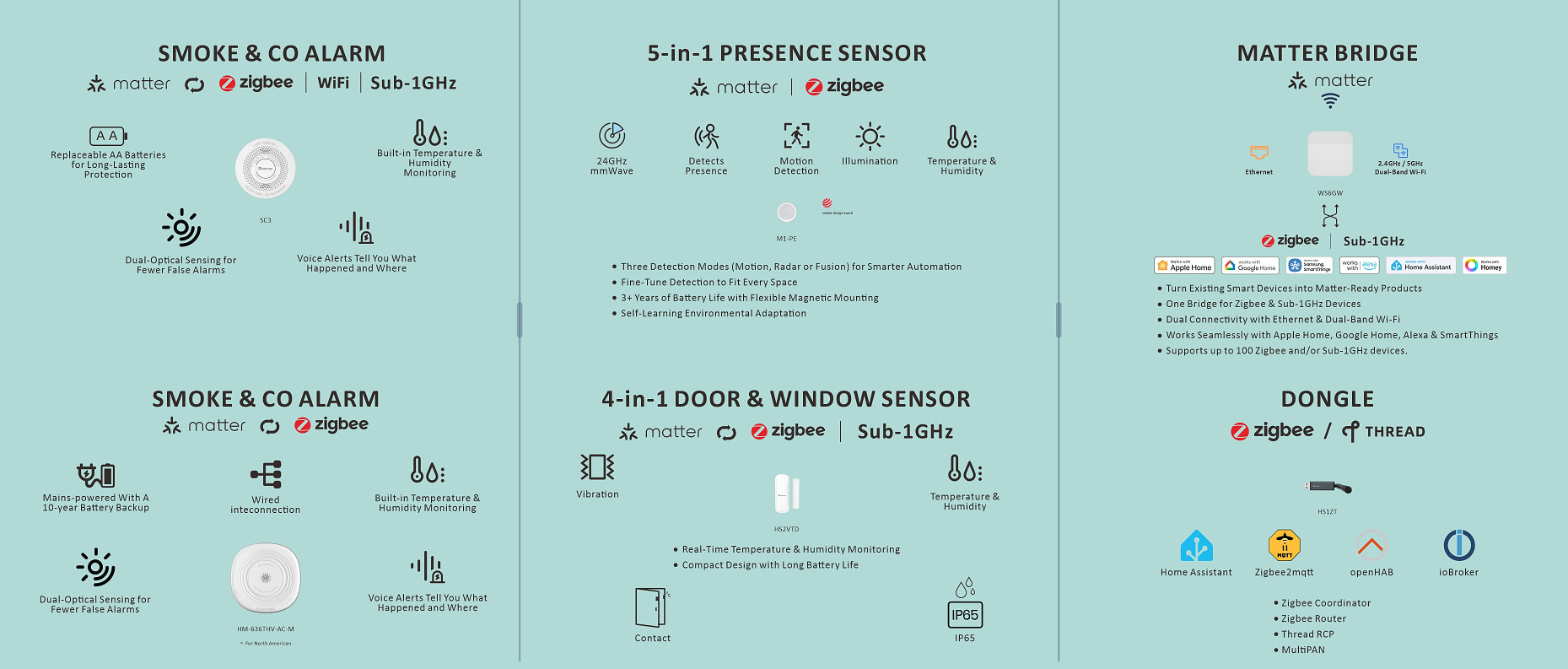
New Zigbee smoke and CO alarms

We are also developing new smoke and carbon monoxide alarms with more functions available to the smart home system.

Depending on the model, planned features include:

  • Zigbee/Matter switching feature.
  • Matter 1.6 support.
  • Smoke or carbon monoxide alarm status
  • Real-time CO concentration reporting
  • Temperature information
  • Battery-level reporting
  • Device health and fault status
  • Remote self-test
  • Remote alarm silencing
  • Siren control
  • First-triggered alarm identification
  • OTA firmware updates
  • Replaceable-battery options
  • Local alarm operation even when the network is unavailable
  • wired interconnection
  • AC-Mains powered with a 10 year backup battery.

We are particularly interested in how functions such as self-test, silence and siren control should be represented in Home Assistant.

5-in-1 presence sensor

The new 5-in-1 presence sensor is intended to provide more information than a traditional PIR motion sensor.

The planned sensing functions include:

  • Zigbee/Matter switching feature.
  • Matter 1.6 support.
  • Human presence detection
  • Motion detection
  • Presence-distance information
  • Ambient-light measurement
  • Temperature and humidity information
  • Zigbee binding

Possible Home Assistant applications include:

  • Keeping lights on while someone remains seated
  • Different automations based on presence distance
  • Lighting control based on occupancy and illuminance
  • HVAC control based on room occupancy
  • Detecting when a room has actually become unoccupied

We would especially like feedback about detection zones, timeout settings, sensitivity controls and how much raw sensor information should be exposed.

4-in-1 door and window sensor

The new multi-function door and window sensor combines several functions in one device:

  • Zigbee/Matter switching feature.
  • Matter 1.6 support.
  • NFC support.
  • Door and window open/closed status
  • Vibration detection
  • Temperature measurement
  • Humidity measurement

This could support automations such as:

  • Security notifications
  • Open-window HVAC control
  • Vibration or tamper alerts
  • Room temperature and humidity monitoring
  • Reminders when a door or window remains open

We would like to know whether users prefer these functions in a single device or as separate dedicated sensors.

Zigbee and Thread dongles

We are developing new dongles for Zigbee and Thread applications.

The goal is to provide:

  • Stable local connectivity
  • Zigbee and Thread hardware options
  • Compatibility with open smart home platforms
  • Reliable operation for long-running installations
  • Easier deployment with Home Assistant
  • Support for common Zigbee and Thread use cases

For Zigbee, we are focusing on use with platforms such as ZHA and Zigbee2MQTT.

For Thread, we are also evaluating installation, firmware-update and recovery workflows, since these are important for long-term maintenance.

Matter Bridge

The Matter Bridge is intended to connect existing devices and sensors with Matter-compatible ecosystems.

Our planned goals include:

  • Bridging supported Zigbee and Sub-1GHz devices
  • Local device communication
  • Matter ecosystem compatibility
  • Multi-platform access
  • Retaining useful device functions after bridging
  • Easier migration of existing safety devices into newer smart home systems

One of our main questions is which advanced functions should remain available through the bridge instead of exposing only basic alarm states.

Wireless home safety solution

We are also developing a wider wireless home safety system that combines alarms, sensors, gateways and local automation.

The system is intended to support:

  • Interconnected smoke and CO alarms
  • Whole-home alarm status
  • Identification of the first device that triggered
  • Local alarm linkage
  • Remote notifications
  • Device health monitoring
  • Battery and communication-status reporting
  • Integration with Home Assistant
  • Continued local safety operation during an internet outage

Our priority is that the core alarm functions remain local and reliable. Cloud connectivity should not be required for basic safety operation.

Home Assistant integration

For us, Home Assistant support should mean more than simply allowing a device to connect.

We are especially focusing on:

  • Local operation without a mandatory cloud service
  • Zigbee2MQTT and ZHA compatibility
  • Matter compatibility
  • Useful diagnostic entities
  • Battery and signal-quality reporting
  • Configuration through standard entities
  • Useful functions for HA users.
  • OTA firmware updates
  • Clear pairing and installation documentation

We would also like to avoid exposing too many entities that most users will never need, we would appreciate your feedback

These products and integrations are still under development, so suggestions from the community may influence future hardware, firmware and integration decisions.

We will also present the devices at IFA 2026. Home Assistant community members attending the exhibition are welcome to see the products and discuss the integrations directly with our team.

Thank you for your feedback.

Wow, this looks very promising. I have to say I’m genuinely impressed by the build quality of Heiman’s products and the pace of the company’s development. If the upcoming products are even better than the current lineup, I can only assume that Heiman has the potential to become a dominant player in the market.

Thanks, your words made our day, we have been trying to work harder to build better products.

I’ve been using your brand’s products for many years—both Z-Wave (have you permanently discontinued that protocol?) and Zigbee. Right now I don’t see any technical or functional added value in Matter.

Your CO and smoke alarms will have a more conventional look, which will prevent questions about their reliability (people really do sometimes get hung up on silly details…). Are they certified or compliant with any standards? If so, how, and which standards do they meet?

Your motion sensor really intrigues me. It looks pretty small and could be a great solution in certain places.

The Zigbee USB dongle is worth checking out, but the market is starting to get flooded with many different models.

If prices stay reasonable, as they usually do, it could be a really good deal.

Are they certified or compliant with any standards? If so, how, and which standards do they meet?

Yes please! I’m currently in the market for new smoke alarms, I sure don’t want to give my insurer any reason for pause. So first things first!

And

Do we really need another USB dongle? No, no we don’t! USB dongles are the main reason people think Zigbee is unreliable. Ditch the dongle, save the Zigbee! I understand that ethernet coordinators may not work for everyone but if you must use USB maybe a “puck” with built-in cable so users don’t plug it into the back of a PC then run to the forums to complain about how crappy Zigbee is.

When frying dinner in the kitchen, if we forget to open a window, our smoke detector doubles as a dinnerbell. What I want is to be able to silence the alarm for a minute from Home Assistant rather than getting a broom to press the reset button on the smoke detector in the ceiling.

The smoke alarms peak my interest the most, if possible I would like to see versions released and certified in Australia so we have more viable options to pick from.

Thanks a lot for the detailed feedback — and especially for using our products for so many years!

Regarding Z-Wave, at the moment our main development focus is on Zigbee,Sub-1G and Matter/Thread, and we don’t currently have new Z-Wave products in the roadmap. I wouldn’t say it is permanently discontinued, though. We are still paying attention to what users and the market actually need, is Zwave still popular in your country?

And I completely understand your point about Matter. For many existing Zigbee users, especially Home Assistant users, Matter may not provide a very obvious functional advantage today. From our side, we see it more as another option for users who want easier cross-platform compatibility. We definitely don’t plan to abandon Zigbee — we are continuing to develop new Zigbee products as well, so we rolled out dual Zigbee/Matter products as well, in case someone changes their mind in the future.

For the new smoke and CO alarms, certification is very important to us. The European smoke alarm models are designed around EN 14604 requirements, while the CO alarm models are designed around EN 50291 requirements. The exact certification and approvals may vary depending on the final model and target market, so we will publish the full certification information for each product when they are officially released.

Glad you noticed the motion sensor! One of the goals is indeed to keep it compact so it can be installed in places where a larger sensor would be inconvenient. We’d also be very interested to hear what locations or use cases you have in mind.

I agree with you about Zigbee USB dongles too — there are already many options on the market. So simply making “another Zigbee dongle” isn’t very interesting. We are looking more at stability, compatibility, firmware support and making it easy to use with open-source platforms such as Home Assistant and Zigbee2MQTT.

And yes, we will try to keep the pricing reasonable. :slight_smile:

Thanks again for the feedback. Comments like this are actually very useful for us when deciding what features and products are worth developing.

Absolutely — certification comes first for safety products like smoke and CO alarms.

We completely understand that these devices may also be related to insurance requirements, so we don’t want users to have any uncertainty about compliance. For the European market, our smoke alarms are developed to meet EN 14604 requirements, and our CO alarms are developed around EN 50291 requirements. For each final product, we will clearly publish the applicable certifications and standards before it goes on sale, so users can check exactly what they are buying.

And I actually agree with your point about USB dongles. A lot of “Zigbee problems” are not really Zigbee problems at all — USB interference, poor placement behind a PC, extension cables, antennas, power supplies and host hardware can all make a big difference.

An Ethernet/PoE coordinator is definitely a very interesting direction because it lets you place the coordinator where the Zigbee network actually needs it, instead of where the server happens to be.

Your “pack with a built-in cable” idea also makes a lot of sense. If we do make a USB coordinator, perhaps the goal shouldn’t be just another small stick, but something designed to encourage proper placement and reduce the common RF problems users run into, we may add extension cable as an option in case someone needs it,

This is exactly the kind of feedback we were hoping to get from the community — thank you!

Haha, that makes a lot of sense, we will add it.

I will check it.

@leoXie Love the direction you are posting. I dont own any of your devices since I’ve never seen them available in the USA but they look nice.

I have over 200 physical automation devices (Wifi, Zwave, Zigbee, 433MHz, etc). I have some thoughts from a power user / prosumer point of view…

  • Wired Smoke detectors are great for those with pre-wired homes - bravo!
    • Would love to see those have Presence detection. That would really reduce the number of devices hanging on walls that need replaceable batteries!
  • Your 5-in-1 Presence Sensor is looks nice, I think what is missing from 99% of the battery powered devices is a way to power them using low-voltage (USB, etc). I have some Zlink wave water leak detectors which take batteries or USB power. The USB power is very nice when there is a power outlet new, or it is easy to run low-voltage wire through walls (which can be done often, and always when building a new home or doing a remodel.
    • Less wasted money on batteries, no wasted time monitoring/replacing them, fewer dead batteries in the landfill.
  • If you make a dongle, make it USB and POE. Allow it to be powered by USB if someone wants the use Ethernet but does not have POE.

Zones, distance and angle, or x-y coords relative to the sensor matter to me with presence. Bounding boxes are important to prevent outside of the room detection.

The closest matching to what I have installed when I moved into my place is this one, mine is hardwired via in the ceiling atm:

need to match its standards as an example:

So if I can source a proper certified smart version that natively works with HA then I am willing to invest to update mine when it expires in 2029 or before then.

In regards to the 4 in1 Window/ Door sensor. I’m not sure what the value in having it measure temperature and humidity is? These metrics are always used to report on the conditions within an environment and potentially used to trigger anotger device so that environment can be maintained at a set level.

But a window or door is normally a threshold between two different environments i.e. inside/outside or another room. So which environment are you trying to measure with a T&H sensor which is located at threshold the interior or the exterior to where the sensor is located?.

In reality it cannot provide any usable data until the window or door is closed and has time to stabilise. IMHO it’s not going to provider any usable data for use in the home automation arena.

Just because a chip set has the ability to provide certain types of metrics doesn’t means it should, sometimes “less is more”.

Apart from that the smoke & CO2 alarms looks very exciting and will be a welcome addition to the choice available to the home assistant user.

For the window-opening sensor, having vibration and position detection (to determine whether the window is open or in the tilt-and-turn position) would be a real plus.

As for the presence sensor, since it works through metal, I use it to check if anyone is standing in front of a mirror or if my pets are in their beds…

It would be great if it were equipped with a distance and zone sensor.

I was thinking the same thing, but they might be a decent choice for interior doors. Especially if you are trying to minimize the number of visible devices for aesthetic/PAF reasons.

hej @leoXie - Really great to see you investing in Matter and Thread products. To me, this feels like the direction the smart home industry is heading.

At home, I currently run several ecosystems in parallel. I started with Z-Wave years ago, but because certain device categories were unavailable, I gradually ended up with multiple radio technologies: Z-Wave, Zigbee, Bluetooth, Hue, and now Matter, all integrated through Home Assistant.

In our newer summer house, we started directly with Matter-based devices. The experience has been significantly better than with older smart home platforms. Mixing products from different vendors and getting them to work together is much smoother, which is exactly the promise of Matter.

Feedback on the 4-in-1 Door & Window Sensor

Temperature and humidity sensors

As others in this tread I am not convinced that temperature measurement inside a window sensor is particularly useful for room temperature monitoring. The device sits on the window frame, which is usually colder than the room, especially during winter.

A dedicated room temperature sensor will always provide more accurate readings.

That said, my current Z-Wave window sensors also include temperature sensors (though no in device humidity sensor), and I do use the data for a rather niche but useful automation: calculating window condensation risk. During winter, our windows and frames tend to collect moisture when outside temperatures drop. By combining indoor temperature and humidity data, Home Assistant can calculate dew point and either:

  • Increase ventilation automatically
  • Notify us to open windows
  • Warn about potential condensation

It’s definitely a nerdy use case, but it demonstrates that even “imperfect” temperature measurements can still be valuable.


Feedback on the Smoke and CO Alarms

Reliability above everything else

For smoke alarms, reliability must be the absolute priority.

We have had Z-Wave smoke detectors from another vendor for many years. While their core alarm function works, the smart-home integration has often been unreliable.

For safety-critical devices, reliable communication, adherence to standards, and predictable behavior are far more important than adding additional features.

A house fire is probably the biggest threat most homeowners face, so dependability comes first.

CO Alarm

combined smoke and CO measurement is a really valuable selling point.

Remote alarm silencing

Being able to silence an alarm from Home Assistant is an excellent feature and a strong selling point. I would definitely expose this functionality through Home Assistant.

First-triggered alarm identification

I am not sure this is a major problem within Home Assistant environments.

Most users already assign devices to Areas, so alarm notifications typically tell you exactly which device triggered the event.

Identifying the first device that triggered is still a nice feature, but I wonder how it would best be represented in Home Assistant. Since users often receive notifications immediately, the first triggering device is usually already visible.

Perhaps the information could be stored persistently as a diagnostic attribute, allowing users to see which sensor originally started an alarm cascade even after the event has ended. Home Assistant logs already retain much of this information, so the implementation should complement existing event history rather than duplicate it.

Battery and power options

A wired connection could be useful for installations where battery replacement is difficult.

However, for safety-critical devices I would generally avoid introducing a dependency on mains power whenever possible. One of the advantages of battery-powered alarms is that they continue operating independently of household power.

What would be most valuable to me is excellent battery health reporting and clear status monitoring.

Real-time CO concentration

Real-time CO reporting sounds great.

Ideally, the reporting interval should be configurable. Users who prioritize battery life may prefer less frequent updates, while users who want near real-time monitoring should be able to reduce the reporting interval.

Temperature reporting

Temperature reporting is a useful addition.

Unlike window sensors, smoke and CO alarms are typically mounted in more central locations. The measurements may still be somewhat biased because warm air rises, but when combined with readings from other sensors throughout the room, they contribute to a more complete temperature profile.

Self-test and siren control

Remote self-test and siren control are both valuable features.

For advanced users, transparency is important. I would love to see:

  • Last self-test timestamp
  • Self-test result
  • Device health status
  • Fault history

These may seem like niche requirements, but users who invest in connected safety systems generally care a lot about visibility and diagnostics.

Most importantly, these capabilities should be fully exposed through Matter and Home Assistant. Some vendors expose advanced functionality only through their own apps while presenting limited functionality through Matter. In my opinion, that is poor practice.

OTA firmware updates

OTA updates are an excellent feature.

One of the most satisfying experiences in Home Assistant is seeing device firmware updates delivered directly through the platform. It creates confidence that products remain maintained and secure over time.

Unfortunately, many of my older Z-Wave devices either never receive updates or require manual firmware management. That’s one reason why I increasingly look at Matter devices for future purchases.


Feedback on the Matter Bridge

The idea is interesting, although I wonder how large the market actually is.

There are certainly users with existing Zigbee or Sub-GHz deployments who would appreciate an easier migration path into Matter ecosystems.

From a technical perspective, however, bridging legacy devices sounds extremely challenging. In my experience, many older devices have manufacturer-specific behaviors, unusual parameter sets, or compatibility quirks that vary between hubs.

A bridge could therefore become a source of frustration if advanced functionality is lost or behaves inconsistently.

More technically inclined users will likely continue adopting platforms such as Home Assistant or Homey, where multiple protocols and ecosystems can already coexist.

That said, there may be a broader market of users who simply want to bring their existing Zigbee or 433 MHz devices into Apple Home, Google Home, or other Matter ecosystems without replacing everything. For those users, the bridge could be very compelling.


Final thoughts

Overall, I really like the direction you’re taking. The strongest selling points for me are:

  • Native Matter support
  • Strong Home Assistant integration
  • Reliable safety devices
  • Fully exposed diagnostics and advanced features
  • OTA firmware updates through standard platforms
  • Local operation without cloud dependencies

If you can deliver those fundamentals well, I think these products will appeal strongly to both Home Assistant enthusiasts and more mainstream smart-home users.

Hi @leoXie, thank you very much for sharing this!

As I am on the wake of setting up a rather large house (about 30 smoke detectors to start with, and about 60 doow/window sensors) I am in the market for quite a lot of sensors and currently evaluating hardware options.

Protocol

I prefer limiting the first selection to Matter/Thread as I think this will be the standard for the upcoming years - good to hear that Zigbee etc. are not discontinued, but starting from scratch I’d rather not invest into that technology anymore.

Smoke Detectors

One of the current choices is the HS1SA-M smoke detector, for the obvious reason that it is one of the few Matter/Thread choices available, and in addition I really like the small form factor, the swappable battery and the fact that the siren can be triggered externally (obviously the size of the house dictates some kind of distributed alerting as you can’t be sure to hear an alarm going off in a distant room in that kind of building).

So to summarise it, my preferences for smoke sensors are:

  • Matter/Thread
  • OTA Update without App
  • Controllable siren
  • Swappable battery and reasonable battery lifetime (> 2 years at least)
  • Small form factor

CO2 detection would be a bonus but is not strictly necessary for my purposes.

Motion/Presence sensors

I’m glad to hear that you plan to release Motion and Presence sensors as well, as my selection process currently still hasn’t progressed very far. One possible chouce is the Aqara presence sensor, but there are some reasons that speak against it (limitation to a vendor app for setting up and upgrading is the worst of them, but I would also prefer battery-operated devices). So any device from Heiman that improves on that would be a hot candidate.

Criteria:

  • Matter/Thread
  • OTA and configuration without a vendor app, or if possible with the option of deinsatlling it when the initial setup is finished
  • Ideally operated on battery at least optionally

Door/Window sensors

Here I’m currently considering the Ikea Myggbett variant. One of the reasons is the sheer number of windows and doors, which adds up to a significant cost for more expensive devices, but the other, very important aspect is the size of the devices and their design. Ideally, the design would be unobtrusive, and the smaller the better, because many of the windows are rather small and a large sensor - or, in case of five small windows next to each other, five large sensors - will look pretty ugly and destroy the optical impression of the windows.

Apparently, with 60 sensors, the power design is also important: The Ikea sensors are great in that respect because they only use one AAA battery and the lifetime according to my tests so far seems to be reasonable.

I would, however, strongly consider a Heiman alternative based on some aspects that Myggbett does not address, such as vibration alert. Having additional sensors for Humidity, lighting etc. is, given the number of sensors, OK, but better if they can be disabled individually because of battery usage and data redundance.

Criteria:

  • Matter/Thread
  • OTA Update without App
  • Small and unobtrusive design, ideally even smaller than Myggbett
  • Sensible battery lifetime (> 2 years at least)
  • Standard batteries with small form factor
  • Choice of colours, but mainly white

Personally I don’t have any use for a Matter bridge device or a dongle, but it probably makes sense to add them to the portfolio.

Availability

This is really an issue: I need the devices this year, ideally before November. For some of them (motion, smoke) I can wait a bit longer, but the door/windows sensors need to be installed as soon as possible. If what Heimann is going to offer is really great I can wait with the majority of sensors, but I need at least some at the main entry points. So it would be very important to know when the devices are going to be available in Europe. I would be very pleased if I could look at them after IFA, which is conveniently timed for our planning.

Again, thanks for sharing your plans - I am really impressed with what you’re doing!

Bit off topic, but wanted to clarify.

I have the FP300 & only needed the app once to switch from the default Matter firmware to Zigbee. All OTA updates came through via Z2M & I haven’t needed to use the app ever again. Looks like Matter has some gotchas when it comes to OTA