I have buy 2 Sonoff Pow R2 units. I want to use them for my washing machine and dryer. I have already one flashed with ESPHOME which works great.
Unfortunately I have read some stories on the internet that there are some people they say that their Sonoffs are burned when using them. The most of them are version 1, but I have also seen a story of someone that has the version R2.
So my question is how SAFE are they in combination of using with a washing machine or dryer. Of course it is import to have the correct wires. I’m using 3 x 1,5 mm2 wires so that should be more than enough.
I don’t have soldered the copper before they go in the connectors but i have stripped the cable and the copper directly placed in the connectors.
I’m using Sonoff POW (with ESPHome FW) for both dryer and washing machine for, maybe over a year, without any problems. Washing machine peaks to somewhere ~2kW, and dryer ~600W.
Running either at once should be ok, but I wouldn’t want both running (3100w) at once. The Amperage rating on these devices is ‘hopeful’ at best. I’d say 8-10A is more likely the safe limit.
It’s worth opening them up every 6 months to check for any issues, that will give you some peace of mind.
15A resistive load. And even that is stretching it to the absolute maximum they could pull in a perfect lab setting. In reality I wouldn’t trust it more than 50% of that stated max load. But again, this is for resisitive loads. Your washing machine and dryers are inductive loads. They can use up to 5 to 10 times their rated power when the motor starts up, stops or changes speeds. So in the worst case scenario, you’re subjecting that cheapo noname chinese relay with up to 95A for few milliseconds. And if you actually switch the washer/dryer while it’s running (don’t ever do that !), you’ll get inductive transients that can go up to 1kV or more on the Sonoff for a fraction of a second.
Will it survive this ? Probably for a while. Until it doesn’t. I hope you have a good home insurance and smoke detectors around.
How people can risk heavy property damage in the best case and the lives of their family and themselves at the worst, just to save a few $/€/whatever by using a cheap-as-crap Chinese device to control high power loads is beyond me. If you really want to switch inductive loads, then use a device that is designed to do that (contactor). If you just want to measure the current of such loads, then use a current clamp, like the Shelly EM.
Sonoff POW, Sonoff TH16/10 are the worst !@#$%. They will burn down your house. If you want to switch high loads & be safe then you only use a contactor like this one here. You can connect Sonoff basic (or a different better brand) to switch on the contactor. For 5 years now to turn on my pool every night I use a Sonoff basic with 110v high amp contactor to turn on a 240v high amp contactor.
I used a Sonoff TH16 to turn on a porch light and it blew a fuse and melted casing after 1 month. And never bury these things inside walls where you can’t see them all the time.
Okay…it sounds not very good. So I think I don’t going to use the Sonoffs.
So I’m checking what are my options now. For me it is not a requirement to have a Wifi version. I have Wifi, Zigbee and Z-wave support in Home Assistant. Also I don’t need switch functionality but only power meassurements is enough.
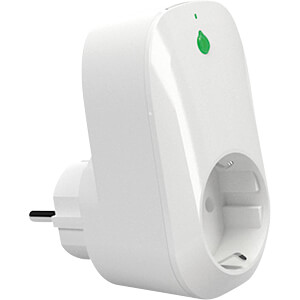
What do you think of the Qubino Smart Plug. The pro is that it doesn’t have a connector for the wires. So that is much better than the Sonoff. Also it is very easy to use of course. It has support for 16A. In the official information they say that washing machines could be connected to it.
So will this be also to small or is this device safe to use?
This is maybee the most safe option. What I understand is that you can connect 2 groups: so washing machine group and dryer group on one single device and put it in the fuse box.
So you want to do power monitoring, and those are inductive loads, and switching on/off is not necessary. Consider all those, I’d recommend you forget about any plugs.
The brand sonoff itself is not the issue here, the issue being the POW R2 is not ideal for the job. In fact, no plug would be ideal for the job… unless it’s a heavy duty plug that is rated to handle inductive loads (think motors) AND does power monitoring. Even 16A rated is not enough.
Use solutions with CT clamps instead.
So Shelly EM, Shelly 3EM, IoTaWatt, Aeotec has a Z-wave+ one, sonoff probably has something also, or you can build one per ideas from here or here
Hey guys, I had been away from the Sonoff party for sometime. I now see there was a recall issued for these burn’y units. I have 2 of them, one burned (used to turn on a porch light), the other is still new in the box.
My questions are…
Am I locked out of the recall?
I can’t even log into my Itead account. Apparently accts were migrated to some other servers or something and I can’t even reset mine. Any tips?
Those from Aliexpress are they eligible for refund or whatever from Itead as manufacturer’s of the unit?
Is there any way to make these units safer, for the simplest task/load like switching a regular bulb?
There are standards for connecting each device to the grid. For example, here each appliance such as washer, dryer, dishwasher, electric oven must be connected with a separate cable and a corresponding circuit breaker. I would never use Sonoff directly on high-power appliances (motors have up to 10x higher power when starting). As already mentioned, Sonoff controls a power element such as a contactor. If you want to monitor power consumption by leaning towards Shelly EM.
“I have been driving on the wrong side of the road all my life and never had an accident ! So I don’t know where the problem is”…
It’s called being lucky. It doesn’t mean it can’t go wrong at any time. It certainly went wrong for others before. You can’t beat the laws of physics. You can just hope that some random manufacturing tolerance of your device is just a tiny amount above the threshold needed for it to start burning. And hope that this threshold will never change…
Yes, you are right that many use Sonoff, but there are others in which the Sonoff module has burned out.
What I wrote is just the opinion of a man with 45 years of experience in the field of electrical engineering.
You’re operating devices from a manufacturer that already has an abysmal safety record waay outside of their (already exaggerated) technical specifications with a failure mode that is likely to be catastrophic (and that already happened to several people). Oh and the ‘it worked for so long, no reason to worry now’ is completely wrong. In fact the chance of it failing increases the longer you have been using it out of spec, due to the unusually high amount of wear and tear you have been subjecting the device to.
But hey, if you choose to ignore this, welp, it’s your house after all