Tesla Powerwall 3 Integration Problems 2025

I have just had Tesla Powerwall 3 and Gateway 2 installed by Octopus in my UK home.

I’d like to integrate them with my Home Assistant installation and am struggling (using Tesla Powerwall - Home Assistant)

I see lots of messages here and on Reddit which seem to be in conflict - people saying the local API is deprecated, but others seem to be using it fine.

If I Add Integration, or Add Device, picking Tesla, Powerwall, I get prompted for IP address and password.

I’m pretty convinced I’ve got the IP address, 192.168.1.34 - although it doesn’t have a useful hostname or manufacturer in the list of devices on my router, nor is the mac address Tesla, doing nmap and looking at the details of the scan showed a certificate signed by Tesla from this ip address.

There are plenty of suggestions for the password:

  • your password to https://www.tesla.com/en_gb/teslaaccount
  • all of or the last 5 characters of the password found inside the Gateway
  • all of or the last 5 characters of serial number inside the Gateway
  • all of or the last 5 characters of the password found inside the Powerwall
  • you have to ask Tesla Customer Services
  • you have to ask Octopus Customer Services
  • it can’t be done any more

Yesterday, whatever I put in the password field (trying all of the first 3 suggestions above), I got “Communications Error” or something (sorry, I stupidly didn’t write it down)

Today, for everything except ‘last 5 chars of password inside the Powerwall’, I’m getting “Authentication failed with error: Access denied for resource https://192.168.1.34/api/login/Basic: bad credentials: Login Error”

But, using last 5 chars of Password inside the Powerwall, I’m getting “An unknown error occurred: Powerwall api error: The url https://192.168.1.34/api/site_info returned error 404”

Progress of sorts, I guess.

But I need advice and encouragement - am I wasting my time here? Does this still work? Or perhaps only on old Powerwalls? What am I missing?
People might be confused between the local API and the local web interface - while the integration works locally (“Its IoT class is Local Polling.”) the web interface that was available when I had my Powerwall 2 installed about 2 years ago has gradually gone away.

For the networking interface you have to distinguish between the LAN and the WLAN interface - while my LAN MAC starts with 98:ed:5c (which is registered to Tesla, Inc.), for the WLAN, the MAC address prefix is 28:0F:EB, which is registered to LG Innotek.

Unfortunately, I don’t recall any more, which login worked for either of the two integrations I’m using:

The only thing I remember is that it was a pain to get them set up, trying all the combinations you mention above as well.

And, one thing I can say for sure is that the LAN connection is 100% reliable while the WLAN was flaky - but that, of course, was also not 100% straightforward:
Availability Issues with Tesla API - Configuration - Home Assistant Community

Sorry that I can’t be of more help.

1 Like

That is indeed helpful. When you say LAN interface as opposed to WLAN interface, do you mean you have a CAT5/RJ45 cable plugged in? To the gateway or the powerwall? Where is the socket (I don’t see one)?

For everyone’s amusement, I add a picture of my powerwall after the front panel’s corner touched concrete from 2mm height…


(I took it off to get the powerwall password)

That front panel doesn’t even look that bad - definitely unique :wink:

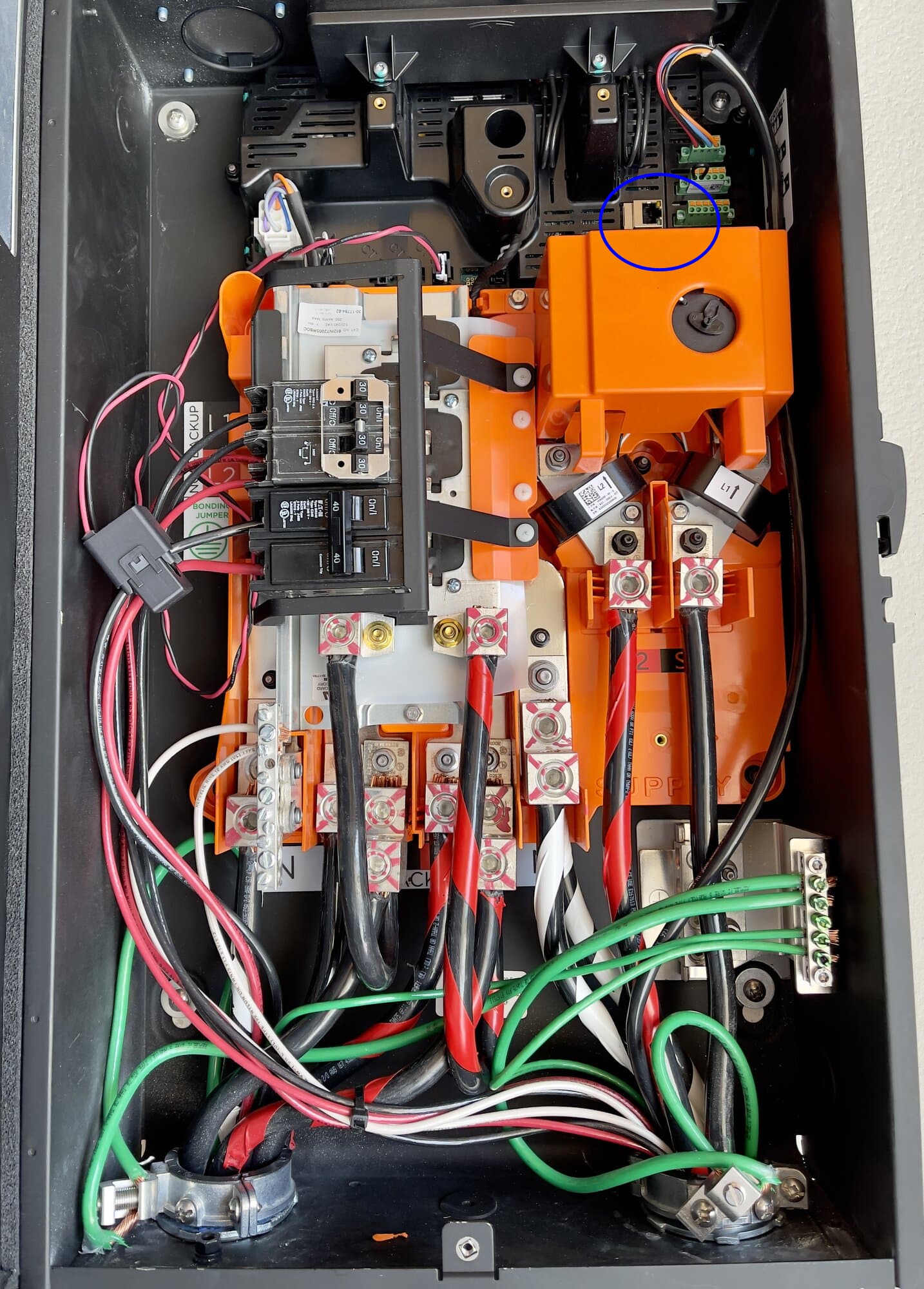
Yup and here’s the inside look of the gateway - it’s not a photo of my gateway, though.
I know I have one but I borrowed it from here because it was easier to find:

As you can see, there are definitely some live wires - so: be careful.

The linked website is generally very useful; I found a lot of stuff explained there that I didn’t find anywhere else, e.g. this.

Did you ever solve this problem of connecting to the Powerwall? Having the same problem here.

EDIT: Got it working. It was the IP address and the last 5 characters of the PASSWORD on the sticker inside the TEG door.

I’ve just started this battle again after a period licking my wounds.
My research so far has indicated that, for Powerwall 3 at least,
a) Tesla has shut down all useful local access to the Gateway (which sits on your home LAN), so the ‘Portal’ UI is no longer available
b) Tesla has shut down the ability to set up a network ‘route’ to the Powerwall itself via the Gateway on your LAN (you used to be able to do something like route -p add 192.168.91.1 mask 255.255.255.255 192.168.1.35, but no longer)
c) the only way to access Powerwall 3 data locally now is to attach directly to the WLAN being radiated by the Powerwall itself (in my case it’s SSID: TeslaPW_xxxxx, WiFi Password: GVMWxxxxx (these details found on a sticker inside the Powerwall 3, not the Gateway - be careful not to smash your Powerwall 3 glass front panel like I did!); Then an API endpoint appears at 192.168.91.1 which can be used by this Python program: GitHub - jasonacox/pypowerwall: Python API for Tesla Powerwall and Solar Power Data. Contrary to the readme there, the password you need is NOT the Gateway password found inside the Gateway front panel, but the Powerwall 3’s wifi password found inside the Powerwall 3.
So, I’m currently looking in to using a Raspberry Pi, with wifi connected to TeslaPW_xxxxx and ethernet connected to the home LAN to act as a bridge.

I’ll update here if I have any success!

1 Like

Hi there,
I’ve reached the same sad conclusion that pw3 is not that easy to integrate locally :frowning:
Have you managed to get it working?

I gave up!! Went with the Teslemetry integration for £2 a month instead, and at that money i’m pretty happy (Intelligent Octopus GO customer) with the automations i can set up. It has been pretty reliable so far (except for the AWS outage earlier this week).
HTH